Algeria
 Egypt
 Libya
 Morocco
 Sudan
 Tunisia
 Benin
 Burkina Faso
 Cabo Verde
 Ghana
 Guinea
 Guinea-Bissau
 Liberia
 Mali
 Mauritania
 Niger
 Nigeria
 Senegal
 Sierra Leone
 The Gambia
 Togo
 Cameroon
 Central African Republic
 Chad
 DR Congo
 Equatorial Guinea
 Gabon
 Republic of the Congo
 São Tomé and Príncipe
 Burundi
 Comoros
 Djibouti
 Eritrea
 Ethiopia
 Kenya
 Madagascar
 Malawi
 Mauritius
 Mozambique
 Rwanda
 Seychelles
 Somalia
 South Sudan
 Tanzania
 Uganda
 Angola
 Botswana
 Eswatini
 Lesotho
 Namibia
 South Africa
 Zambia
 Zimbabwe
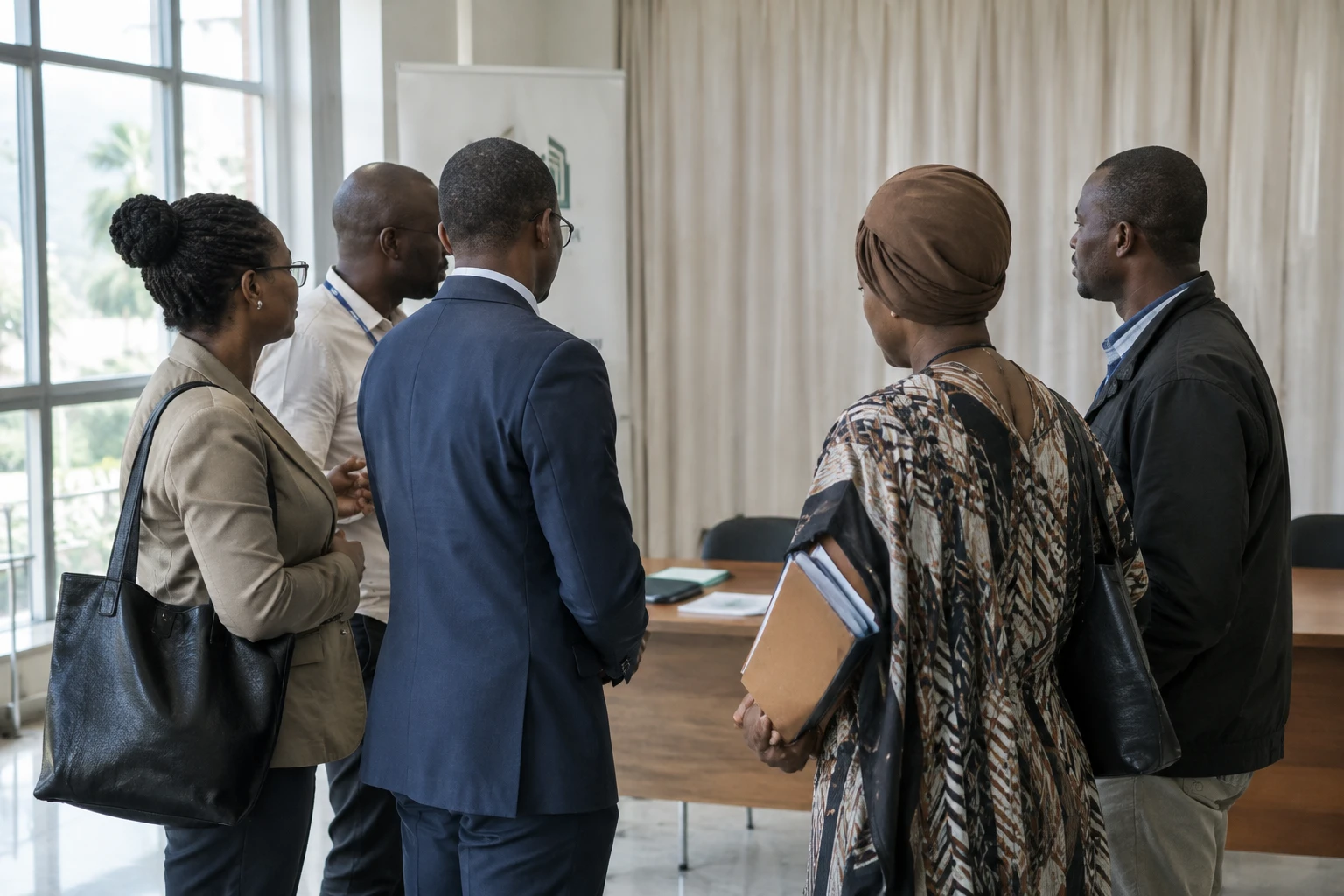
In Yamoussoukro, the archives of the African Democratic Rally (RDA) reveal a political choice that remains contested: how could colonial domination be rolled back when immediate independence seemed out of reach? Eighty years after its founding, the movement’s history is a reminder that emancipation in French-speaking Africa was built through diverse, sometimes conflicting strategies.
Ivorian archives offer a fresh reading of regional history
At the documentation centre of the Félix-Houphouët-Boigny Foundation for Peace Research in Yamoussoukro, books, articles and documentary films trace the RDA’s history. The documents held there tell the story not only of its leading figures. They also shed light on relations between activists, colonial administrations and the populations they mobilised.
Among the items available for consultation is a circular concerning the administration’s “new attitude” towards the Sudanese Union-RDA. It bears witness to tensions between the movement and the colonial authorities. The archives thus make the workings of power visible, as well as the ability of African organisations to organise political action beyond a single territory.
This history is at the heart of an international conference being held in Yamoussoukro from 17 to 19 October 2026 to mark the RDA’s 80th anniversary. According to the Ivorian press, the meeting brings together academics and researchers to compare their work and reflect on Pan-African archives. The event is part of a local tradition: Yamoussoukro had already hosted a conference on the RDA in 1986, for its 40th anniversary.
Bamako, 1946: bringing political forces together
The founding congress opened in Bamako, then in French Sudan, on 18 October 1946. It led to the creation of the African Democratic Rally, a federation of political parties from territories under French administration. Historical studies estimate that around 800 delegates attended. This figure, cited by several sources, conveys the rally’s ambition to span territories.
The RDA aimed to defend Africans’ rights and fight the injustices of the colonial system. In 1946, however, its leaders did not make immediate independence their central demand. They operated within the post-war political framework, marked by the creation of the French Union, which reorganised ties between France and its colonial territories without ending colonial domination.
Félix Houphouët-Boigny, an Ivorian MP and a leading figure in the movement, favoured negotiation and an expansion of rights. This approach did not encompass all the RDA’s views. The rally brought together people and parties with distinct histories, and its past is marked by debates over alliances, the pace of emancipation and relations with Paris.
A pragmatism whose effects remain contested
The decision to negotiate must be viewed in the context of the constraints of the time. Historian Jean-Noël Loucou notes that in 1946 even anti-colonial movements outside Africa could still advocate political association with the colonial power. The demand for independence grew stronger later, as the balance of power shifted and the limits of reform became clear.
For political scientist Geoffroy Julien Kouao, the co-operation pursued by Houphouët-Boigny helped equip Côte d’Ivoire with the human resources and means to build the state. This reading highlights the institutional gains sought by the leaders. It is not, however, enough to sum up the legacy of this strategy: the ties maintained with the former colonial power also fuelled lasting debates about sovereignty, dependencies and France’s role in Ivorian decision-making.
The consequences were not the same for everyone. Negotiations took place within institutions and among political leaders. On the ground, activists and populations faced administrative restrictions, unequal relations and tensions linked to mobilisation. The Yamoussoukro archives can help bridge these levels, provided history is not reduced to the story of the leaders alone.
The RDA’s trajectory cannot be equated with that of an Ivorian party either. Its initial ambition was regional: to create political solidarity among the territories of French West Africa and, more broadly, the French empire in Africa. This dimension explains why the movement’s birth in Bamako also matters to the political history of Mali, Senegal, Guinea and other countries that are now independent.
A legacy that extends beyond Côte d’Ivoire
For Côte d’Ivoire, the RDA is both a milestone in the anti-colonial struggle and a foundation of national political life. For West Africa, its history raises questions about the possibilities and limits of a common political organisation in the face of territorial interests. The Economic Community of West African States (ECOWAS), an organisation for co-operation between West African states, is very different, but this history is a reminder of how regional projects depend on compromises between national interests and collective ambitions.
The 1986 precedent in Yamoussoukro shows that the RDA’s history is regularly revisited. The conference from 17 to 19 October 2026 will, in particular, bring to the fore the question of who preserves the archives, interprets them and produces historical knowledge. This debate is not about choosing between negotiation and rupture as though they were a simple either-or. Rather, it invites scrutiny of the constraints, the choices and their consequences, with African voices at the forefront.
The discussions in Yamoussoukro thus have regional significance: they shed light on the paths to emancipation, but also on the difficulty of turning solidarity in struggle into a lasting political project. The documents held in Côte d’Ivoire’s political capital offer a concrete basis for continuing this reassessment.