Algeria
 Egypt
 Libya
 Morocco
 Sudan
 Tunisia
 Benin
 Burkina Faso
 Cabo Verde
 Ghana
 Guinea
 Guinea-Bissau
 Liberia
 Mali
 Mauritania
 Niger
 Nigeria
 Senegal
 Sierra Leone
 The Gambia
 Togo
 Cameroon
 Central African Republic
 Chad
 DR Congo
 Equatorial Guinea
 Gabon
 Republic of the Congo
 São Tomé and Príncipe
 Burundi
 Comoros
 Djibouti
 Eritrea
 Ethiopia
 Kenya
 Madagascar
 Malawi
 Mauritius
 Mozambique
 Rwanda
 Seychelles
 Somalia
 South Sudan
 Tanzania
 Uganda
 Angola
 Botswana
 Eswatini
 Lesotho
 Namibia
 South Africa
 Zambia
 Zimbabwe
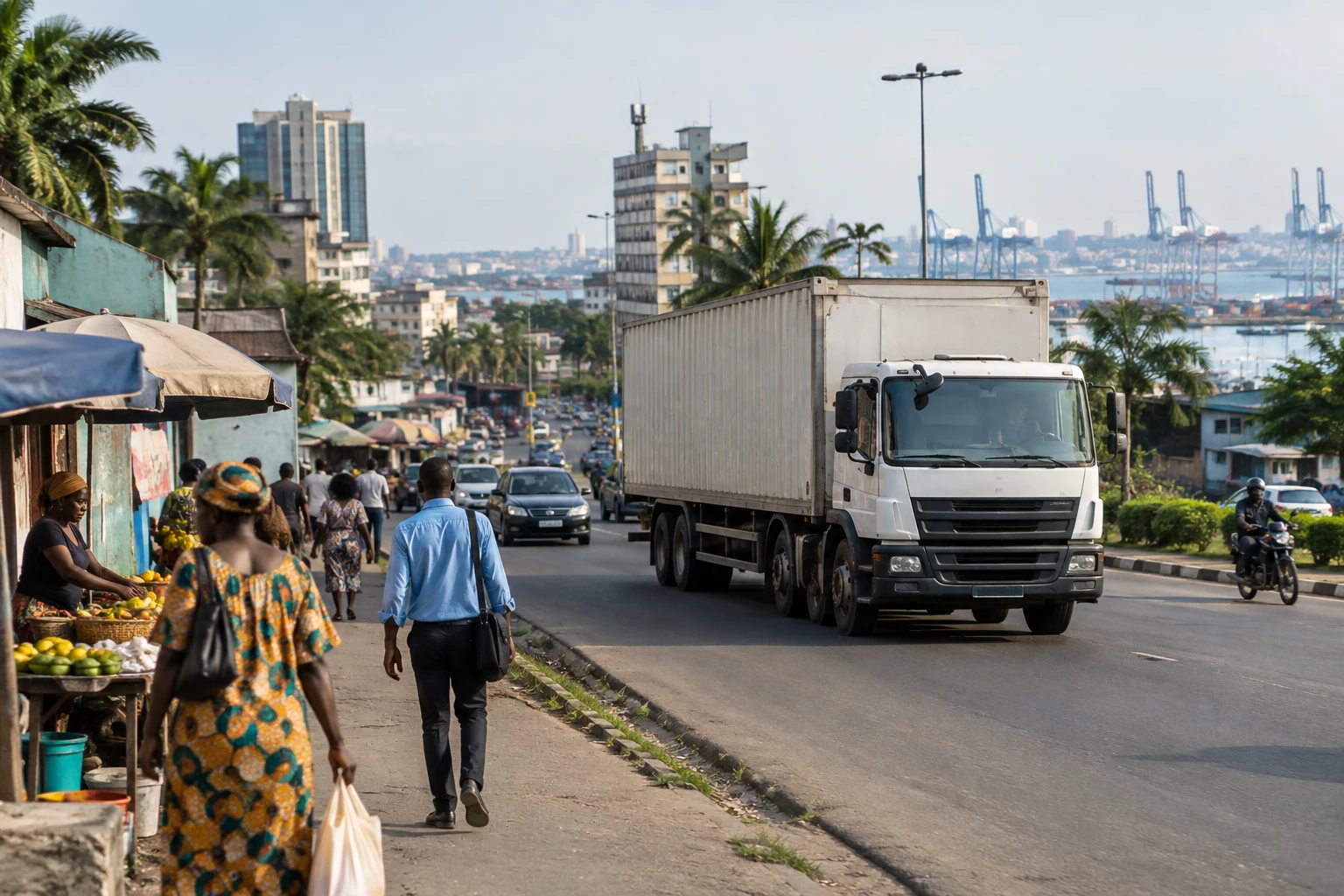
A lorry leaving the port of Abidjan for Bamako carries more than goods: it travels along a route whose security affects trade and daily life in both countries. It is also on this practical front that a resumption of dialogue between Côte d’Ivoire and Mali could be put to the test.
A vital corridor in a tense region
As a landlocked country, Mali depends on routes linking it to its neighbours’ ports for some of its supplies. The Abidjan-Bamako corridor is one such route. It connects businesses, transport operators and markets on both sides of the border. Disruptions to traffic can therefore have effects far beyond border posts.
The Autonomous Port of Abidjan says transit traffic destined for Mali reached about 1.5 million tonnes in 2025, up from 0.8 million in 2024. This increase underscores the route’s growing importance to trade with Mali. It does not mean that all goods or fuels use this one route.
The security of convoys has become a more prominent concern following attacks and threats attributed to the Group for the Support of Islam and Muslims (JNIM), affiliated with al-Qaeda, targeting supplies and road routes in Mali. Episodes of fuel-related tension have shown how insecurity can affect economic activity, travel and access to services. Transport operators and traders are directly exposed; households then feel the effects of shortages or higher costs.
Announced visit puts rapprochement to the test
Côte d’Ivoire’s national intelligence co-ordinator, Vassiriki Traoré, is expected in Bamako on Thursday 15 October 2026. He is travelling at the invitation of his Malian counterpart, General Modibo Koné, director-general of the National State Security Agency. Available information presents counter-terrorism and intelligence-sharing as central to the discussions. Details of any potential agreement or timetable for co-operation have not been made public.
The visit has been reported by several media outlets, including the Malian outlet Kibaru and Deutsche Welle. It is a signal of dialogue, but is not enough to establish that disagreements between the two governments have been resolved.
Relations became severely strained after soldiers seized power in Mali in 2020. The most notable breaking point came in July 2022, when 49 Ivorian soldiers were arrested at Bamako airport. Bamako accused them of being mercenaries; Abidjan said they had been deployed as part of a support arrangement for the United Nations Multidimensional Integrated Stabilization Mission in Mali, MINUSMA. These opposing accounts fuelled a major diplomatic crisis.
In December 2022, a Malian court convicted the soldiers. On 6 January 2023, the transitional president, Assimi Goïta, granted them a pardon and remitted their entire sentences, and they returned to Côte d’Ivoire. The case was thus closed in terms of their detention, but it left a political mark. Resuming exchanges between security officials does not, on its own, resolve the questions of trust and co-ordination that arose from it.
Results expected beyond statements
For the authorities, better information-sharing could help prevent attacks, track the movements of armed groups and protect cross-border routes. But practical mechanisms matter more than the announcement of a meeting: designated contacts, communication channels, procedures in the event of an incident and respect for each state’s responsibilities. No public details are yet available to show whether these issues will be formalised in Bamako.
The effects of closer co-operation would not be the same for everyone. Transport operators and businesses need roads that are usable and reliable. Traders, particularly those in the informal economy, also depend on border crossings and local markets. For people living near the border, security is not limited to protecting convoys: it also concerns travel, daily activities and relations with forces on the ground.
The region’s political geography complicates the rapprochement. Mali left the Economic Community of West African States (ECOWAS) with Burkina Faso and Niger, which formed the Alliance of Sahel States. Côte d’Ivoire remains a member of ECOWAS. These distinct political frameworks do not prevent bilateral co-operation, but they make relations between Sahelian and coastal states particularly important for security and trade.
Stakes beyond Abidjan and Bamako
The announced visit therefore comes at the intersection of two realities: a security threat that crosses borders and economic interdependence embodied by the corridor. For Mali, a variety of supply routes reduces dependence on a single outlet. For Côte d’Ivoire, the smooth flow of transit supports port activity and regional trade. Security along the route is a shared interest, even if the two governments’ political priorities do not coincide.
What happens next will be judged less by the language of renewed ties than by verifiable signs: continued contact between services, co-ordination during border incidents and uninterrupted traffic. In Yamoussoukro and Bamako, the challenge will be to turn a high-level meeting into sustained exchanges, without confusing security dialogue with full political reconciliation.
Traffic data are published by the Autonomous Port of Abidjan. The chronology of the soldiers’ case is documented by the United Nations report and the Ivorian authorities.