Algeria
 Egypt
 Libya
 Morocco
 Sudan
 Tunisia
 Benin
 Burkina Faso
 Cabo Verde
 Côte d'Ivoire
 Ghana
 Guinea
 Guinea-Bissau
 Liberia
 Mali
 Mauritania
 Niger
 Nigeria
 Senegal
 Sierra Leone
 The Gambia
 Togo
 Cameroon
 Central African Republic
 Chad
 DR Congo
 Equatorial Guinea
 Gabon
 Republic of the Congo
 São Tomé and Príncipe
 Burundi
 Comoros
 Djibouti
 Eritrea
 Kenya
 Madagascar
 Malawi
 Mauritius
 Mozambique
 Rwanda
 Seychelles
 Somalia
 South Sudan
 Tanzania
 Uganda
 Angola
 Botswana
 Eswatini
 Lesotho
 Namibia
 South Africa
 Zambia
 Zimbabwe
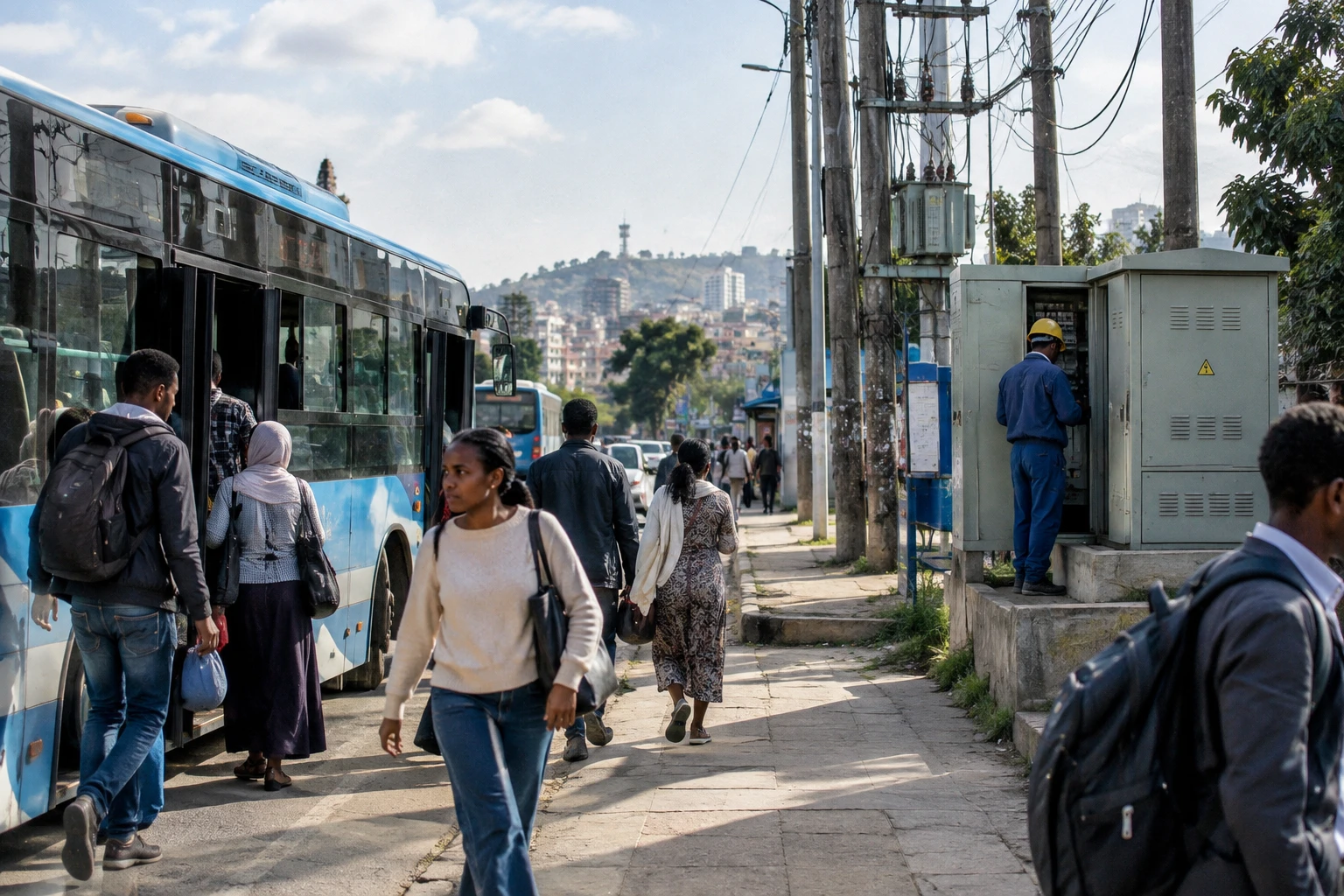
A power station can generate more electricity without households receiving it more reliably. In Ethiopia, the challenge now also lies in the lines, substations and connections that carry power to neighbourhoods and businesses.
A grid under pressure in the capital
In Addis Ababa, rapidly rising demand is testing transmission and distribution infrastructure that must keep pace with the city’s expansion. Power cuts and connection delays weigh on households, shops and productive activities. Businesses need a predictable supply; outlying neighbourhoods, meanwhile, are waiting for accessible and reliable connections.
The challenge is not confined to the capital. The International Energy Agency and the World Bank have described an access and reliability deficit that particularly affects rural and peri-urban areas. A high-voltage line alone does not guarantee that a household will be connected: local networks, maintained equipment and suitable payment arrangements are also needed.
This mismatch comes as Ethiopia’s power generation has expanded significantly. The Grand Ethiopian Renaissance Dam, on the Blue Nile, was inaugurated on 9 September 2025. But greater installed capacity does not automatically mean fewer power cuts. Electricity must be able to flow, be distributed and reach consumers at the right time.
Funding to strengthen infrastructure
On 13 October 2026, the House of Peoples’ Representatives approved financing from the International Development Association (IDA), the World Bank’s facility for low-income countries. The project, called PRIME-1, plans, among other things, to build new substations, modernise facilities and strengthen transmission lines, including underground lines in the capital.
A clarification on the amount is needed. Ethiopian News Agency (ENA) reports a loan of $145.8 million, while the World Bank’s database lists $200 million in financing for PRIME-1, approved on 20 July 2026. The original text, meanwhile, associates 145.8 million special drawing rights with about $200 million. These units are not interchangeable: the dollar amount reported by ENA therefore does not match the other two references. The amount in SDRs remains to be verified in the published legal text.
According to ENA, the loan provides for a six-year grace period followed by repayment over 31 years. The House ratified it through Proclamation No. 1441/2026. It is financing that must be repaid, even if its terms are described as concessional. Its cost and implementation timetable will need to be monitored alongside tangible results in service quality.
The financing forms part of PRIME, a programme of electricity-sector reform and modernisation launched in several phases. In 2024, the World Bank presented a potential package of up to $1.4 billion over ten years. The first phase aims to strengthen networks and the sector’s capacity to connect new users. The project is therefore not limited to Addis Ababa: modernisation of the capital is part of a broader transformation of Ethiopia’s electricity system.
Generating more is not enough
The immediate challenge is to reduce bottlenecks between generation and consumers. Better-equipped substations can facilitate distribution and absorb some of the growth in demand. Strengthened lines can also ease transmission constraints. But the work must be completed, maintained and coordinated with distribution networks to deliver a noticeable improvement.
The benefits will not be the same for everyone. In neighbourhoods already served, the priority may be a more stable supply and fewer interruptions. For new neighbourhoods and peri-urban areas, access to connections is also at stake. Small businesses, which are often less equipped than major industrial players to cope with outages, depend particularly on a regular service.
Higher generation also bolsters Ethiopia’s ambitions as an electricity exporter in the Horn of Africa. However, regional exports and domestic supply depend on interconnected infrastructure and management decisions. Strengthening the national grid can therefore support both domestic activity and cross-border trade, without by itself guaranteeing that every region will benefit equally.
A showcase ahead of COP32
Addis Ababa is due to host COP32 in 2027, the UN’s annual climate conference. A reliable electricity supply will matter for organising an international summit, but the stakes extend beyond the event. Ethiopia wants to link its energy development, largely based on renewables, to an economy less dependent on fossil fuels. The strength of the grid will partly determine whether this generation can support transport, services and industry.
The capital is also home to the African Union and is a regional diplomatic hub. The work there will be watched as a test of the ability to turn major energy investments into reliable services. In the Horn of Africa, where networks and interconnection projects are becoming increasingly important, progress in Ethiopia’s system will have implications beyond its national borders.
The next steps will be decisive: publication and clarification of the loan’s legal amount, the launch of construction tenders, the timetable for installing equipment and monitoring of new connections. The main measure will not simply be the number of substations built. It will be the regularity of electricity for residents and economic activity, in Addis Ababa as well as in less well-served regions.
Read ENA’s report on parliamentary approval · View the World Bank’s financing data · Learn about the PRIME programme and its objectives · Background on the inauguration of the Grand Ethiopian Renaissance Dam · African Union confirmation that Ethiopia will host COP32