Algeria
 Egypt
 Libya
 Morocco
 Sudan
 Tunisia
 Benin
 Burkina Faso
 Cabo Verde
 Côte d'Ivoire
 Ghana
 Guinea
 Guinea-Bissau
 Liberia
 Mali
 Mauritania
 Niger
 Senegal
 Sierra Leone
 The Gambia
 Togo
 Cameroon
 Central African Republic
 Chad
 DR Congo
 Equatorial Guinea
 Gabon
 Republic of the Congo
 São Tomé and Príncipe
 Burundi
 Comoros
 Djibouti
 Eritrea
 Ethiopia
 Kenya
 Madagascar
 Malawi
 Mauritius
 Mozambique
 Rwanda
 Seychelles
 Somalia
 South Sudan
 Tanzania
 Uganda
 Angola
 Botswana
 Eswatini
 Lesotho
 Namibia
 South Africa
 Zambia
 Zimbabwe
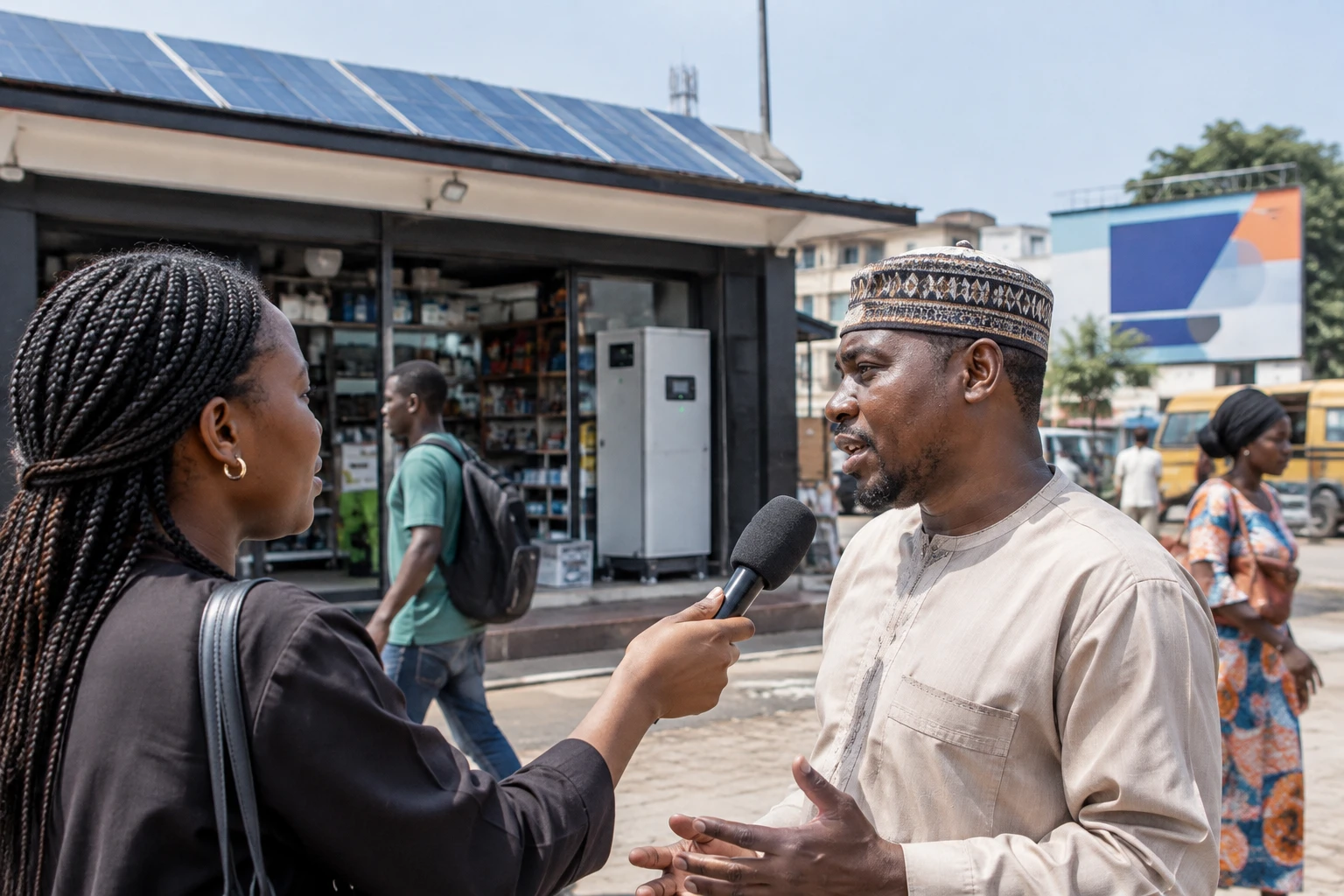
In Lagos, Abuja and Nigeria’s secondary cities, a power cut can halt a cold chain, delay production or force a business to run a generator. For companies, the question is therefore not just how to find cleaner energy: it is how to secure reliable power without adding to costs that are already high.
A market shaped by the limits of the grid
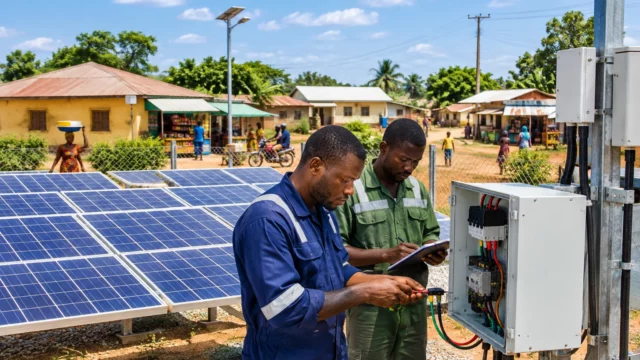
Decentralised solar meets this demand with installations located close to customers. They can power a business or several buildings, with batteries and, depending on requirements, a backup generator. Mini-grids serve groups of consumers in areas where the national grid is absent or inadequate.
Nigeria has begun regulating these solutions. The Electricity Act 2023 recognises several sources of generation and creates more room for renewable energy. The Nigerian Electricity Regulatory Commission (NERC) has also adopted rules specifically for mini-grids. They cover areas that are unserved, as well as those where the grid exists but does not provide an adequate service. Nigeria’s Electricity Act 2023 and NERC’s mini-grid regulations thus provide a framework for private operators.
The results of electrification programmes show that the model is no longer merely theoretical. The World Bank says the Nigeria Electrification Project, carried out from 2018 to 2024, helped install 125 mini-grids and sell more than one million solar home systems. More than 5.5 million Nigerians are said to have gained access to electricity as a result. These systems do not replace the national grid on their own, but provide complementary solutions, particularly in rural communities and for local businesses. The review of Nigeria’s electrification programme documents this progress.
PowerGen targets businesses and communities
On 17 September 2026, All On, a Nigerian investor specialising in energy access, announced a strategic investment in PowerGen Renewable Energy. The financing is intended to support both installations for businesses and decentralised distribution operations. According to information published by Delphos, PowerGen’s financial adviser, the project could fund up to 6,000 connections and reach around 41,000 beneficiaries in Nigeria.
These figures describe announced targets, not connections already completed. The announcement does not specify the amount invested or a detailed deployment timetable. It does, however, say the deal follows a fundraising round by PowerGen in 2025. All On’s participation, as a local energy finance player, gives the project a Nigerian foothold. The announcement of the investment in PowerGen sets out the stated objectives.
For businesses, the potential benefit lies in continuity of operations. Hybrid solar systems can reduce reliance on diesel or petrol and limit exposure to grid interruptions. But the benefit depends on the price of the service, battery capacity, maintenance and the quality of supply during periods of low sunshine. PowerGen describes its solutions as a combination of solar power, storage and energy management; this commercial description is not, in itself, a guarantee of lower costs for every customer.
Financing, a pressure point for the model
Solar equipment and batteries are often imported. When their purchase or financing is denominated in dollars, a depreciation of the naira can increase project costs and undermine repayment. This is a major concern for investors, but also for customers if the increase is passed on through tariffs.
The PowerGen transaction therefore brings back to the fore how currency risks are shared between investors, operators and consumers. The announcement reviewed confirms Delphos’s role in structuring the financing, but does not publish terms that would make it possible to assess this protection. It would therefore be premature to claim that currency risk has been neutralised. A Nigerian investor’s involvement may bring financing closer to the local market, but cannot by itself resolve difficulties related to the currency, interest rates or equipment costs.
Affordability remains central. A solar installation may require substantial upfront investment, or involve regular payments under a supply contract. Businesses with stable operations are better placed to take up these offers than small shops with irregular incomes. In rural areas, a mini-grid can bring electricity closer to residents, but its viability depends on the number of customers, their consumption and their ability to pay.
A complement, not a substitute for the grid
For Nigeria, the challenge is to make decentralised investment work alongside improvements to the national grid. Mini-grids can serve poorly connected areas and local economic centres. Solar installed at businesses can reduce pressure on the electricity supply they need to operate. These systems, however, do not replace investment in large-scale generation, transmission and distribution.
The trend also extends to other West African markets, where businesses are looking for ways to secure their electricity supply. However, national rules, currencies and market structures differ from one country to another: a model that works in Nigeria cannot automatically be transferred to its neighbours. Across the continent, the expansion of decentralised solutions forms part of a broader effort to extend access to energy, notably through mini-grids and standalone solar systems.
The next steps will be concrete: verify how many connections are actually completed, track the tariffs offered and see whether the financing genuinely protects projects from currency fluctuations. Results will be measured both in continuity of power for businesses and in the ability of households and small operators to access reliable, affordable energy.