Algeria
 Egypt
 Libya
 Morocco
 Sudan
 Tunisia
 Benin
 Burkina Faso
 Cabo Verde
 Côte d'Ivoire
 Ghana
 Guinea
 Guinea-Bissau
 Liberia
 Mali
 Mauritania
 Niger
 Nigeria
 Senegal
 Sierra Leone
 The Gambia
 Togo
 Cameroon
 Central African Republic
 Chad
 DR Congo
 Equatorial Guinea
 Gabon
 Republic of the Congo
 São Tomé and Príncipe
 Burundi
 Comoros
 Djibouti
 Eritrea
 Ethiopia
 Kenya
 Madagascar
 Malawi
 Mauritius
 Mozambique
 Rwanda
 Seychelles
 Somalia
 South Sudan
 Tanzania
 Uganda
 Angola
 Botswana
 Eswatini
 Lesotho
 Namibia
 Zambia
 Zimbabwe
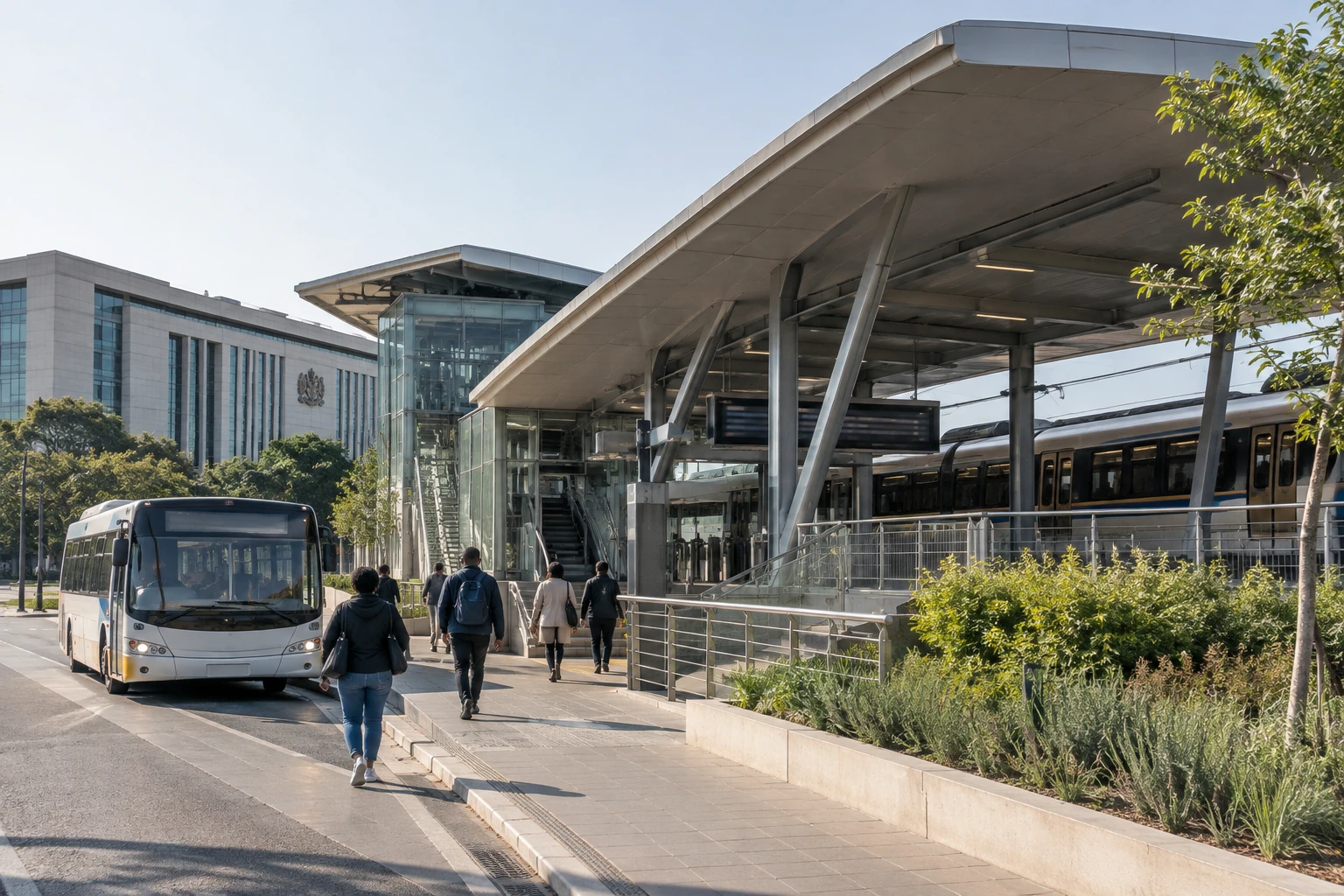
In Johannesburg, Pretoria or near OR Tambo International Airport, the quality of a journey is not measured solely by train speed. It also depends on timetables, fares and how easily passengers can reach a station. The Gauteng rapid rail network’s new operating cycle in South Africa will have to meet these everyday needs.
The Sihamba Sonke Mobility (SSM) consortium has been selected to operate, maintain and modernise the network for 15 years, until 2041. The concession took effect on 28 September 2026. The challenge therefore begins after the signing: turning announced investment into visible improvements for passengers.
A network central to Gauteng
The Gautrain connects Johannesburg, Pretoria — South Africa’s capital — and OR Tambo Airport. Its 80 kilometres of track and ten stations are complemented by feeder buses and minibuses. The network serves Gauteng, the country’s most populous province and one of its main economic centres.
Launched in June 2010, just days before the football World Cup, the service has recorded more than 216 million journeys in 16 years, according to the Gautrain Management Agency (GMA), the provincial body overseeing the project. This cumulative ridership shows the network’s role in regional travel, but does not by itself tell us who can access the service, at what cost or under what conditions.
The Gautrain operates as a public-private partnership, or PPP: the province owns the asset, while a private concessionaire carries out duties defined by contract. The previous agreement with Bombela, signed in 2006, expired in March 2026. A transitional period allowed the outgoing operator to maintain services during negotiations and preparations for the new agreement.
A 15-year concession, with works planned
The Gauteng provincial government and the GMA named SSM as the preferred bidder. The consortium includes AIIM-Motseng, Alstom, RATP Dev, GIBB-Crede, AIH Connect and SSM InvestCo. RATP Dev is to lead operations and maintenance; Alstom is involved as a shareholder and industrial partner in rail modernisation.
The programme plans to increase the fleet from 24 to 32 four-car electric trainsets. The eight new trainsets are to be manufactured at Alstom’s Ubunye plant in Gauteng. A new signalling system, upgraded communications and the refurbishment of existing trains are also planned. The cumulative value of the services planned for Alstom over the concession is estimated at €800 million, according to the company.
The GMA has also announced more frequent services outside peak hours and extended operating hours. Other measures cover stations and depots, security, passenger information, Wi-Fi and digital services. The agency also plans to gradually integrate payment methods and a digital platform bringing together several modes of transport. These measures are part of a programme to be rolled out over time: they do not mean that all the improvements are already in service.
Connections, the decisive link
More frequent trains alone will not solve the problem of the entire journey. For residents who live far from a station, access also depends on buses, minibuses or other local transport. The plan therefore includes additional feeder services and minibuses to make it easier to travel between neighbourhoods and stations.
This integration is particularly important for people who use several modes of transport, as well as for activities that depend on predictable journeys. A poorly coordinated connection can cancel out the time saved by taking the train. Conversely, suitable timetables and reliable information can extend its usefulness beyond the corridors it serves directly.
Affordability is also at stake. The GMA says a discounted fare, KlevaMova, accounts for about 11% of Gautrain journeys and targets, among others, some low-income households, pupils, older people and recipients of disability-related grants. The figure, provided by the agency, offers a measure of the scheme’s use, but is not enough on its own to assess the network’s overall affordability.
The public-private partnership test
The change of concessionaire renews the private partnership without transferring ownership of the network away from the province. The GMA retains a supervisory role on behalf of the provincial government. For the authorities, the model is meant to bring expertise and investment; for passengers, its value will be judged above all by reliability, safety, cost and service continuity.
Implementation will also have to balance construction work with day-to-day operations. The new trainsets, signalling and communications require close coordination. The contract runs until 2041, so the province will need to monitor milestones, spending and results over time, rather than judge success by the initial announcement.
Across Southern Africa, the Gautrain experience is feeding into debate about the financing and management of urban infrastructure. It also raises the question of how to develop local industrial skills: the planned manufacturing at Ubunye could support South Africa’s rail supply chain, provided the expected benefits materialise. The next milestone under close scrutiny will be the phased delivery of the trainsets and equipment, followed by their impact on frequencies and connections.
Ridership figures and the timetable for improvements will therefore be essential in assessing this new phase. The network has already carried millions of passengers; the contract’s outcome will now hinge on service reliability and how easily people in Gauteng’s neighbourhoods can reach the train.