
 Algeria
 Egypt
 Libya
 Morocco
 Sudan
 Tunisia
 Benin
 Burkina Faso
 Cabo Verde
 Côte d'Ivoire
 Ghana
 Guinea
 Guinea-Bissau
 Liberia
 Mali
 Mauritania
 Niger
 Nigeria
 Senegal
 Sierra Leone
 The Gambia
 Togo
 Central African Republic
 Chad
 DR Congo
 Equatorial Guinea
 Gabon
 Republic of the Congo
 São Tomé and Príncipe
 Burundi
 Comoros
 Djibouti
 Eritrea
 Ethiopia
 Kenya
 Madagascar
 Malawi
 Mauritius
 Mozambique
 Rwanda
 Seychelles
 Somalia
 South Sudan
 Tanzania
 Uganda
 Angola
 Botswana
 Eswatini
 Lesotho
 Namibia
 South Africa
 Zambia
 Zimbabwe
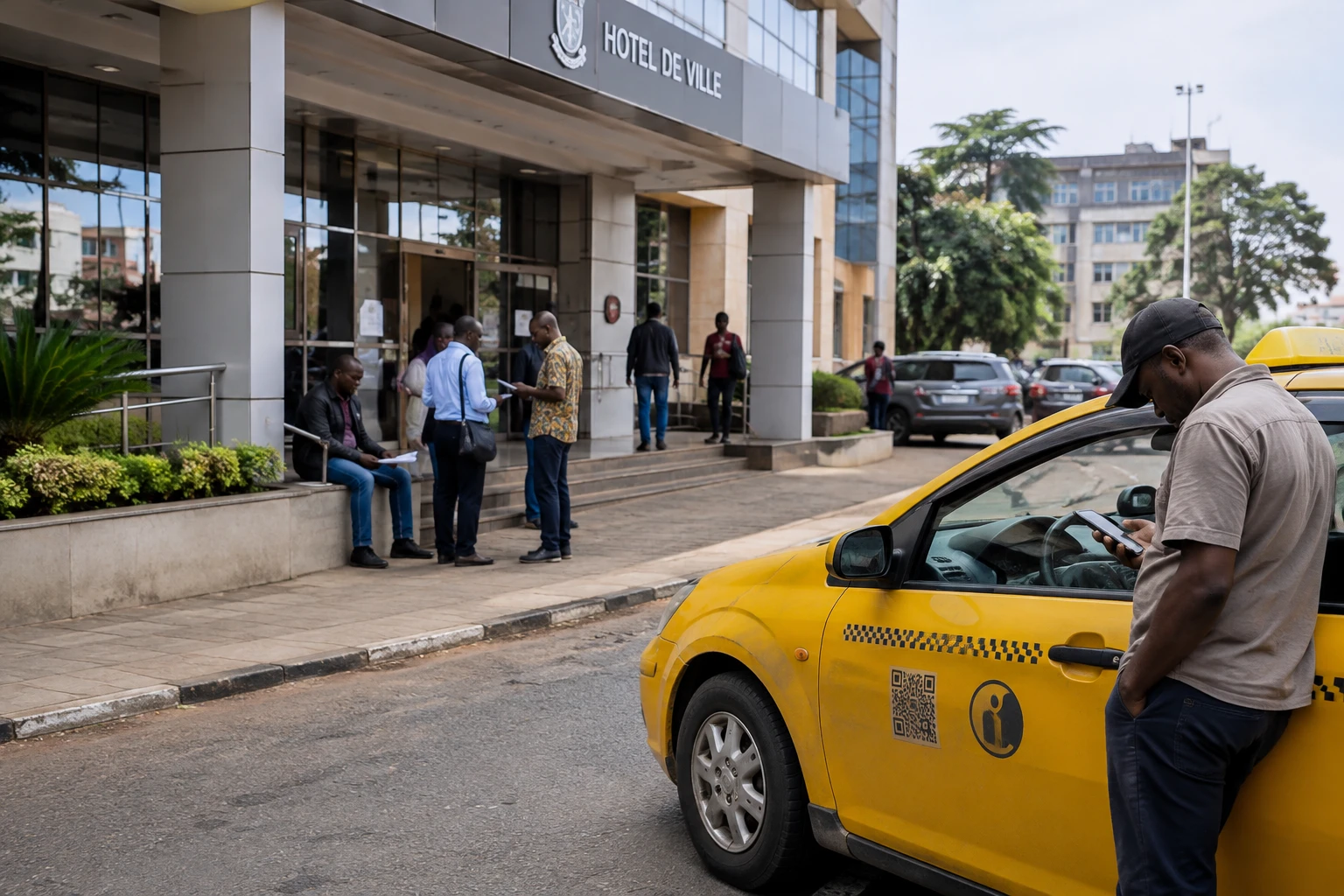
In Yaoundé, taking a taxi could soon start with a simple step: checking a code on the door. But for drivers, the sector’s digitisation also means a deadline has passed and checks could take their livelihood off the road.
A census moves into the inspection phase
The Yaoundé City Council (CUY) launched an operation to identify taxis on 3 July 2026. Each registered vehicle receives a unique door number; the driver is given a QR code that can be read with an internet-connected phone. The system is intended to enable passengers to check certain information about the vehicle and its operations.
The campaign was due to end on 5 October. The city’s mayor, Luc Messi Atangana, had announced checks from 6 October, with unidentified taxis to be impounded. That deadline has now passed. Cameroonian media report that the operation is entering its inspection phase, but the material consulted does not allow independent confirmation of initial reports that several thousand vehicles have been taken off the road.
The available figures give an idea of the scale of the task, although they do not count exactly the same categories. On 3 September, the city council reported 15,524 owners and 15,999 drivers registered. On 30 September, the mayor cited about 17,000 owners and more than 18,000 drivers. A municipal estimate puts the fleet at nearly 30,000 taxis.
On 7 October, Cameroonian media outlet Journal Intégration reported 19,213 registered taxis and 19,980 drivers counted. These figures do not mean that all vehicles already have their new identifier: owners, vehicles and drivers are counted separately.
Promised safety, disputed procedures
For the municipal authorities, a reliable database would help provide a clearer picture of the vehicles on the road, their owners and their drivers. It could make it easier to find a taxi after a theft or complaint. A verifiable QR code may also reassure some passengers, provided the information is accurate, accessible and regularly updated.
But identification is no substitute for insurance, a roadworthiness test or the required professional licences. The file includes several administrative documents for the vehicle and its owner, as well as documents specific to the driver. Checks can therefore uncover problems beyond the absence of a code: expired documents, unpaid tax formalities or a non-compliant vehicle.
This is where the reform affects different players in different ways. For an owner with several taxis, compliance is a fleet-management task. For a driver who relies on daily takings, being taken off the road means an immediate loss of income. Passengers, meanwhile, may face reduced supply or greater difficulty making journeys if many vehicles remain out of service.
Drivers have complained about queues and a lack of resources at registration desks. On 1 October, according to Journal Intégration, industry professionals called for more registration points to avoid congestion at city hall. The same outlet said identification was free, but that some of the documents required involved costs in advance. The distinction matters: a process with no registration fee is not necessarily cost-free for those seeking to comply.
There is also disagreement over the timetable. A union representative quoted by Mutations said the checks risked penalising those still registering. The city council, for its part, blames latecomers for waiting until the end of the allotted period. Both views point to the same practical problem: how can a common rule be enforced when registration capacity and the readiness of applications do not keep pace everywhere?
Urban mobility, a local governance issue
In Yaoundé, Cameroon’s political capital, shared taxis are a daily part of getting around. The reform therefore concerns much more than the appearance of taxi doors. It affects access to work, markets, healthcare facilities and services in a city where activity depends heavily on urban transport operated by private players.
The project is part of a broader debate on mobility. In April 2025, Cameroon’s Ministry of Housing and Urban Development organised a conference on informal transport in Yaoundé, with discussions on sector reforms and the census of taxis. The creation of a digital register builds on that effort, but its success will also depend on the quality of inspections, how disputes are handled and the services’ ability to support professionals.
Trust remains central. Drivers need to know what data is being collected, who can access it and how to correct an error. Passengers, for their part, need to understand exactly what the QR code certifies. An identifier can improve traceability; on its own, it cannot guarantee responsible driving or a vehicle’s mechanical condition.
A precedent to watch in Central Africa
The issue is primarily one of municipal management, but it is set in the context of Cameroon, a member of the Central African Economic and Monetary Community (CEMAC), a regional grouping that coordinates economic policies, among other things. Efforts to digitise urban services in a Central African capital may inform debates about safety, formalisation and workers’ rights, without assuming that all cities in the region operate in the same way.
For Yaoundé, the next test will be practical: will checks launched after 5 October leave room for drivers whose applications are still being processed? How many vehicles will actually be impounded, and under what procedure can they be recovered? The answers will affect drivers’ incomes, continuity of service for residents and the credibility of the database the city is seeking to build.



