Algeria
 Egypt
 Libya
 Morocco
 Sudan
 Tunisia
 Benin
 Burkina Faso
 Cabo Verde
 Côte d'Ivoire
 Ghana
 Guinea
 Guinea-Bissau
 Liberia
 Mali
 Mauritania
 Niger
 Nigeria
 Senegal
 Sierra Leone
 The Gambia
 Togo
 Central African Republic
 Chad
 DR Congo
 Equatorial Guinea
 Gabon
 Republic of the Congo
 São Tomé and Príncipe
 Burundi
 Comoros
 Djibouti
 Eritrea
 Ethiopia
 Kenya
 Madagascar
 Malawi
 Mauritius
 Mozambique
 Rwanda
 Seychelles
 Somalia
 South Sudan
 Tanzania
 Uganda
 Angola
 Botswana
 Eswatini
 Lesotho
 Namibia
 South Africa
 Zambia
 Zimbabwe
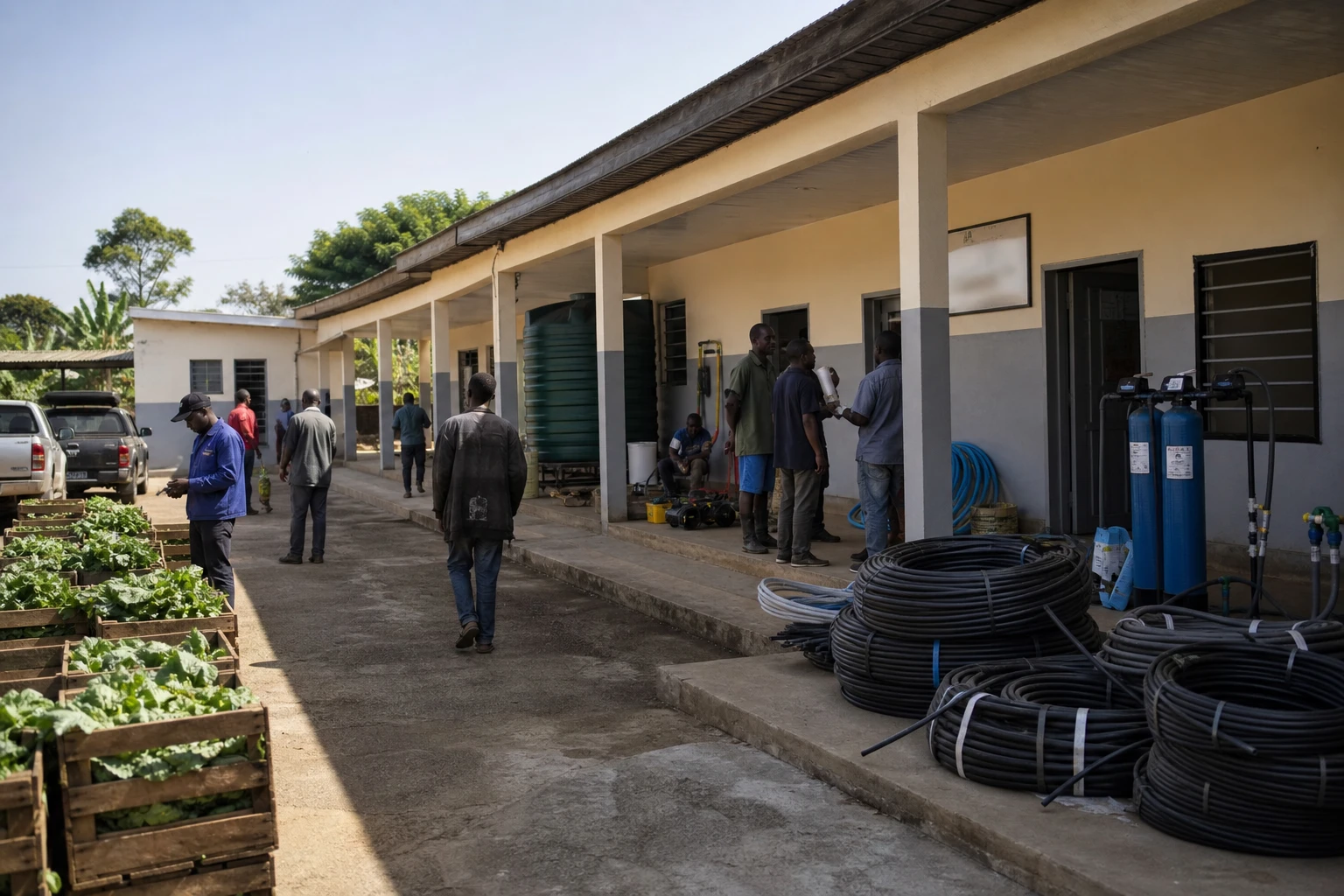
In Yaoundé and Douala alike, vegetable availability depends less on large dams than on small plots that are often overlooked in agricultural policies. When water is scarce between January and March, the effects are quickly felt : harvests fall, prices rise and lorries leave with lighter loads for markets across the sub-region.
Small fields at the heart of urban supply
Before dawn, Yaoundé’s Mfoundi and Mokolo markets receive tomatoes, cabbages, leeks, chillies and African nightshade, known as njama-njama in Cameroon. In Douala, Sandaga market plays a similar role. Some of this produce comes from low-lying areas and urban outskirts. Other consignments arrive from agricultural areas in the West and Centre, including Foumbot, Santa, the Bamboutos, Dschang and Lékié.
These supply chains rely mainly on small farms. Producers still water their crops with buckets, makeshift hoses or fuel-powered motor pumps. They often pay for installation, maintenance and energy themselves. Yet their plots act as genuine food infrastructure for Cameroon’s two largest cities.
Foumbot market illustrates this role. Located in the West Region, it brings together tomatoes, cabbages, carrots, chillies, green beans, potatoes and leafy vegetables, among other produce. Traders load goods there for Cameroonian cities as well as neighbouring countries. An investigation into Foumbot market describes it as a major redistribution point for market-garden produce in Central Africa.
Land pressure nonetheless complicates this system. Urbanisation is eating into peri-urban plots. At the same time, producers must manage two opposing risks : water shortages during the dry season and flooding during periods of heavy rain.
Water, the weak link in a regional supply chain
Tomatoes occupy an important place in this economy. Data from the FAOSTAT database indicate that Cameroon produced around 1.28 million tonnes in 2024. This figure covers total national production and is not limited to peri-urban market gardening. It nevertheless gives an idea of the scale of a sector that supplies some produce directly to urban and cross-border markets. Production data compiled from FAOSTAT place Cameroon among the continent’s significant producers.
Trade flows remain difficult to measure. Some pass through informal channels, particularly to landlocked countries. Customs statistics therefore do not always reflect the volumes actually transported. World Bank data on agriculture in CEMAC nevertheless show that Cameroon supplies neighbouring countries with cereals, fruit, onions, plantains and vegetables. The regional report on agriculture in CEMAC describes the role of Cameroonian markets in this trade.
Chad is an important destination, with agricultural produce flows passing notably through markets and routes connecting to northern Cameroon. Gabon, Equatorial Guinea and the Central African Republic are also part of the regional trading area. CEMAC, which comprises six Central African states, is seeking to facilitate the movement of goods. In practice, transport costs, checks and road conditions continue to weigh on traders.
Water resources also raise health concerns. When river or well water is used without checks, crops may be exposed to pollutants or bacteria. The issue is not limited to yields. It also affects vegetable quality and consumer safety, particularly when the same water sources are used for drinking, cooking and irrigation.
Producing more without depleting resources
Small-scale irrigation could reduce this vulnerability. It does not necessarily mean building major infrastructure. On many plots, a tank, a suitable pump, a filter and a network of drip lines can already stabilise production. The choice depends on the size of the farm, the available water source and the producer’s ability to maintain the equipment.
Fertigation combines irrigation with the application of soluble fertilisers. The principle is to deliver small quantities of nutrients with the water, directly to the base of the plants. This method limits losses when the system is properly designed. It nevertheless requires filtered water, fertilisers compatible with the system and practical training. Without these precautions, drippers become clogged and the investment quickly loses its value.
Experience in several African countries shows that drip irrigation can reduce water consumption while improving yields. These results cannot automatically be applied to Cameroon. Climate, soil quality, fuel prices and access to spare parts vary from one area to another. They nevertheless point to a possible way forward for farms supplying cities.
The priority, therefore, is to fund solutions suited to small-scale producers. This means shared equipment, solar-powered systems where conditions allow, storage facilities and technicians able to respond quickly. Credit must also cover maintenance. A pump abandoned after a breakdown is not an irrigation policy.
Food policy shaped around Yaoundé and Douala
Peri-urban market gardening should be incorporated into municipal urban plans and food policies. Protecting certain agricultural valleys would help limit the loss of productive land. Clear agreements could also govern access to water between farmers, residents and local authorities.
This approach concerns several groups. Urban households are directly exposed to fluctuations in supply. Women traders bear the losses when harvests arrive late or deteriorate in transit. Producers, for their part, shoulder the cost of pumping and risk losing an entire season. Regional importers and wholesalers also face shortages that disrupt markets beyond Cameroon’s borders.
Agricultural investment in other sectors shows that substantial funding can be mobilised for water and infrastructure. The challenge now is not to reserve this effort solely for export sectors or large-scale schemes. Vegetables consumed in Yaoundé, Douala and several CEMAC capitals also deserve an investment policy.
For Cameroon, the issue extends beyond tomato production alone. It affects price stability, public health, rural incomes and the country’s role in Central African food trade. The next step will be to turn these informal but essential supply chains into better-supported sectors, without distancing them from the producers and traders who keep them going.