Algeria
 Egypt
 Libya
 Morocco
 Sudan
 Tunisia
 Benin
 Burkina Faso
 Cabo Verde
 Côte d'Ivoire
 Ghana
 Guinea
 Guinea-Bissau
 Liberia
 Mali
 Mauritania
 Niger
 Nigeria
 Senegal
 Sierra Leone
 The Gambia
 Togo
 Cameroon
 Central African Republic
 Chad
 DR Congo
 Equatorial Guinea
 Gabon
 Republic of the Congo
 São Tomé and Príncipe
 Burundi
 Comoros
 Djibouti
 Eritrea
 Ethiopia
 Kenya
 Madagascar
 Malawi
 Mauritius
 Mozambique
 Rwanda
 Seychelles
 Somalia
 South Sudan
 Tanzania
 Uganda
 Angola
 Botswana
 Eswatini
 Lesotho
 Namibia
 South Africa
 Zambia
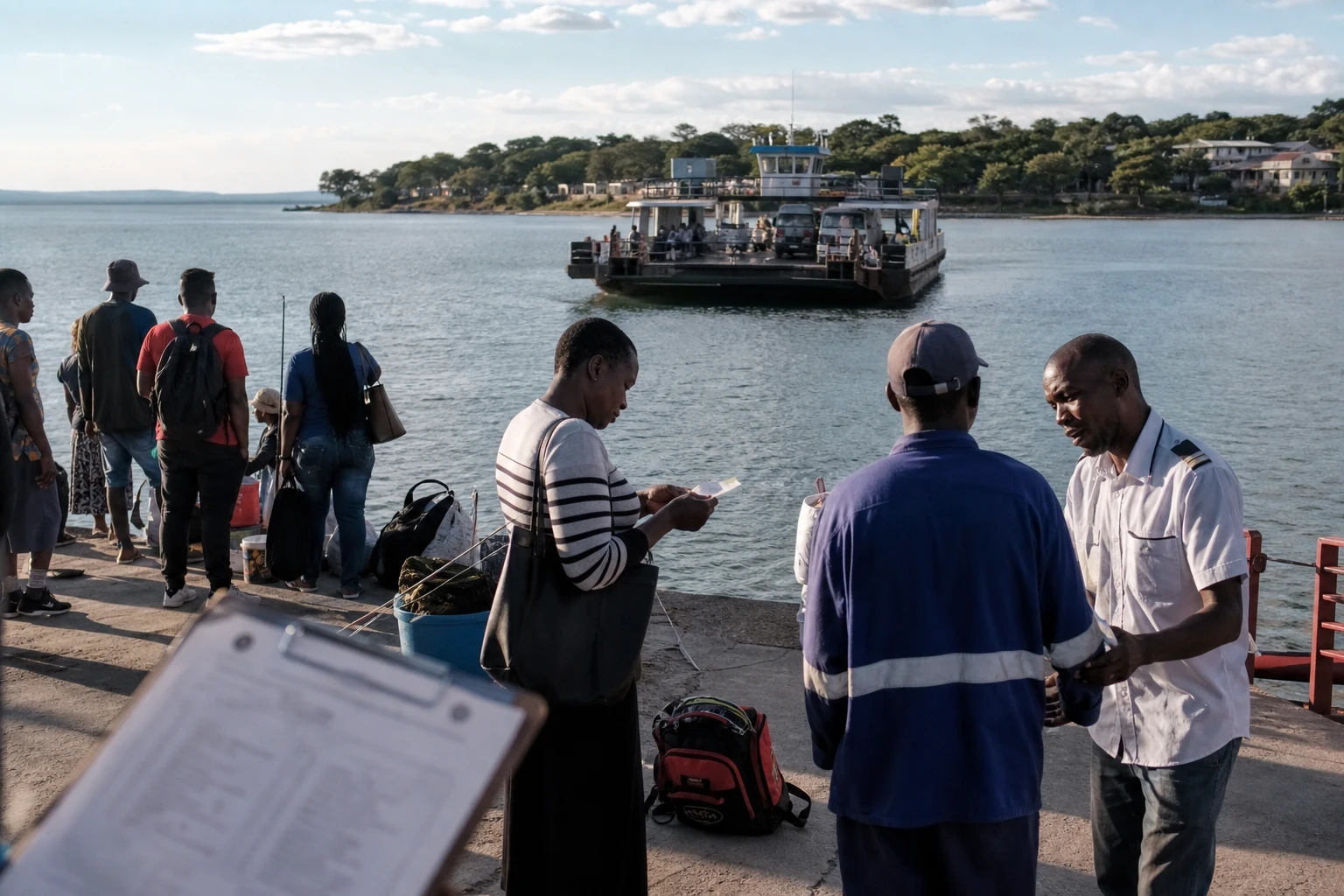
On the shores of Lake Kariba, the sinking of the Mbuya Nehanda did more than disrupt a ferry service. It undermined essential access to healthcare, markets, schools and family for several isolated communities. The petition filed with Zimbabwe’s High Court therefore raises a practical question: how can passenger safety be guaranteed when public transport remains their only realistic option?
A vital link between Kariba and lakeside communities
Lake Kariba stretches along the border between Zimbabwe and Zambia. On the Zimbabwean side, residents of Kariba and fishing areas such as Chalala rely heavily on boat services. By road, the journey can take nearly ten hours and cost between $40 and $45. By ferry, it used to take about two to three hours and cost between $10 and $15.
This difference weighs heavily on rural households. It also affects small traders, fishers and families who need to transport goods or reach services in Kariba. A prolonged disruption to the service therefore has different consequences in the capital, Harare, than in lakeside villages.
The issue also falls within the remit of SADC, the Southern African Development Community. The organisation brings together Zimbabwe and Zambia, among others, on cross-border issues related to transport, infrastructure management and the safety of regional mobility.
The 11 August sinking and figures still under dispute
On 11 August 2026, the Mbuya Nehanda capsized while travelling between Kariba and Chalala. The ferry belonged to the Rural Infrastructure Development Agency, a Zimbabwean public agency. Authorities ultimately put the death toll at 97, with 77 survivors, making it the deadliest shipwreck ever recorded in Zimbabwe. These figures have been reported by several Zimbabwean media outlets and international sources.
The exact number of people on board remains a central issue in the investigation. Initial counts put the number at 114 adult passengers and five crew members, while other estimates reached 153 people. The presence of children who were not recorded in the ticket registers made it harder to compile a reliable list.
The vessel’s authorised capacity is also disputed. The government said it could carry 90 to 95 people, including crew. However, documents and testimony cited by the Zimbabwean press point to a lower capacity after an earlier incident. When the wreck was brought ashore, an inscription reading “50 PAX” — meaning 50 people — was reportedly visible on the hull. The investigation will have to determine the legal and technical significance of this marking.
Technical warnings at the centre of the investigation
The government announced an inquiry commission after the disaster. Local Government Minister Daniel Garwe blamed Captain Sign Patsikadova, who died in the sinking. According to this account, the captain put to sea despite a weather warning of large waves.
This account is not enough to establish the full extent of responsibility. An investigation published by Zimbabwe’s The Standard, along with information reported by other media, has raised questions about maintenance, inspections and the keeping of records.
KB Engineering, the company responsible for maintaining the ferry, reportedly sent several warnings to RIDA and to the lake’s navigation chief, Adam Nyekete. The recommendations included adding two pontoons to improve the vessel’s stability. Adam Nyekete reportedly acknowledged that these warnings existed at a meeting held after the sinking.
Lameck Chitenga, the director of inland waters control, said he had only discovered them at that meeting. RIDA chief executive Christopher Shumba maintained that the ferry was in good condition and disputed the engineers’ findings. These conflicting accounts will have to be checked against correspondence, certificates, logbooks and inspection reports.
The vessel, bought in Denmark in 1985, had already suffered a serious incident in December 2024. Its engines failed shortly after it left Peters Point. Authorities will have to verify what action was taken after that episode and any subsequent reports.
Legal action based on fundamental rights
On 25 September 2026, Tonderai Ndevani, a resident of Kariba, and Chilumbo Mudenda, a resident of Binga, filed a case with the High Court in Chinhoyi. They are represented by Zimbabwe Lawyers for Human Rights, a Zimbabwean organisation specialising in human rights advocacy.
The claimants are asking the Ministry of Transport, RIDA and the Ministry of Local Government to provide ferries that are safe, regular and affordable. They cite the freedom of movement protected by the Constitution, as well as the right to dignity. Their argument is straightforward: a right is difficult to exercise in practice when it depends on an ageing boat, uncertain capacity or an unaffordable service.
The claimants are also asking for future vessels to comply with the Inland Waters Shipping Act, Zimbabwe’s law governing navigation on inland waters. Finally, they want the government to provide the court with regular updates on the acquisition and commissioning of new ferries.
Ignatius Chiome, RIDA’s acting head in Kariba district, is also facing criminal proceedings. He is charged with culpable homicide. The prosecution cites administrative failures, possible overloading and breaches of safety rules. He was released on $500 bail on 28 August. The charge does not prejudge the court’s final decision.
The risk of a solution that falls short
Since 18 September, private operator Most High Ferries has been running the MV Silverstone on the Kariba–Chalala route. The vessel can carry 60 passengers and four crew members. The service provides an immediate response, but the claimants consider it inadequate for the needs of the area.
The 2022 census recorded 45,774 residents in the 12 wards of rural Kariba constituency. This comparison does not mean that the entire population uses the ferry. It does, however, show the gap between the capacity of a single boat and the size of the area it serves.
A severely limited service can have unintended consequences. When departures are infrequent, passengers may agree to travel in poor conditions. Crews may also face commercial or social pressure to take on more passengers and freight. After a disaster, safety therefore depends not only on the condition of the vessel. It also depends on the frequency of sailings, fares, ticket checks and the state’s ability to enforce standards.
A test for transport governance in southern Africa
The Mbuya Nehanda case goes beyond the question of a maritime accident. It raises issues of public operator accountability, the quality of inspections, transparency around technical documents and access to essential services in remote areas.
The next stages of the court case and the findings of the inquiry commission will therefore be closely watched. They will need to establish the chain of decisions leading up to the departure on 11 August 2026, without reducing the disaster to the actions of the deceased captain alone.
For Zimbabwe, the challenge is also to restore the trust of Kariba’s communities. For SADC, the case is a reminder that transport infrastructure in a border area must be treated as a strategic public service. The immediate priority is to serve lakeside residents. In the longer term, the priority will be to ensure that safety no longer depends on ignored warnings, incomplete records or conflicting capacity figures.