Algeria
 Egypt
 Libya
 Morocco
 Sudan
 Tunisia
 Benin
 Burkina Faso
 Cabo Verde
 Côte d'Ivoire
 Ghana
 Guinea
 Guinea-Bissau
 Liberia
 Mali
 Mauritania
 Niger
 Nigeria
 Senegal
 Sierra Leone
 The Gambia
 Togo
 Central African Republic
 Chad
 DR Congo
 Equatorial Guinea
 Gabon
 Republic of the Congo
 São Tomé and Príncipe
 Burundi
 Comoros
 Djibouti
 Eritrea
 Ethiopia
 Kenya
 Madagascar
 Malawi
 Mauritius
 Mozambique
 Rwanda
 Seychelles
 Somalia
 South Sudan
 Tanzania
 Uganda
 Angola
 Botswana
 Eswatini
 Lesotho
 Namibia
 South Africa
 Zambia
 Zimbabwe
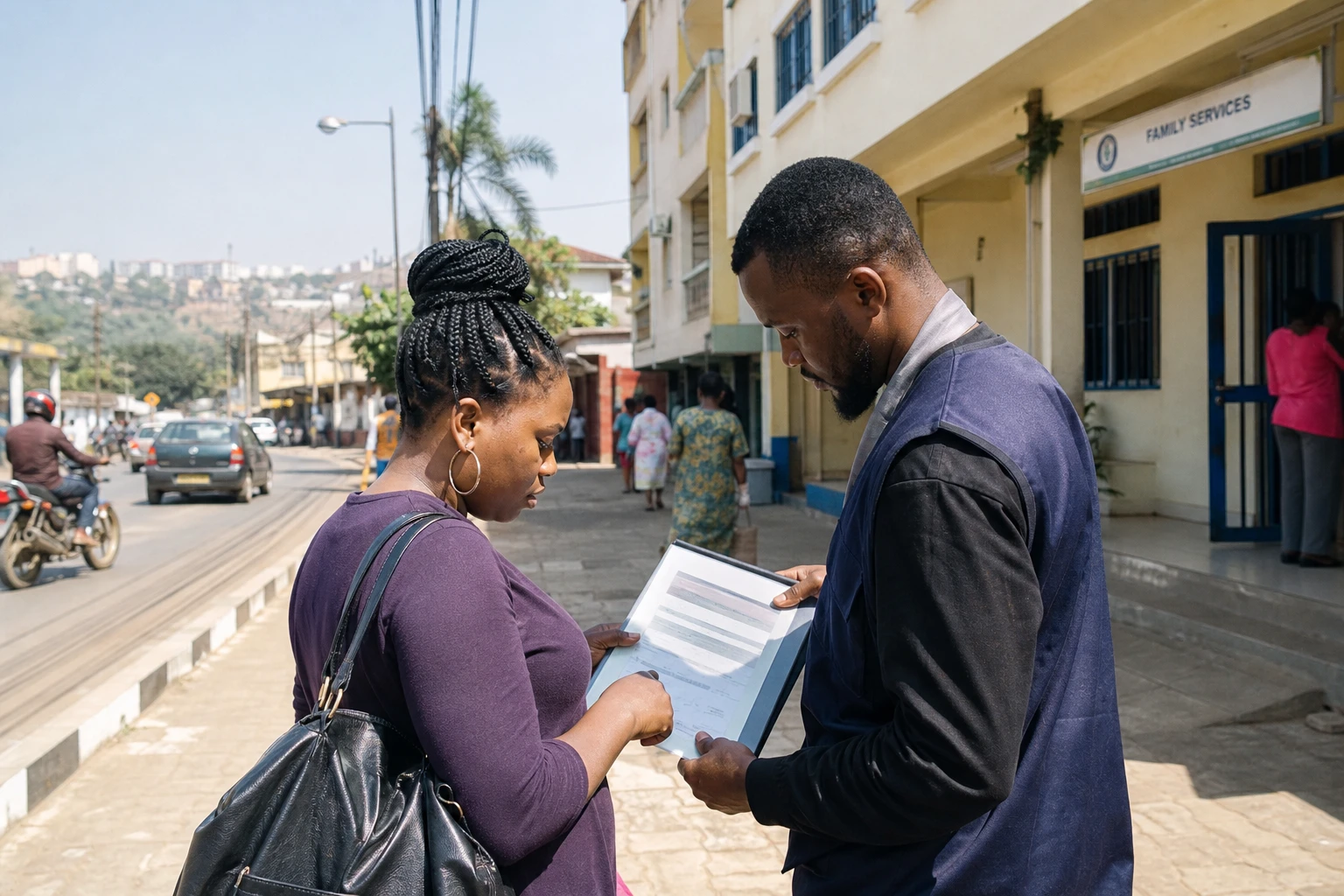
In Yaoundé, as in other Cameroonian cities, a couple’s separation does not always end with a private decision. It can become a legal, financial and family ordeal. For many spouses, the disagreement is therefore not only about the break-up, but about whether it can be recognised at all by the civil registry and the courts.
From marriage between families to individual choice
In Cameroon, marriage remains tied to several circles of solidarity. Families, religious communities and social networks can influence the decision to marry, as well as the decision to separate. Yet couples increasingly see their relationship as a personal project.
This shift does not mean family ties have disappeared. Rather, it reflects a change in where decisions are made. In previous generations, the stability of the household was closely bound up with the honour and interests of two families. Today, many Cameroonians also assess marriage in terms of their emotional wellbeing, economic independence and individual plans.
This change is particularly visible among young urban couples. In Yaoundé and Douala, spouses sometimes work in different sectors, manage separate incomes and make decisions without direct family involvement. In rural areas, community ties often remain stronger. But everywhere, tensions over money, the division of household tasks and the upbringing of children can strain a household.
Faith-based associations and support organisations now offer marriage preparation or counselling for couples. Their aim is to stress that a ceremony alone is not enough to organise daily life. The management of income, the role of families, parenting and each partner’s expectations need to be discussed before and during the union.
A legal framework that does not reduce separation to a simple agreement
Cameroonian law does not provide, under the civil framework applicable to marriages, for a procedure as simple as a joint declaration allowing a union to end without further proceedings. A marriage can be dissolved only through court proceedings and in accordance with the conditions set out in divorce law.
Spouses may therefore agree that they need to separate while still having to bring a case before the competent court. Their agreement can make some aspects of the case easier, particularly arrangements for where the children live, their care or the division of property. It does not automatically turn the separation into a divorce decree.
The case will generally need to establish that the marriage exists and present the information required for the application to be considered. Questions concerning children, property and financial obligations can then prolong discussions between the parties. The procedure varies according to the couple’s circumstances, their matrimonial property regime and the grounds cited.
In its legal information documents, Cameroon’s Ministry of Justice states that divorce falls under civil law and the jurisdiction of the courts. Rules may also differ depending on the status of the marriage and the part of the country concerned. This means it is important to distinguish between a marriage celebrated before a civil registrar, a customary union and a religious marriage.
A cohabiting relationship, for example, does not have the same effects as a registered marriage. The Ministry for the Promotion of Women and the Family notes that, in the absence of a recognised marital bond, separating cohabiting partners does not require divorce proceedings. However, the lack of legal status can leave an economically dependent partner or children more vulnerable.
Cost and duration, two major obstacles
In practice, cost is one of the main barriers to accessing divorce. Lawyers’ fees, court costs, travel and administrative procedures can place a heavy burden on a household’s income. Figures cited in some accounts, ranging from several hundred thousand to several million CFA francs, do not amount to a single official tariff. They depend on the case and the professionals involved.
It should therefore not be claimed that a poor person can never get divorced. Cameroon has a legal aid scheme for people whose resources are insufficient to assert their rights. Access is, however, subject to conditions and procedures. In practice, lack of awareness of the scheme, delays and indirect costs can limit its effectiveness.
This difficulty affects both sexes, but its impact can be greater for women with irregular incomes or who have stopped working to care for children. Separation can then lead to the loss of housing, a lower standard of living or greater dependence on the extended family.
Men are not immune. They may have to meet costs related to children, housing or the division of property. In households with modest incomes, a lack of agreement on these obligations often prolongs the conflict.
When financial disagreements become marital conflict
The changing role of women in employment is also altering relationships within couples. More and more Cameroonian women are contributing directly to household expenses. This independence strengthens their decision-making power, but can also cause tensions when spouses disagree about how income should be used.
The issue is not limited to the amount of each person’s salary. It concerns trust, transparency over spending and recognition of domestic work. Some couples keep their incomes separate; others pool them. Without clear rules, spending on the family, relatives or professional activities can become a source of conflict.
Domestic violence adds a more serious dimension. Preserving a marriage cannot justify keeping someone in danger. Relatives, religious leaders and associations must therefore distinguish between supporting a couple and protecting victims. Mediation cannot replace safety measures when violence has been reported.
Between civil law, religious beliefs and the protection of individuals
Religion plays an important role in Cameroonian social life. Some Christian traditions uphold the indissolubility of religious marriage. Other communities have a different understanding of marriage and its dissolution. These positions are matters of faith and the internal rules of churches or communities.
They do not, however, have the same effects as a civil divorce. A divorce granted by a court ends the bond recognised by the state. It does not automatically determine whether a person may remarry under the rules of a particular faith. In Catholicism, for example, recognition of the nullity of a marriage is dealt with through a separate ecclesiastical procedure.
This distinction is essential for couples. It prevents confusion between legal dissolution, separation in fact and a religious decision. It also helps protect children, whose rights do not disappear when a couple stops living together.
A debate that goes beyond couples
The question of divorce ultimately points to access to justice and the changing nature of the Cameroonian family. It concerns courts, lawyers, social services, religious leaders and local authorities. It also affects CEMAC, the Economic and Monetary Community of Central Africa, where professional and family mobility is making cross-border situations more common.
The debate is not simply about making separation easier or more difficult. It is about how to ensure free consent to marriage, protect children, secure economic fairness between spouses and prevent violence. The next step should be to provide the public with better information about marital rights, legal aid and the civil consequences of divorce.
In Cameroon, marriage therefore remains both a private matter and a social institution. Between family expectations, individuals’ growing autonomy and the requirements of the law, separation cannot be understood without considering all three dimensions. The future of family law in Cameroonian society now depends on striking this balance.
Legal resources: information from Cameroon’s ministry on cohabiting unions, resources from the Ministry of Justice on marriage and divorce and the report on Cameroon’s matrimonial framework.