Algeria
 Egypt
 Libya
 Morocco
 Sudan
 Tunisia
 Benin
 Burkina Faso
 Cabo Verde
 Ghana
 Guinea
 Guinea-Bissau
 Liberia
 Mali
 Mauritania
 Niger
 Nigeria
 Senegal
 Sierra Leone
 The Gambia
 Togo
 Cameroon
 Central African Republic
 Chad
 DR Congo
 Equatorial Guinea
 Gabon
 Republic of the Congo
 São Tomé and Príncipe
 Burundi
 Comoros
 Djibouti
 Eritrea
 Ethiopia
 Kenya
 Madagascar
 Malawi
 Mauritius
 Mozambique
 Rwanda
 Seychelles
 Somalia
 South Sudan
 Tanzania
 Uganda
 Angola
 Botswana
 Eswatini
 Lesotho
 Namibia
 South Africa
 Zambia
 Zimbabwe
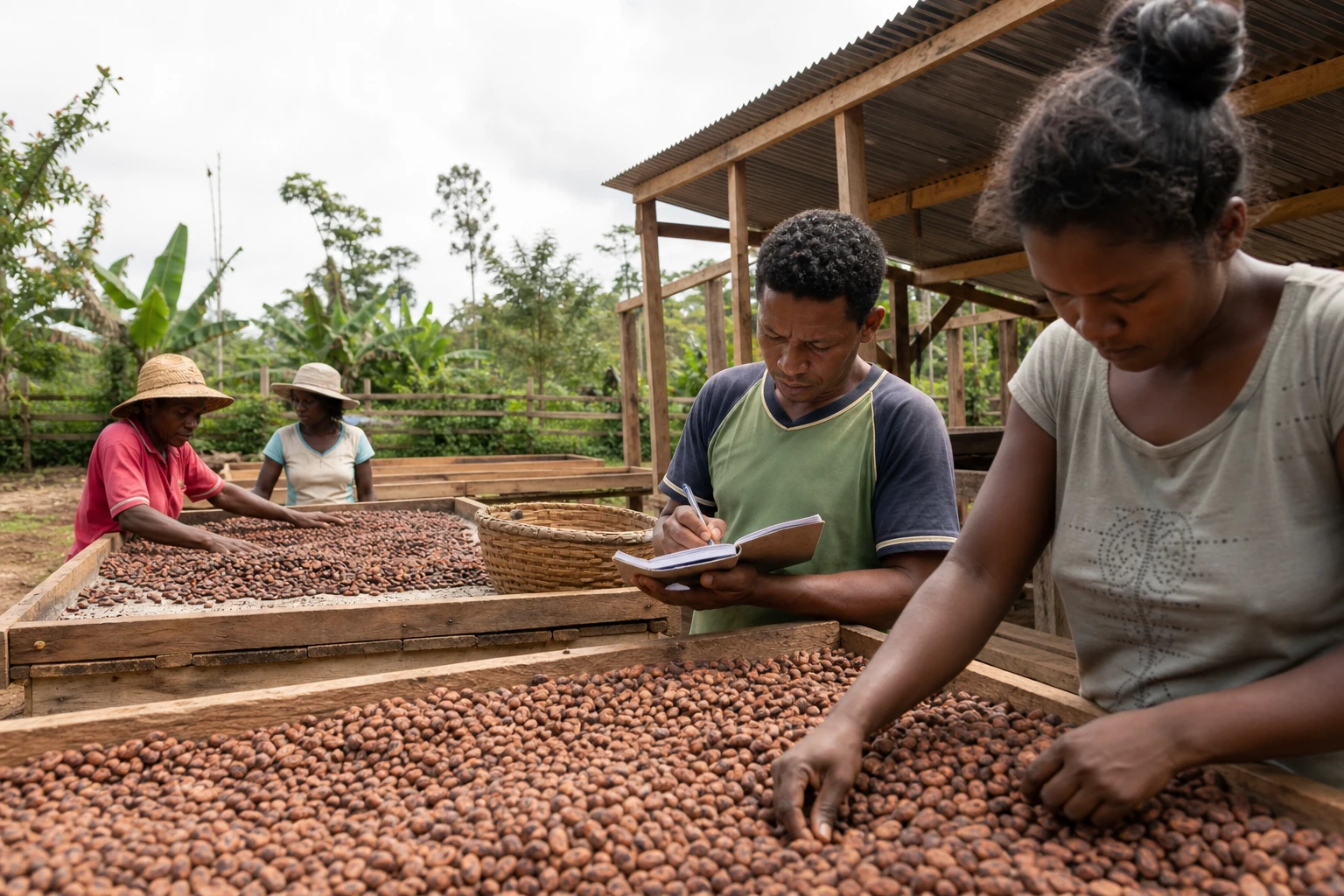
Madagascar’s cocoa is not in the same league as the West African giants. The country accounts for little by volume, but it matters in a segment where aroma, origin and consistency can be worth more than mass production. This distinctiveness recently gave Madagascar’s cocoa sector new visibility in international cocoa governance.
A sector concentrated in north-western Madagascar
Madagascar’s cocoa production is mainly based in the Sambirano basin, around Ambanja, in the Diana region. According to available estimates, this area supplies around 90% to 95% of the country’s cocoa. It benefits from a hot, humid climate and conditions favourable to growing cocoa trees whose beans develop sought-after aromatic profiles.
The sector relies mainly on family farms. It supports tens of thousands of producers, alongside those involved in collection, fermentation, drying, transport and export. This creates significant economic activity in a region far from Antananarivo, but also exposes producers to fluctuations in international prices and difficulties accessing infrastructure.
Production data should, however, be treated with caution. The FAO officially reported 10,234 tonnes of beans for Madagascar in 2022. The FAOSTAT database shows an estimate of 21,000 tonnes for 2024, while specifying that this figure comes from an external source and is not official FAO data. These discrepancies highlight the limits of statistical monitoring in a sector that remains poorly structured.
On a global scale, Madagascar therefore remains a niche producer. The 2024-2025 cocoa season represents nearly 4.8 million tonnes, according to data from the International Cocoa Organization, the ICCO. Even using the higher estimate for Madagascar, the country’s share remains below 1% of global supply.
Quality as a strategy for differentiation
Madagascar cocoa’s main asset is its classification as fine or flavour cocoa. This category refers to beans with particular sensory characteristics, linked to plant genetics, the terroir, farming practices and post-harvest processes.
The ICCO classifies 100% of Madagascar’s bean exports in this category. The list updated by the organisation in 2024 confirms this recognition. It does not mean that Madagascar dominates the market by volume. Rather, it indicates that its beans are positioned in a specialist segment, used in particular by chocolate makers seeking fruity, tangy or spicy notes.
In the Sambirano, quality depends as much on the varieties grown as on fermentation and drying. These steps determine much of the bean’s final profile. They take time and require suitable equipment and regular monitoring. Poor fermentation can reduce the value of cocoa even when it comes from a favourable terroir.
This reputation can enable exporters to secure a premium over standard cocoa. However, that premium does not automatically reach all producers. It depends on supply-chain transparency, the quality of batches, contracts, logistics costs and the ability of farmers’ organisations to negotiate.
A country still heavily reliant on bean exports
As in several African producing countries, Madagascar still processes only a small share of its harvest locally. Most cocoa leaves the country as beans. European markets are among the main destinations, alongside the United States, the United Arab Emirates, India and Russia.
Between 2020 and 2023, Madagascar exported an average of around 13,400 tonnes of beans a year, according to data compiled from trade and agricultural statistics. The corresponding revenues averaged nearly $25 million a year over the period. These sums are modest by the standards of global cocoa trade, but represent significant income for producing areas.
The contrast with processed products remains stark. In 2023, bean exports reached around 11,600 tonnes, while cocoa-derived products accounted for just over 280 tonnes. Cocoa products, notably chocolate and its derivatives, made up most of these processed volumes.
This situation limits value creation in Madagascar. Local processing could nevertheless generate more jobs, strengthen industrial skills and reduce dependence on raw bean prices. It requires, however, a reliable electricity supply, suitable equipment, robust health standards and regular access to markets.
Investment emerges around Ambanja
New capacity is beginning to change this equation. In July 2024, a cocoa powder production unit was commissioned in Ambanja under the public programme “One District, One Factory”. Its announced capacity is one tonne per hour.
In November 2024, Sambirano Ingredients also inaugurated a facility dedicated to cocoa processing. The company announced capacity of at least 100 tonnes of semi-finished products a year. These units remain limited relative to the sector’s potential, but mark an important shift: cocoa is no longer seen only as a raw material destined to leave the island.
The challenge now is to link these investments to small-scale producers. Without long-term contracts, technical services and quality-linked remuneration, factories risk operating below capacity. Conversely, better organised collection could secure supplies and increase the share of value going to Sambirano communities.
A new responsibility in global governance
Madagascar’s cocoa sector gained further visibility after Philippe Fontayne, vice-president of the National Cocoa Council, was elected president of the International Cocoa Council for the 2026-2027 cocoa year. The decision was taken at the ICCO’s 114th regular meeting, held in Abidjan from 14 to 18 September 2026, according to reports published by CapMad and confirmed by the Malagasy outlet Newsmada.
This presidency does not automatically turn Madagascar into a cocoa power. It does, however, give the country a platform in discussions on quality, sustainability, producer incomes and the evolution of international rules. It also comes as African countries seek to extract more value from their raw materials rather than mainly exporting products with little processing.
For Madagascar, the next step will be to turn this international recognition into tangible progress in the Sambirano. The central question will not be simply how much is produced. It will be whether the country can preserve quality, expand local processing and distribute value more equitably among producers, businesses and communities.