Algeria
 Egypt
 Libya
 Morocco
 Sudan
 Tunisia
 Benin
 Burkina Faso
 Cabo Verde
 Côte d'Ivoire
 Ghana
 Guinea
 Guinea-Bissau
 Liberia
 Mali
 Mauritania
 Niger
 Nigeria
 Senegal
 Sierra Leone
 The Gambia
 Togo
 Cameroon
 Central African Republic
 Chad
 DR Congo
 Equatorial Guinea
 Gabon
 Republic of the Congo
 São Tomé and Príncipe
 Burundi
 Comoros
 Djibouti
 Eritrea
 Ethiopia
 Kenya
 Madagascar
 Malawi
 Mauritius
 Mozambique
 Rwanda
 Seychelles
 Somalia
 South Sudan
 Tanzania
 Uganda
 Angola
 Botswana
 Eswatini
 Lesotho
 Namibia
 South Africa
 Zambia
Rail returns to the heart of mining
In Zimbabwe, the question is not only how to get more minerals out of the country. It is also how to move them without choking roads, driving up costs or undermining exporters’ competitiveness. That is why rail is once again becoming strategic for Harare, as the revival of lithium and chrome puts logistics at the heart of growth.
The National Railways of Zimbabwe, the state-owned rail operator, is central to this shift. The company, which is part of the Mutapa Investment Fund, is negotiating a $115 million package with Afreximbank to buy 10 locomotives and 315 wagons, while repairing some infrastructure. The information was confirmed by Mutapa chief John Mangudya, as the Zimbabwean state seeks to get a long-underfunded network back into operation.
A weakened network and an urgent need
The issue has not emerged out of nowhere. The NRZ says its network extends for 2,760 kilometres and that its mandate is to provide safe, efficient and affordable bulk transport for the national economy. But the company has lost much of its freight capacity over the years to road haulage. Rail rehabilitation is therefore also a response to the deterioration of tracks, rolling stock and workshops.
The figures show the scale of the decline. NRZ freight traffic fell to about 2 million tonnes in 2025, from 12 million tonnes in the 1990s and a peak of 18 million in 1998, according to figures cited in the Zimbabwean press. Meanwhile, the National Development Strategy 1 had already set a target of raising freight volumes to 6.7 million tonnes a year by 2025, showing that upgrading the rail network had long been a public priority.
The new financing sought from Afreximbank will cover only part of the need. John Mangudya estimates that $600 million is required to modernise rolling stock and the network. This estimate shows that the problem is not only financial. It is also industrial, technical and organisational.
Lithium intensifies pressure on corridors
The mining context is changing the equation. Zimbabwe has strengthened its position in African lithium, while the government has also tightened the framework governing exports of raw minerals and lithium concentrates, in a bid to encourage more local processing. This approach puts logistics at the intersection of two goals: exporting more and capturing more value before goods leave the country.
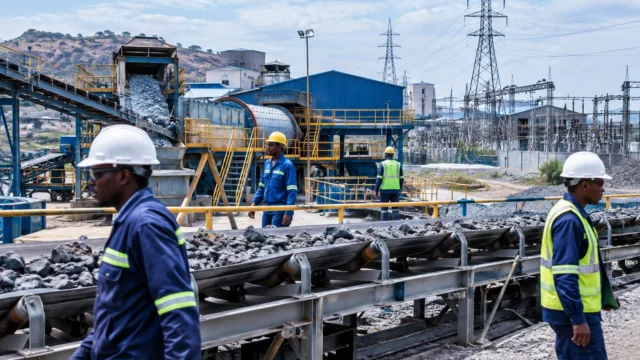
Rail is already helping to advance this ambition. In July 2026, the NRZ announced that it had transported lithium concentrate to the port of Maputo in Mozambique as part of an arrangement involving private operators. Beitbridge Bulawayo Railway, for its part, confirmed the launch of a new transshipment point at West Nicholson and the departure of its first lithium shipment for Maputo. The corridor illustrates a simple principle: move heavy volumes by rail, then transfer them to the port, rather than exhausting roads under tonnes of mineral cargo.
This is also a regional choice. The Limpopo line links Maputo to Zimbabwe over 522 kilometres, and rail cooperation between Harare and Maputo is part of the Southern African corridor network, where SADC has long promoted transport interconnectivity. For Mozambique, Zimbabwe and private operators, the challenge is to smooth the flow of mineral exports while reducing road congestion.
A recovery strategy, but with difficult trade-offs
The Zimbabwean government wants to go beyond emergency repairs. Its 2026-2030 strategy provides for modernising NRZ infrastructure and encouraging some bulk freight to shift to rail. The rationale is clear: fewer lorries on major routes, less wear on roads and more rail revenue for a state-owned company that needs to become useful to domestic industry again.
But the operation remains challenging. It brings together external financing, public expectations and the responsibilities of the state as shareholder. The NRZ has already worked with private partners to return locomotives and wagons to service, notably under agreements with Zimasco. It has also held other discussions on broader arrangements, including with China Railway Group, a sign that Harare is exploring several ways to close its rail infrastructure gap.
For miners, the immediate priorities are to reduce costs and secure volumes. For the cities and rural areas crossed by the trains, the benefits are broader: less heavy traffic on roads, fewer accidents and less damage to road surfaces. For the state, the wager is political as well as economic. If rail recovers, it can once again become an instrument of logistical sovereignty. If it fails, the country will continue to depend on road transport, which is more expensive and more vulnerable.
A signal watched across Southern Africa
Zimbabwe is not alone in facing this equation. Across Southern Africa, several mining economies are seeking to shift freight towards rail and port corridors to absorb rising raw-material exports. This is happening on the Maputo route, as well as on other regional projects where competition hinges on transport costs, the reliability of rail paths and the availability of rolling stock.
In this context, the financing under discussion between the NRZ and Afreximbank goes beyond Zimbabwe alone. It tests the ability of African institutions to fund basic infrastructure serving African value chains, rather than leaving mineral logistics almost entirely dependent on roads. The key question now is the pace of implementation: buying locomotives, upgrading wagons, restoring lines and delivering on the promises of the 2026-2030 strategy.