Algeria
 Egypt
 Libya
 Morocco
 Sudan
 Tunisia
 Burkina Faso
 Cabo Verde
 Côte d'Ivoire
 Ghana
 Guinea
 Guinea-Bissau
 Liberia
 Mali
 Mauritania
 Niger
 Nigeria
 Senegal
 Sierra Leone
 The Gambia
 Togo
 Cameroon
 Central African Republic
 Chad
 DR Congo
 Equatorial Guinea
 Gabon
 Republic of the Congo
 São Tomé and Príncipe
 Burundi
 Comoros
 Djibouti
 Eritrea
 Ethiopia
 Kenya
 Madagascar
 Malawi
 Mauritius
 Mozambique
 Rwanda
 Seychelles
 Somalia
 South Sudan
 Tanzania
 Uganda
 Angola
 Botswana
 Eswatini
 Lesotho
 Namibia
 South Africa
 Zambia
 Zimbabwe
Cotonou sets the date, but the real issue lies in the rules
In Cotonou, major digital events often attract attention. Yet the real question for Beninese people and West Africa as a whole is not simply who will attend the forum, but what digital finance is actually changing for businesses, households and governments. In the WAEMU region, fintech is no longer a showcase topic. It now touches payments, credit, supervision and customer protection.
Benin is part of this movement, with its own public policy choices. The Beninese Ministry of Digital Affairs says it wants to make the country a digital services hub for West Africa, while the national financial inclusion strategy seeks to broaden access to financial services. At regional level, the BCEAO has launched the interoperable instant payment platform, now central to exchanges between banks, operators and fintechs.
The 2026 edition is conceived as an industrial project
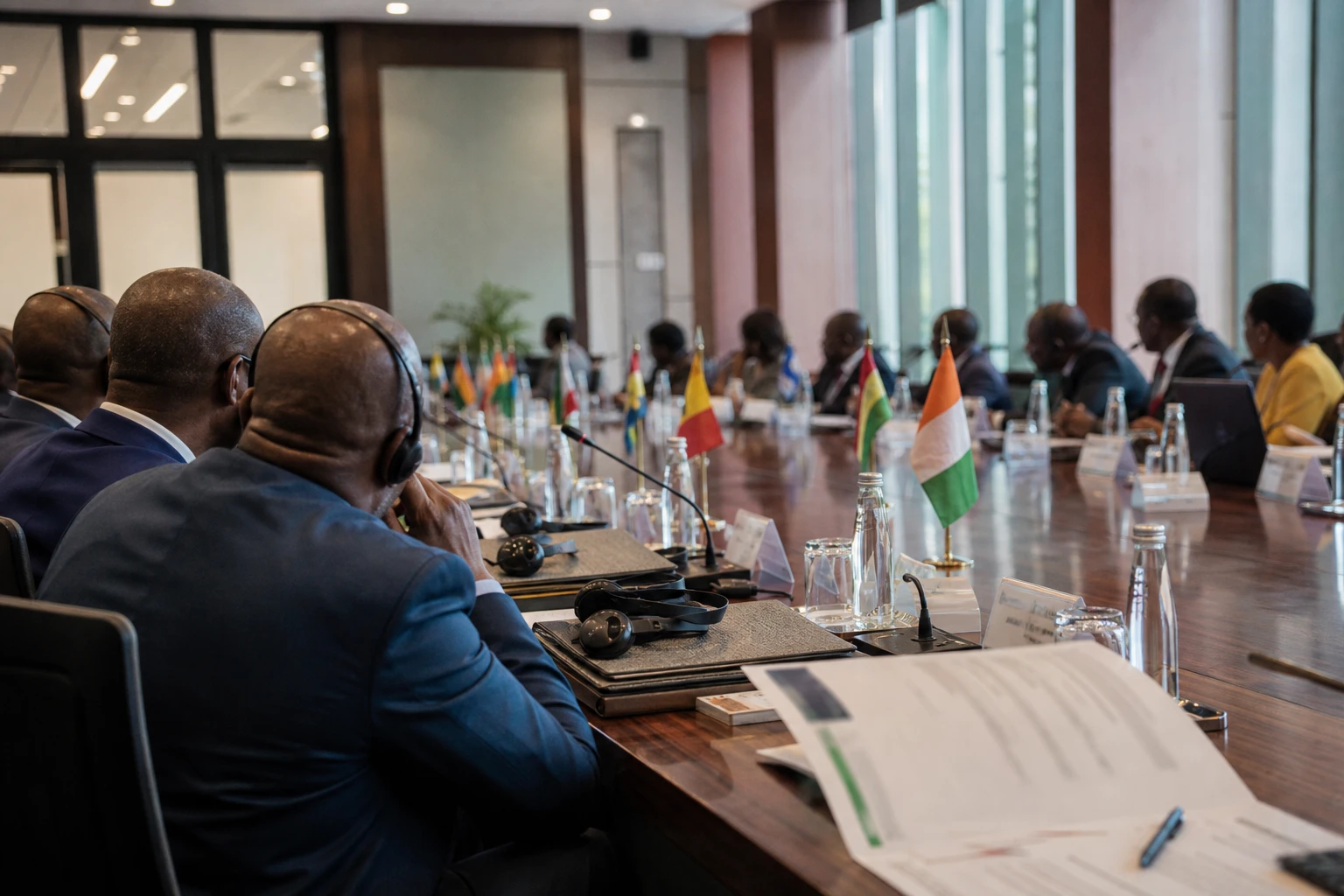
The Next Fintech Forum will return to Cotonou on 26 and 27 November 2026, at the Sofitel Cotonou Marina Hotel & Spa. The event’s official website announces an eighth edition under the theme: “From adoption to value: industrialising fintech to accelerate growth”. The organisers also highlight more than 500 expected decision-makers, over 30 nationalities and a “Cotonou Declaration”, presented as the political outcome of the event.
The move from Dakar to Cotonou is no minor detail. The 2025 edition had already served as a full-scale test for the Francophone ecosystem, with 500 participants, more than 30 nationalities and over 20 major sponsors, according to information published by the organiser. For 2026, the stated ambition is on a different scale: the aim is no longer simply to raise awareness of fintech, but to make it a structured industry, with rules, viable business models and measurable outcomes.
The terminology matters here. In the WAEMU context, industrialising fintech means moving beyond isolated experiments. It means better connecting start-ups, banks, regulators and investors. It also means creating services capable of scaling across the Union’s eight countries, without losing sight of compliance, fraud prevention and user confidence.
Regional institutions remain decisive
The announced presence of sectoral ministries, the BCEAO, the WAEMU Commission, the BOAD and the AMF-UMOA shows that West African fintech is not being built on the sidelines of institutions. It is being built with them. The BCEAO has been closely following this issue for several years through its framework for payment services, its FinTech committee and its work on interoperability.
In April 2025, the Union’s Council of Ministers adopted a new regional financial inclusion policy and strategy framework for 2025-2030. The Central Bank emphasises the need to adapt supervision to technological innovation, strengthen consumer protection and improve the provision of responsible financial services. In this context, the Cotonou forum could become a useful venue: not for commenting on regulation from a distance, but for translating it into concrete commitments.
Benin has a direct interest in this sequence of events. On the one hand, Porto-Novo is the country’s political capital, as set out in the national legal framework. On the other, Cotonou is home to a large share of economic activity, infrastructure and high-level meetings. Making Cotonou a fintech hub therefore means linking Benin’s political centre with its economic powerhouse, in a country where digital transformation has already become an explicit public policy priority.
What Cotonou could change for businesses, banks and users
For fintechs, the challenge is clear: moving from a fragmented market to a more coherent regional space. For banks, the equation is more delicate. They must take account of competition from new players, while also finding partners among them who can reach customers still far from the traditional system. For regulators, the goal is to keep pace with innovation without stifling it, while limiting risks related to digital credit, payments and data protection.
For users, the issue is tangible. In WAEMU, useful fintech is not measured by the number of conferences or the scale of promises. It is measured by transfer costs, payment speed, access to credit, ease of use and trust in platforms. This is where the Union’s adopted 2025-2030 regional financial inclusion strategy finds its purpose: fewer speeches about modernity, more genuine access to services.
The Cotonou forum is also taking place at a time when payment infrastructure is changing rapidly. With the launch of the interoperable instant payment platform, the BCEAO is pushing the Union towards smoother exchanges between institutions. This could accelerate the adoption of digital services, but it also requires common standards, because interoperability is valuable only when accompanied by security and clear rules.
A reach beyond the Francophone region alone
The organisers’ decision to put Nigeria and Ghana in the spotlight this year says something important. The strongest dynamics in West African fintech do not stop at the language barrier. They flow between Anglophone and Francophone regions, and Cotonou can serve as a bridge between these two worlds. This is strategically significant for ECOWAS, where payments, investment and regulatory frameworks are still seeking greater coherence.
At continental level, the forum will also show whether West Africa wants simply to consume imported digital solutions or to build its own standards. The work is already under way: regional financial inclusion, instant payments, stronger supervision, consumer protection and the development of a market capable of attracting capital without sacrificing regulatory sovereignty. This is where Cotonou will matter in 2026, far beyond the calendar of a single industry event.