Algeria
 Egypt
 Libya
 Morocco
 Sudan
 Tunisia
 Benin
 Cabo Verde
 Côte d'Ivoire
 Ghana
 Guinea
 Guinea-Bissau
 Liberia
 Mali
 Mauritania
 Niger
 Nigeria
 Senegal
 Sierra Leone
 The Gambia
 Togo
 Cameroon
 Central African Republic
 Chad
 DR Congo
 Equatorial Guinea
 Gabon
 Republic of the Congo
 São Tomé and Príncipe
 Burundi
 Comoros
 Djibouti
 Eritrea
 Ethiopia
 Kenya
 Madagascar
 Malawi
 Mauritius
 Mozambique
 Rwanda
 Seychelles
 Somalia
 South Sudan
 Tanzania
 Uganda
 Angola
 Botswana
 Eswatini
 Lesotho
 Namibia
 South Africa
 Zambia
 Zimbabwe
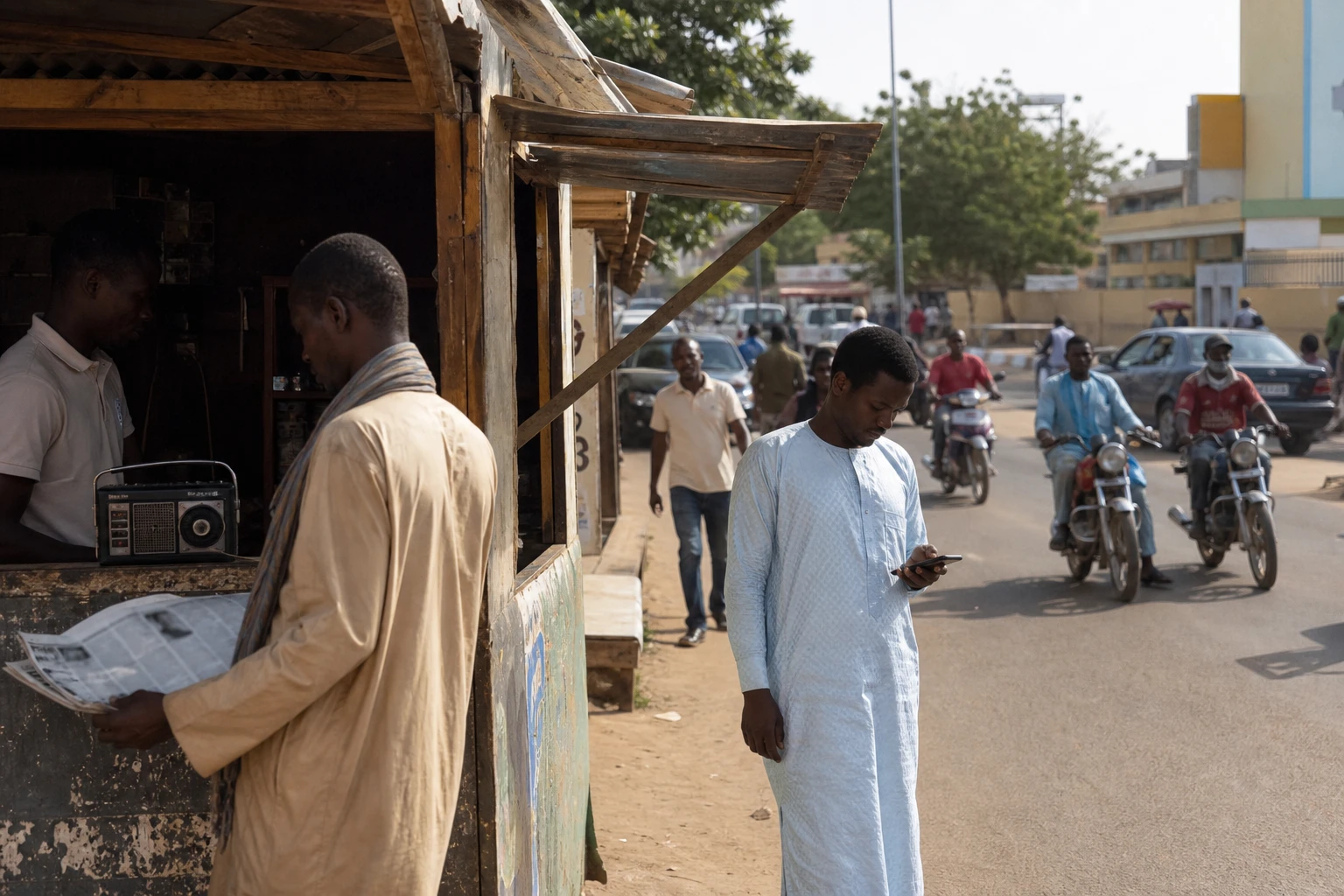
In Niamey, a disappearance that speaks to the state of the press
In Niger, a journalist’s absence is never just a crime story. It also reflects the level of tension between the authorities, the media and a society that relies on reliable information to understand what is happening in Niamey and the regions.
The disappearance of Moussa Kaka, director-general of the Radio-Télévision Saraounia group, has brought this reality back into focus. The Nigerien journalist has not been heard from since 31 August 2026, after leaving his office in Niamey at around 7pm to go home. Several press freedom organisations say they fear he may have been forcibly disappeared.
A country under a prolonged transition and regional scrutiny
The context matters. Since the July 2023 coup, Niger has been governed by military authorities based in Niamey. In the central Sahel, the country stands alongside Mali and Burkina Faso, two states also governed by juntas and marked by growing restrictions on civil liberties. ECOWAS, the Economic Community of West African States, has lost some of its political leverage following successive breaks with these regimes, but remains a frame of reference for the movement of people and goods and for democratic standards.
In this landscape, the press is paying a high price. RSF says Niger recorded the steepest decline in its 2026 World Press Freedom Index, falling 37 places to 120th. The organisation also notes that amendments to the cybercrime law, adopted in June 2024, reintroduced prison sentences for certain offences related to the distribution of online content. Amnesty International and the Office of the United Nations High Commissioner for Human Rights describe the same trend towards a tougher repressive framework.
What is known about Moussa Kaka’s disappearance
Information gathered by RSF and reported by the African Press Agency, Human Rights Watch, the CPJ and the MFWA points to the same essential facts: Moussa Kaka disappeared in Niamey on 31 August 2026, a few days after an attempted coup in the capital was thwarted, in the night of 28 to 29 August, according to international media and Nigerien authorities. RSF says it has received no news of him since that date.
Several organisations have described the disappearance as alarming or even forced. Human Rights Watch says the circumstances recall other disappearances targeting critics of the junta. The CPJ, for its part, has called on Nigerien authorities to act urgently to locate him. So far, no independent source has publicly established what happened to the journalist after he left his office. It is therefore important to distinguish the verified fact — his disappearance — from the hypothesis about responsibility, which has been put forward by human rights organisations.
Moussa Kaka is no newcomer to Niger’s media landscape. He was previously imprisoned in the mid-2000s in a case involving accusations of undermining state security, before eventually being released after a lengthy legal battle. This history helps explain the concern now felt in newsrooms and among defenders of press freedom.
What this case means for the media and the public
The issue is not just one man. It concerns the very possibility of producing independent journalism in Niger. When a prominent journalist disappears without explanation, the message to newsrooms is stark: investigating, commenting and publishing can all invite reprisals. In practice, self-censorship becomes a survival reflex, especially when cybercrime laws or accusations of “disturbing public order” can be used against media professionals.
For Nigeriens, the stakes are tangible. In a country facing security, economic and political challenges, the shrinking of media freedom weakens public debate. It also penalises people in the regions, who often depend more on radio than digital networks and are even more exposed to rumours when reliable channels become scarce. The capital, Niamey, is home to the institutions, but the quality of information also matters in Agadez, Maradi, Tillabéri and Diffa, where the effects of security tensions are felt in daily life.
The administrative closure of the Press House in January 2024, followed by arrests of journalists and repeated restrictions on certain organisations, had already signalled a shrinking civic space. Moussa Kaka’s disappearance adds a further cause for concern. It leaves Nigerien authorities with a straightforward obligation: provide verifiable answers, or at the very least allow a credible and swift investigation.
A warning for the whole central Sahel
The Moussa Kaka case extends beyond Niger. In Mali, Burkina Faso and Niger, military governments have all tightened restrictions on expression in the name of security, while armed groups continue to exert pressure on the ground. This combination carries the same risk: that information black spots will spread, depriving millions of people of reliable points of reference. RSF speaks of an “information black hole” in the Sahel; the term is stark, but developments across the sub-region give it tangible basis.
At continental level, the case is also of interest to the African Union and African human rights protection mechanisms, as it raises questions about how states handle criticism during prolonged military transitions. What is happening in Niamey is therefore not an isolated matter. It is another test of the ability of African institutions to defend press freedom when security becomes the main argument for restricting public debate.