Algeria
 Egypt
 Libya
 Morocco
 Sudan
 Tunisia
 Benin
 Burkina Faso
 Cabo Verde
 Côte d'Ivoire
 Ghana
 Guinea
 Guinea-Bissau
 Liberia
 Mali
 Mauritania
 Niger
 Nigeria
 Senegal
 Sierra Leone
 The Gambia
 Togo
 Cameroon
 Central African Republic
 Chad
 DR Congo
 Equatorial Guinea
 Gabon
 Republic of the Congo
 São Tomé and Príncipe
 Burundi
 Comoros
 Djibouti
 Eritrea
 Ethiopia
 Madagascar
 Malawi
 Mauritius
 Mozambique
 Rwanda
 Seychelles
 Somalia
 South Sudan
 Tanzania
 Uganda
 Angola
 Botswana
 Eswatini
 Lesotho
 Namibia
 South Africa
 Zambia
 Zimbabwe
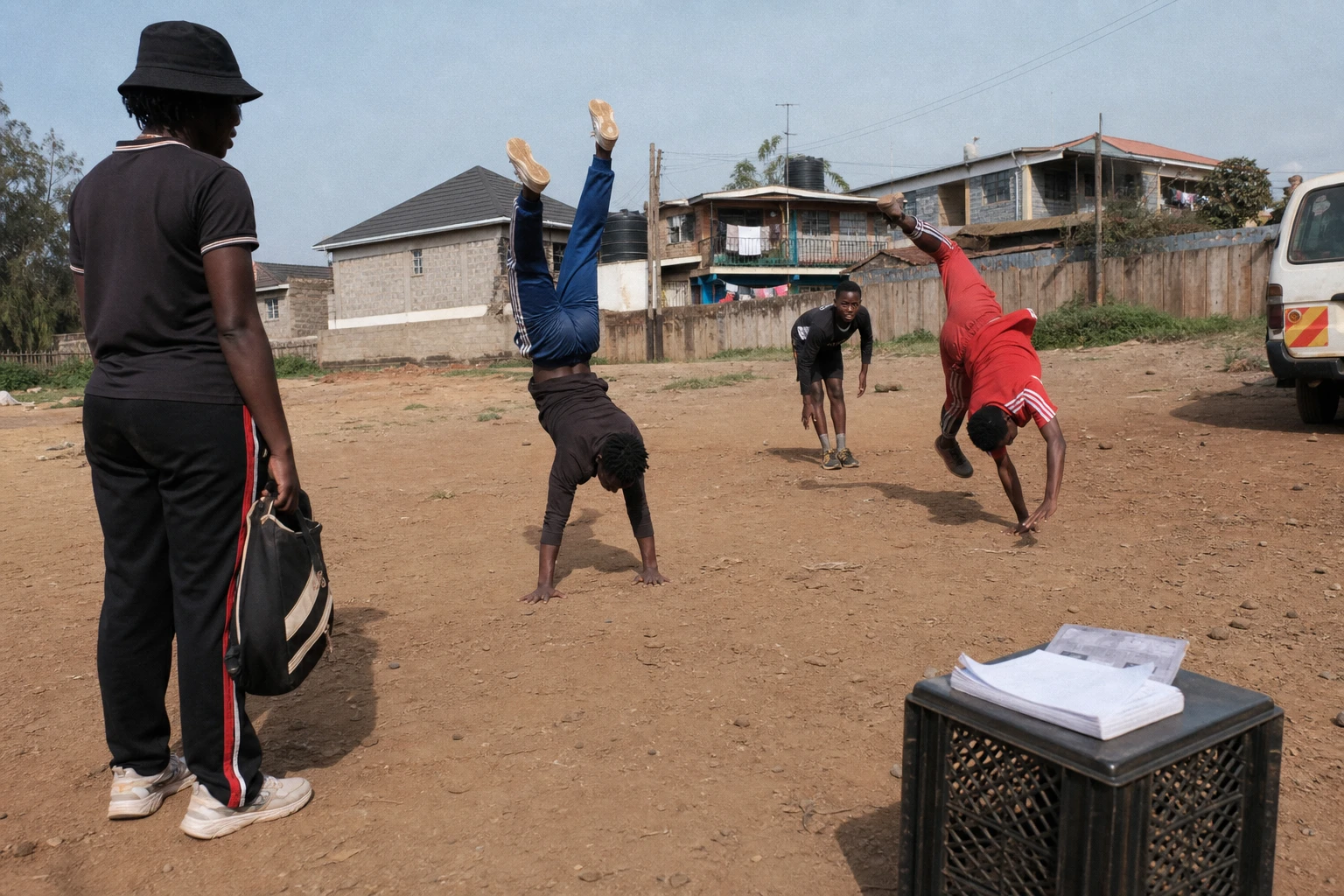
When traffic jams become a stage
In Nairobi, rush hour does more than bring cars to a standstill. It also creates improvised jobs, born beside traffic lights and on congested roads. For young Kenyans, the street is not just somewhere to pass through: it is sometimes the only place where a few minutes of waiting can be turned into a few shillings.
The phenomenon says a lot about Kenya’s capital. A city of services, commerce and offices, Nairobi also embodies the contradictions of a metropolis growing faster than its transport solutions. Local authorities have identified congestion as a structural problem and have recently stepped up mobility projects, from parking enforcement to preparations for mass transit systems. But for now, traffic jams remain an everyday feature of the city.
Acrobats in the traffic, out of necessity, not for show
The young performers spotted on Nairobi’s streets do not present themselves as tourist attractions. They are there first and foremost to work. The group featured in the report meets early in the morning in Kawangware, in the west of the city, to practise on an empty plot before heading to busy junctions as traffic builds. They scatter when the lights turn green. Their approach is simple: attract attention while cars are stopped, then move from driver to driver with a hat held out.
Mohammed Nyale, 22, says he began acrobatics at 15. Jackson Okoth, another member of the group, sums up this generation’s outlook in plain words: they say they have no other immediate opportunities and prefer to stay active rather than remain idle. These words matter because they shift the perspective. This is not an anecdotal form of entertainment, but an urban survival strategy.
The sums mentioned are modest. The acrobats say they can earn around 800 Kenyan shillings on average, the equivalent of a few dollars, with some better days and others less lucrative. The report also mentions small amounts ranging from 300 to 2,000 shillings, depending on traffic and the generosity of motorists. Yet this tiny economy is decisive. In Nairobi, as in many African capitals, a few notes can make the difference between getting through the day and ending it empty-handed.
What this street trade reveals about Kenya
The underlying issue is economic. Kenya has a robust statistical system, and its indicators confirm that a large share of the working population remains in precarious or informal forms of employment. The Kenya National Bureau of Statistics is the official authority on these figures, and its recent publications highlight the scale of the challenges around employment, economic activity and incomes. At the same time, regional analyses by the East African Community underline that youth unemployment, underemployment and informality remain persistent problems in several member states.
In other words, Nairobi’s acrobats have not emerged from nowhere. They are part of a labour market in which the formal sector does not absorb enough new entrants, particularly young people in cities. The result is visible on buses, at junctions and on pavements, in daily delivery work and in small services paid for in cash or by mobile wallet. Economic creativity is alive, but it often rests on a fragile foundation.
This kind of activity also says something about Nairobi itself. Kenya’s capital remains a gateway for talent from the coast, from elsewhere in the country and from other regions. Young people come looking for an audience, an income and sometimes the visibility that their villages or smaller towns cannot yet offer. But the city deals them a tough hand: high rents, costly transport, fierce competition and dependence on tips. The performers therefore make their living in an economy of the moment, without a safety net, where traffic becomes a resource.
A local scene, a regional signal
The Nairobi case extends beyond Kenya. Across East Africa, rapid urban growth, demographic pressure and difficulties accessing formal employment are forcing many young people to devise hybrid ways of making a living. Regional institutions are aware of this: the East African Community’s strategy for 2026/27-2030/31 places employment, labour mobility and economic inclusion at the heart of its priorities.
In Nairobi, then, the debate is not just about acrobats at traffic lights. It concerns how a major African capital organises its public spaces, welcomes its young people and manages its flows. It also touches on public transport, road quality, road safety and the ability of the authorities to offer something beyond improvisation. The mobility projects announced by the city point in a direction, but the street continues to produce its own solutions, often ahead of the state.
For motorists, the performance may seem like a pleasant interlude in a slow-moving journey. For the young acrobats, it means more: a source of income, a discipline, sometimes a stage apprenticeship, and above all a way to stay on their feet in a demanding urban economy. That is where the African significance of this story lies: it shows that amid gridlock, the continent’s cities also produce forms of adaptation, skill and dignity, even when a lasting solution is still lacking.