Algeria
 Egypt
 Libya
 Morocco
 Sudan
 Tunisia
 Benin
 Burkina Faso
 Cabo Verde
 Côte d'Ivoire
 Ghana
 Guinea
 Guinea-Bissau
 Liberia
 Mali
 Mauritania
 Niger
 Nigeria
 Senegal
 Sierra Leone
 The Gambia
 Togo
 Cameroon
 Central African Republic
 Chad
 DR Congo
 Equatorial Guinea
 Gabon
 Republic of the Congo
 São Tomé and Príncipe
 Burundi
 Comoros
 Djibouti
 Eritrea
 Ethiopia
 Kenya
 Madagascar
 Malawi
 Mauritius
 Mozambique
 Rwanda
 Seychelles
 Somalia
 South Sudan
 Tanzania
 Uganda
 Angola
 Botswana
 Eswatini
 Lesotho
 South Africa
 Zambia
 Zimbabwe
Namibian copper attracts capital faster than drill rigs
In Namibia, copper is no longer just a geological prospect. It is becoming a focus for financing, speculation and industrial strategy. After years dominated by uranium, gold and diamonds, several junior miners are now testing Namibia’s subsoil with a clear ambition: find quickly, drill more and convince investors in a market anticipating a constrained global supply. The country remains a sought-after mining destination, supported by a framework considered stable and by infrastructure that facilitates exploration projects.
This movement is also part of the regional landscape. Namibia belongs to SADC, the Southern African Development Community, which brings together 16 member states and promotes economic integration, peace and industrial cooperation. In this context, minerals remain an issue of productive sovereignty as well as a magnet for foreign capital.
Kaoko Metals steps up a gear
Kaoko Metals announced on 7 July a fundraising of 20 million Australian dollars, or about 14 million US dollars. The transaction was ultimately reported in early September 2026 and presented as an institutional placement, with the subscription price set at 2.20 Australian dollars per share. The company says it received strong support from institutional, professional and sophisticated investors. The new funds are expected to take the group’s cash balance above 24 million Australian dollars before costs.
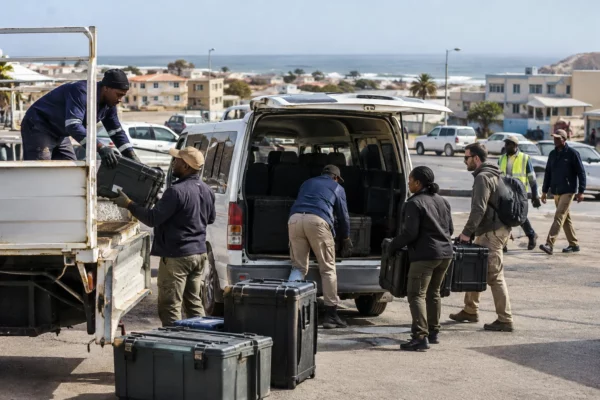
The funding will initially go towards Chalkos, the company’s flagship project in north-western Namibia, at the heart of the Kaoko copper belt. Kaoko Metals owns 100% of the project and describes the area as fully permitted for immediate exploration. The company wants to deploy a second diamond drill rig to accelerate drilling at the Otniel and Donkey Hill targets, then expand work across its 400 km² permit. It also plans to begin preliminary work at Karibib, in the Erongo region, where it is targeting an interest of up to 85%.
Kaoko Metals chief executive Gerard O’Donovan presents this step as a way to intensify drilling, test larger mineralised systems and advance Karibib through geophysics ahead of an initial drilling programme. The message is clear: the company is not yet looking for a mine, but for a discovery that would change the scale of the project.
What the copper market says about Namibia
The timing is no coincidence. Several copper announcements have come out of Namibia in recent months. In May 2026, Appian Capital Advisory acquired 95% of the Omitiomire project, near Windhoek, in a transaction completed on 13 May. The group plans to invest 400 million US dollars there. Bezant Resources, meanwhile, said in June 2026 that it was targeting a production start in the third quarter of 2026 at Hope & Gorob, in the country’s south-central region. Koryx Copper is also continuing to advance Haib, a large copper deposit in southern Namibia.
This flurry of activity is based on a broader reality. Copper remains in demand for electricity grids, electric vehicles and digital equipment. At the same time, several recent studies on Namibia highlight an economy still highly exposed to traditional commodities, with activity supported by uranium and gold but weakened by the decline in diamonds and contraction in some mining industries. The International Monetary Fund also notes that growth forecast for 2026 remains moderate and that gains from exports and investment have yet to translate into broadly shared job creation.
Official figures nevertheless underline the central role of Namibia’s subsoil. In 2024, the mineral industry accounted for about 61% of the country’s goods exports, according to the US Geological Survey. Namibia’s Ministry of Mines, for its part, notes that the country already has a base in base metals, including copper, and offers a favourable investment environment. In other words, copper is not replacing other resources: it is broadening the mining portfolio of a state seeking more diversified revenues.
A test for junior miners, a signal for Windhoek
For Kaoko Metals, the challenge is simple: turn geological indicators into drilling results strong enough to attract further funding. For a junior miner, capital is first used to buy geological time. If it reveals promising grades, the company can raise more. If results disappoint, the window closes quickly. The risk therefore remains high, even when the market is favourable.
For Namibia, the arrival of capital in copper exploration could have a broader impact. In the short term, it supports the work of contractors, geologists, drillers and logistics services, especially in regions such as Kunene and Erongo. In the medium term, it could also intensify competition between projects for access to water, roads, energy and skilled labour. The benefits for local communities are therefore not automatic. They depend on how quickly permits become projects, and projects become jobs and tax revenues.
The Omitiomire precedent also shows that investors see Namibia as an emerging copper province, rather than simply a country of uranium and diamonds. If upcoming drilling campaigns at Chalkos confirm the company’s hopes, the project could join a new generation of African copper assets capable of supplying the regional value chain. What happens next will depend chiefly on field results, drilling timelines and operators’ ability to move exploration from promises to measured resources.