Algeria
 Egypt
 Libya
 Morocco
 Sudan
 Tunisia
 Benin
 Burkina Faso
 Cabo Verde
 Côte d'Ivoire
 Ghana
 Guinea
 Guinea-Bissau
 Liberia
 Mali
 Mauritania
 Niger
 Nigeria
 Senegal
 Sierra Leone
 The Gambia
 Togo
 Cameroon
 Central African Republic
 Chad
 DR Congo
 Equatorial Guinea
 Gabon
 Republic of the Congo
 São Tomé and Príncipe
 Burundi
 Comoros
 Djibouti
 Eritrea
 Ethiopia
 Kenya
 Madagascar
 Malawi
 Mozambique
 Rwanda
 Seychelles
 Somalia
 South Sudan
 Tanzania
 Uganda
 Angola
 Botswana
 Eswatini
 Lesotho
 Namibia
 South Africa
 Zambia
 Zimbabwe

In Port Louis, the debate is no longer just about cannabis
In Mauritius, discussion of cannabis has ceased to be a simple matter of principle. It now involves prisons, youth employment, the police and how the state wants to focus its resources on more dangerous substances, as synthetic drugs gain ground on the island. The issue is also moving forward because the pressure is not coming only from activists: it is coming from figures, the courts and the police services.
The country is not starting this process from scratch. The current framework is based on the Dangerous Drugs Act 2000, which criminalises the possession and use of drugs classified as dangerous, including cannabis. Regionally, Mauritius is a member of SADC, the Southern African Development Community, and the Indian Ocean Commission, whose headquarters are in Ebène, near Port Louis. In this institutional neighbourhood, public health and security policies quickly circulate from one country to another.
A technical committee, three options and a clear direction
The shift is now official. In May 2026, the National Agency for Drug Control set up a technical committee to examine three options for cannabis: depenalisation, decriminalisation and regulated legalisation. The group brings together a range of expertise, from public health and criminal justice to taxation, neuroscience, addiction medicine and harm reduction. Discussions have also been held with the United Nations Office on Drugs and Crime and the World Health Organization.
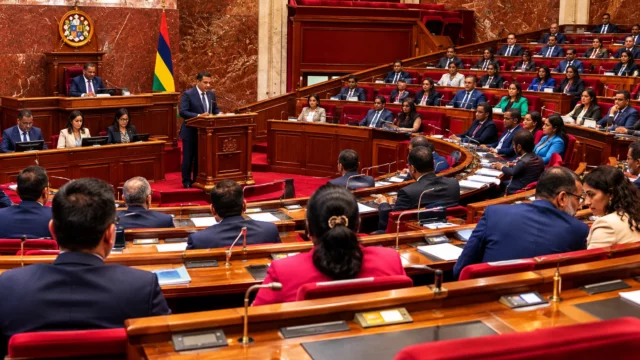
The political structure of this process is clear. The technical work is to inform the National Drug Control Commission, chaired by the Prime Minister, before any government decision. The timetable announced in parliament provides for a legal briefing, a public health assessment and then a draft administrative framework. The authorities initially aimed to produce a first summary by July 2026, before later referring to submission of the report at the end of July. This uncertainty over the deadline points less to a retreat than to an issue that remains sensitive.
The issue is also fundamentally economic. The committee is to study the potential of hemp, a variety of cannabis used in some industrial sectors, in order to clearly distinguish the plant as an agricultural resource from the product as a regulated substance. This matters in Mauritius, where every reform immediately affects the balance between customs controls, taxation, agriculture and employment. The government therefore wants to assess what regulation might bring in, as well as what it would require in terms of monitoring and traceability.
Prisons and the streets tell a different story
The authorities themselves illustrate the scale of the pressure. In 2025, official statistics recorded 4,913 drug-related offences, up 12.3% year on year. Of these, 41.9% involved cannabis, 28.1% synthetic cannabinoids and 10.2% heroin. The same data indicate that the market value of drugs seized in 2025 was estimated at Rs 9.33 billion, with a substantial share linked to a cocaine shipment intercepted at sea and not intended for the Mauritian market.
The prison situation is just as significant. Official justice and security figures show that 5,597 adults were admitted to prison in Mauritius in 2025, and that the average occupancy rate of facilities reached 74.3%. At the same time, offences involving “controlled drugs or other psychoactive substances” rose by 12.3% year on year. This is where the cannabis debate becomes tangible: some detainees are serving sentences or being held on remand for possessing or using small quantities, fuelling the view that the criminal justice response is disproportionate.
Anti-drug services also describe a changing market. In the National Assembly, the government said that in 2025 the Forensic Science Laboratory had recorded 1,110 cases involving synthetic cannabinoids, and that about 60 new psychoactive substances had been identified since 2013. This development changes the hierarchy of risks. It explains why cannabis reform is now seen in Port Louis not as an isolated issue, but as a way to free up police and judicial resources for more toxic and volatile substances.
What Mauritian stakeholders want
Mauritian NGOs working on addiction have long called for an end to an entirely punitive approach. Cure Mauritius believes that criminalising small quantities mainly harms young people, with lasting effects on their criminal records and access to employment. Ailes, which works on risk behaviours, advocates a more closely state-regulated approach to combat trafficking, corruption and illicit money. These organisations are not calling for controls to be abandoned. They support smarter regulation, in which public health takes precedence over punishment alone.
Law enforcement agencies, for their part, point out that the illicit trade remains organised. The Mauritian police list gandia, the local name for cannabis, among the products seized in mountainous areas, forests and sugar-cane fields. Their official website also notes that the law penalises unauthorised possession, cultivation and trafficking. In other words, the proposed reform is not starting from a regulatory vacuum: it seeks to correct a system in which repression has long been the main tool, without drying up the market.
For families and poorer neighbourhoods, the stakes are twofold. On the one hand, resale networks and synthetic drugs put young people at greater risk because these drugs are more accessible and often cheaper than cannabis. On the other, a conviction for a small quantity can close off a career path. The Mauritian debate is therefore as much about security as social mobility. It also sets two visions of the state against each other: punishing use, or focusing public intervention on trafficking and prevention.
A reform watched beyond the island
This issue extends beyond Mauritius. In the Indian Ocean, the IOC is already working on technical cooperation, including customs and health, while SADC is seeking to further harmonise its responses to cross-border challenges. If Mauritius changes its law, even partially, it will send a signal to its partners about how to address use, industrial hemp sectors and the judicial burden associated with minor offences.
The next steps will play out in Port Louis, but also through regional discussions. The technical committee’s forthcoming report will have to say whether penalties should be reduced, use distinguished from trafficking, or a strictly regulated market established. This is the key question: whether Mauritius chooses to shift the focus of its drug policy away from minor possession and towards networks, away from prisons and towards public health, and away from a reflexive punitive approach and towards clearer regulation.