Algeria
 Egypt
 Libya
 Morocco
 Sudan
 Tunisia
 Benin
 Burkina Faso
 Cabo Verde
 Côte d'Ivoire
 Ghana
 Guinea
 Guinea-Bissau
 Liberia
 Mali
 Mauritania
 Niger
 Nigeria
 Senegal
 Sierra Leone
 The Gambia
 Togo
 Cameroon
 Central African Republic
 Chad
 DR Congo
 Equatorial Guinea
 Gabon
 Republic of the Congo
 São Tomé and Príncipe
 Burundi
 Comoros
 Djibouti
 Eritrea
 Ethiopia
 Kenya
 Madagascar
 Malawi
 Mauritius
 Mozambique
 Rwanda
 Seychelles
 Somalia
 South Sudan
 Tanzania
 Uganda
 Angola
 Botswana
 Eswatini
 Lesotho
 Namibia
 Zambia
 Zimbabwe
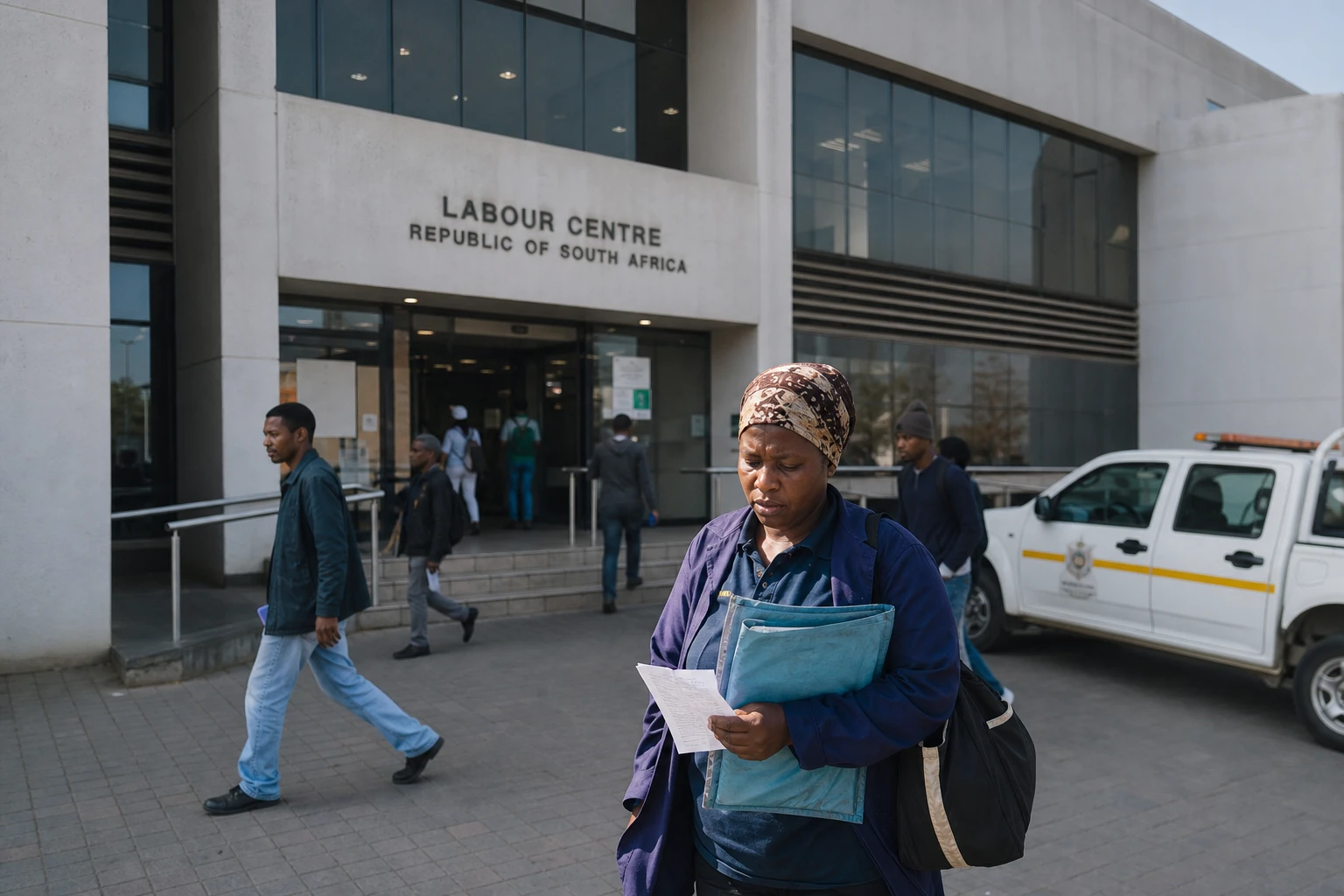
In Newcastle, in northern KwaZulu-Natal, a sewing line coming to a halt tells a story that goes far beyond a local dispute. It speaks to the fragility of an industry that depends on skilled hands, tight margins and a social balance that has become unstable.
In this South African textile town, the question is not simply who works in the workshops. It is also about understanding what happens when a sector built on low costs, fast production rates and a large presence of workers from elsewhere suddenly loses part of its workforce.
A local shock in a country already under pressure
The national context is bleak. In the second quarter of 2026, South Africa’s official unemployment rate rose to 33.6%, after a further 345,000 people became unemployed. At the same time, agriculture and manufacturing each lost 15,000 jobs. In other words, the jobs crisis is not down to a single migration issue. It is part of an economy that struggles to absorb workers and has yet to regain solid momentum.
The timing adds another layer of tension. On 2 September 2026, the South African department responsible for mineral and petroleum resources announced a further increase in fuel prices, with sharp rises in petrol, diesel and illuminating paraffin. For the textile industry, the transport of goods, workers’ shuttle services and small businesses that depend on daily movement, every increase immediately adds to costs. In a country where domestic consumption remains fragile, even a small rise in prices spreads quickly.
The regional context also matters. Newcastle does not exist in isolation. Workshops have long recruited across southern Africa, particularly from Lesotho, Malawi and Zimbabwe. This labour mobility is an established feature of the SADC, the Southern African Development Community, where political borders have never erased economic flows. When these workers leave, it is not just a workforce that disappears. A network of skills, rent payments, meal purchases and daily journeys also contracts.
In the workshops, the issue is not nationality but pace
Several textile industry players in Newcastle say they have lost between 12% and 19% of their workforce. The sector’s trade union puts the figure at 15% of the industry’s 15,000 employees. This decline is not hitting an ideal labour market where jobs are waiting for a plentiful supply of candidates. It is affecting workshops that were already operating at full stretch, with teams accustomed to specialised tasks and piece-rate pay.
That is the crucial point. In garment factories, piece-rate pay does not allow everyone to reach the legal minimum wage of 30.23 rand an hour easily. Employers therefore do not describe standard jobs, but roles that often exist only through high production rates and considerable availability. When workers leave the workshop, the machines stop. Replacing those departures in compliance with the rules pushes up costs. And when workers are not replaced, production falls.
This explains why public debate sometimes misses the point. The departure of foreign workers does not automatically free up jobs “for nationals”. In several workshops, the vacant posts remain unfilled, not because they are invisible, but because they are too demanding, too specialised or too poorly paid to attract a new local workforce quickly. The problem is therefore not only about migration. It is industrial, wage-related and organisational.
Factory owners interviewed in Newcastle also describe a sector already weakened by inspections carried out earlier in the year. Inspections in February 2026 highlighted, at some sites, wages below basic benchmarks, unsanitary dormitories and dangerous working conditions. These revelations tarnished the sector’s image and complicated relations with buyers. As a result, workshops are facing regulatory pressure, workers’ fears and lost orders all at once.
Beyond Newcastle, a signal for southern Africa
The South African case resonates far beyond KwaZulu-Natal. On the one hand, it is a reminder that policies to close off or sideline migrant workers can disrupt entire industries when they rely on skills built up over several years. On the other, it shows that South Africa’s textile industry cannot survive on tariff protection or political announcements alone. It depends on its ability to train, retain and pay its workers properly.
For neighbouring countries, the impact is mixed. Workers returning to Lesotho, Malawi or Zimbabwe do not automatically find comparable jobs. Their return can even turn a South African industrial problem into a straight loss of income for households already exposed to precarious conditions. In southern Africa, labour mobility has long acted as an economic safety valve. When that valve closes abruptly, the shock spreads across borders in both directions.
For Pretoria, the stakes are broader still. The country wants to defend a manufacturing base capable of creating local value, while managing social tensions linked to the employment of foreigners. But if the response is limited to exclusion, it risks reducing production without addressing the labour market’s structural weakness. The figures for the second quarter of 2026 already show that the South African economy is shedding jobs in several sectors, including agriculture and industry. Textiles are therefore no exception: they are a litmus test.
The continental implications are clear. At a time when the African Union and regional blocs are championing free movement, productive integration and industrial upgrading, the South African example is a reminder of a sometimes-forgotten truth: the movement of people is not enough if value chains remain fragile. Across the continent, the real question is not only who works, but under what conditions, with what training, and to produce what.
The next major economic milestone is already in sight, with the detailed release of third-quarter statistics and further monetary and budgetary decisions. But in Newcastle, the warning is immediate: when skilled workers leave, it is not just empty seats in workshops. Entire areas of activity are left wavering.