Algeria
 Egypt
 Libya
 Morocco
 Sudan
 Tunisia
 Benin
 Burkina Faso
 Cabo Verde
 Côte d'Ivoire
 Ghana
 Guinea
 Guinea-Bissau
 Liberia
 Mali
 Mauritania
 Niger
 Nigeria
 Senegal
 Sierra Leone
 The Gambia
 Togo
 Cameroon
 Central African Republic
 Chad
 DR Congo
 Equatorial Guinea
 Gabon
 Republic of the Congo
 São Tomé and Príncipe
 Burundi
 Comoros
 Djibouti
 Eritrea
 Ethiopia
 Kenya
 Madagascar
 Malawi
 Mozambique
 Rwanda
 Seychelles
 Somalia
 South Sudan
 Tanzania
 Uganda
 Angola
 Botswana
 Eswatini
 Lesotho
 Namibia
 South Africa
 Zambia
 Zimbabwe
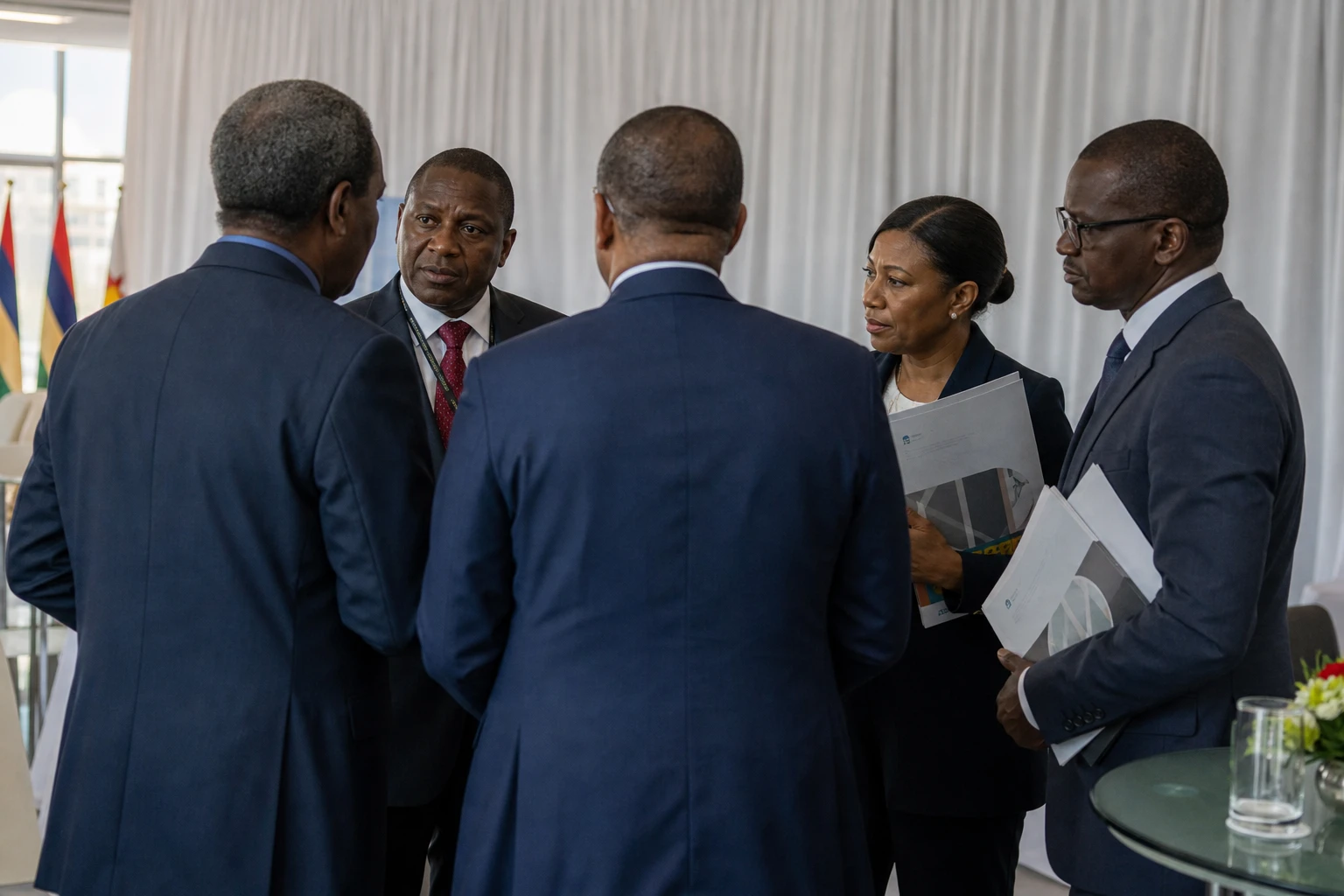
In Port Louis, a battle for financial credibility is now being fought at continental level
For many African governments, the real issue is not simply raising money. It is knowing at what cost, and according to which criteria. In this debate, Mauritius occupies a unique position: Port Louis is due to host the official launch of the Africa Credit Rating Agency, or AfCRA, on 7 October 2026, following a dedicated conference on 5 and 6 October. This series of events puts the Republic of Mauritius at the heart of a continent-wide effort on financial sovereignty.
The choice is no coincidence. Mauritius emerged as the leading jurisdiction after a selection process overseen by the African Peer Review Mechanism, an African Union body tasked with examining the governance policies of member states. The African Union Assembly subsequently welcomed the designation and asked the host country to support the agency’s operationalisation in 2026.
What the African Union is seeking to address
For years, several African capitals have challenged the way major international agencies assess their credit risk. Fitch, Moody’s and S&P dominate a market in which a state’s rating can push up or bring down the cost of its debt. AfCRA was conceived to provide a more contextualised assessment of the continent’s economies, without promising lenient ratings. The central idea is simple: produce African assessments that are nevertheless credible to investors.
This ambition is part of a longer-term trajectory. As early as 2023, the UNDP noted that African countries often pay more to borrow than comparable economies elsewhere, and that better-adapted methodologies could reduce financing costs. The same organisation later argued that taking African realities better into account could generate massive savings for public budgets. The debate is therefore not theoretical: it directly affects the room for manoeuvre available to treasuries and businesses and, ultimately, households.
The timetable announced by Mauritius confirms that the project is entering an operational phase. The Mauritian government said the conference on 5 and 6 October 2026 would focus on the theme “Towards Developing African Capital Markets: Rechannelling Africa’s Capital”, before the agency’s launch the following day. This sequencing says much about the political wager: AfCRA is not meant to be a symbolic body, but an instrument serving African capital markets.
Why Mauritius was selected
Mauritius’s selection also tells another story: the African desire to rely on financial centres that are already regulated and connected, and able to attract private-sector expertise. The Mauritian Financial Services Commission, the regulator of the non-bank financial sector, already oversees activities related to credit rating. The country points to its regulatory stability and its role as an international financial centre to justify this responsibility.
The Mauritian context also matters in this reading. Since leaving the FATF grey list in 2021, the island has stepped up its messaging on compliance, transparency and financial architecture. In this context, hosting AfCRA allows Port Louis to strengthen its image as a credible platform for African business, rather than a mere offshore intermediary. It is also a way for an island state in East Africa to wield greater influence in continental discussions on finance.
The wager is nevertheless demanding. AfCRA will have to demonstrate its independence from African governments themselves. If a continental agency is seen as a tool for political messaging, it will immediately lose credibility. Conversely, if it also penalises budgetary excesses and governance weaknesses, it may win the markets’ trust. The challenge is therefore twofold: to be African without being captive, and technical without becoming opaque.
Very different effects for different stakeholders
For states, the stakes are financial. A more nuanced rating could eventually help lower risk premiums and thus the cost of debt. For public administrations, it also requires better statistical quality, budget transparency and coordination between departments. The African Peer Review Mechanism has emphasised in several studies the need to improve economic governance and the production of reliable data. In other words, AfCRA will not by itself correct structural weaknesses; it can, however, make them more visible and more politically costly to ignore.
For African businesses, particularly those seeking market financing, the effect could be even more tangible. Better understanding of African sovereign and corporate risk could ease access to credit, especially in countries where local bond markets remain shallow. The project therefore also concerns the continent’s banks, investment funds, pension funds and asset managers. In the background, it affects how African savings are channelled back into the African economy.
For citizens, the impact is more indirect but real. When borrowing costs less, some of the fiscal space can be redirected towards infrastructure, education or health. The counterargument is just as important: if the agency lacks rigour, it could provide no more than another label, with no effect on financing conditions. The launch in Mauritius will therefore be less a culmination than an initial test of method, governance and trust.
A test of African financial sovereignty
At continental level, AfCRA is part of a broader drive to build African financial instruments. It complements other initiatives, such as the African Continental Free Trade Area, which seeks to facilitate trade, and ambitions to develop regional capital markets. If the agency delivers on its promises, it could become a technical tool serving a broader political assertion: financing African development more effectively with instruments conceived on the continent.
The key date is now set for early October 2026 in Port Louis. That is when the African Union, the peer review mechanism, the Mauritian authorities and private-sector players will have to show that a financial sovereignty project can move from rhetoric to implementation. What follows will depend less on symbolism than on the quality of the first ratings, the robustness of the methods and the agency’s ability to withstand political pressure. At this level, Mauritius is not merely hosting an institution: it is hosting a test for Africa’s financial architecture.