Algeria
 Egypt
 Libya
 Morocco
 Sudan
 Tunisia
 Benin
 Burkina Faso
 Cabo Verde
 Côte d'Ivoire
 Ghana
 Guinea
 Guinea-Bissau
 Liberia
 Mali
 Mauritania
 Niger
 Nigeria
 Senegal
 Sierra Leone
 The Gambia
 Togo
 Cameroon
 Central African Republic
 Chad
 DR Congo
 Equatorial Guinea
 Gabon
 Republic of the Congo
 São Tomé and Príncipe
 Burundi
 Comoros
 Djibouti
 Eritrea
 Kenya
 Madagascar
 Malawi
 Mauritius
 Mozambique
 Rwanda
 Seychelles
 Somalia
 South Sudan
 Tanzania
 Uganda
 Angola
 Botswana
 Eswatini
 Lesotho
 Namibia
 South Africa
 Zambia
 Zimbabwe
A sporting gamble that goes beyond the pitch
In Addis Ababa, a bid to host the Africa Cup of Nations is never just a sporting proposal. It also says something about the place Ethiopia wants to reclaim in African football, at a time when the continent is seeking to distribute its major events more evenly between East Africa, southern Africa and North Africa. The country has not hosted AFCON since 1976, and that memory still weighs on the national narrative.
On 3 July 2026, the Confederation of African Football opened the bidding process for the 2028, 2032 and 2036 editions. It also confirmed that AFCON 2027 will be held in Kenya, Tanzania and Uganda, the first time three countries have hosted the tournament. For East Africa, this creates a rare opportunity. For Ethiopia, it brings Addis Ababa back into the regional conversation as major football events reshape the continent’s balance.
The calendar now matters as much as sports policy. CAF has announced that AFCON will move to a four-year cycle from 2028, bringing the competition into line with other major international events. In other words, the 2028 edition is not an AFCON like any other. It opens a new chapter in the governance of African football, with more demanding bids, more targeted investment and fiercer competition between candidates.
Ethiopia’s bid: strengths and limitations
The Ethiopian Football Federation confirmed on 24 August 2026 that it had formally submitted its bid to CAF to host AFCON 2028. Ethiopian and regional media reported the announcement, presenting the submission as a formal step after months of publicly stated interest. Ethiopia has already hosted the tournament in 1962, 1968 and 1976, giving it a historical legitimacy that few East African states can claim.
But the bid comes amid a complex domestic situation. The country continues to face armed and political tensions, particularly in Amhara and Oromia, while the question of Tigray remains a factor in overall stability. This sporting ambition must therefore be viewed with caution. A major tournament is about more than a stadium or a logo. It requires lasting security, reliable transport, sufficient hotel capacity and an administration capable of meeting a tight schedule.
The sporting challenge is just as clear. Ethiopia’s men’s national team is ranked 143rd in the FIFA rankings, according to the official update of 20 July 2026. It exited AFCON 2022 in the group stage. That ranking does not rule out a hosting bid, but it is a reminder that the country’s historical prestige is no longer enough. To convince CAF, Ethiopia must prove it can host the tournament with the same rigour with which it hopes to compete in it.
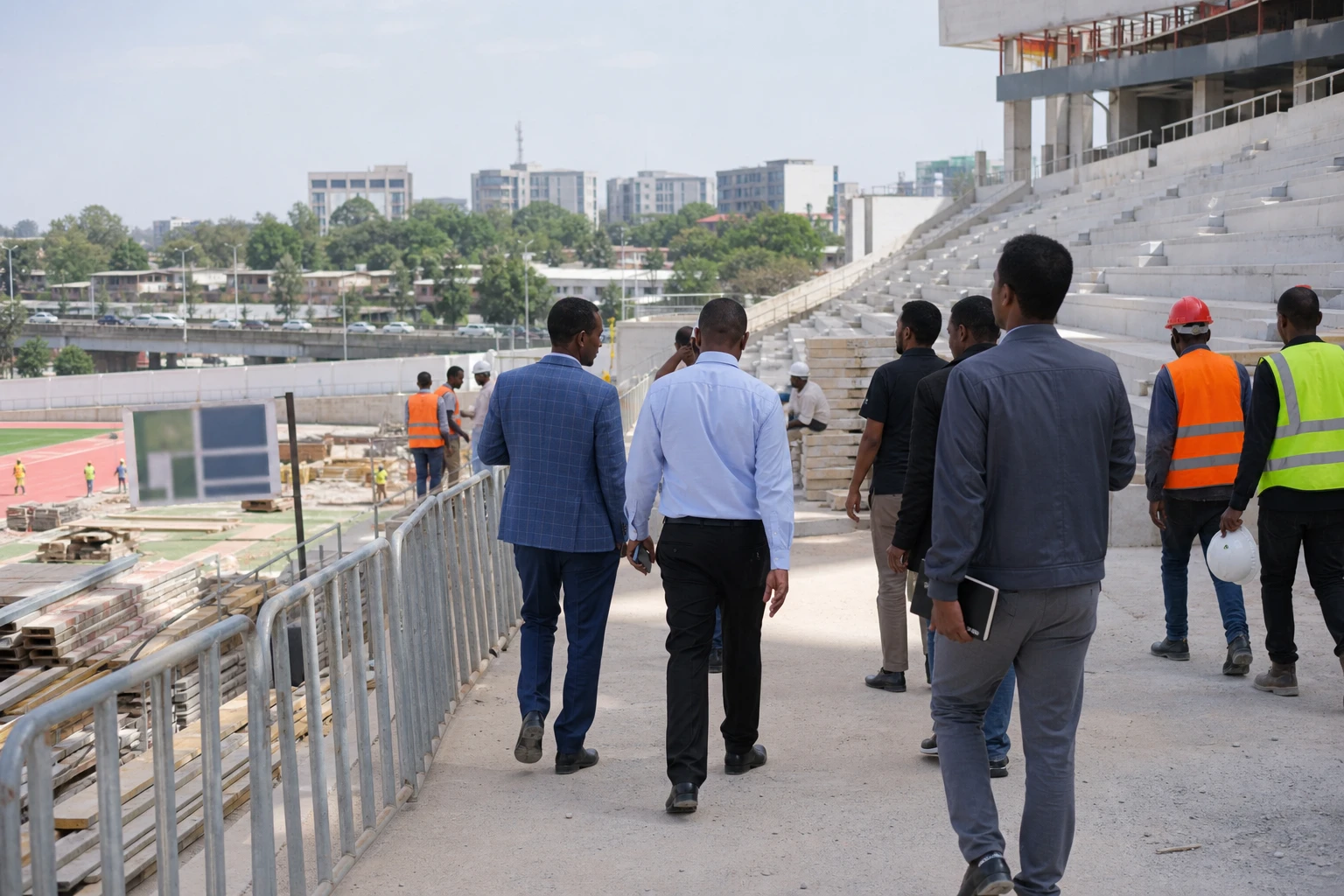
The authorities are counting on infrastructure to bridge the gap. Addis Ababa has made a series of announcements about Adey Abeba Stadium, Abebe Bikila Stadium and other urban and sporting projects. Municipal and national officials present these developments as a foundation for hosting major events. But the AFCON bid remains a reality check. African football no longer assesses only a country’s symbolism. It compares practical capacity, timelines and financial guarantees.
What the bid means for the region
The significance of the bid extends beyond Ethiopia. If Addis Ababa wins the right to host AFCON 2028, East Africa would strengthen its position in the continent’s sporting landscape. The region has already secured AFCON 2027, to be hosted by Kenya, Tanzania and Uganda. An award to Ethiopia would build on that momentum and establish the area as a credible host for the long term, after years in which major competitions have largely circulated among a handful of countries with better-developed infrastructure.
For CAF, the Ethiopian bid is also part of a broader strategy. The governing body wants to smooth its calendar, broaden its commercial base and secure revenues across several cycles. It has also launched a call for commercial rights for the 2028, 2032 and 2036 editions. The stakes are therefore not only sporting. They involve resources, international visibility and the ability of African federations to deliver credible projects in competition with rivals that are often better equipped administratively.
The Ethiopian bid can also be read as a domestic political signal. A country seeking to host AFCON is also trying to show that it can shape its national narrative, develop its infrastructure and assert its presence on the African stage. But that signal matters only if it stands up to reality. CAF will assess security, stadiums, logistics and the capacity to stage a tournament without undermining public finances or local stability. With the competition moving to a four-year cycle, the margin for error will be small.
The next steps therefore merit close attention. They will show whether Ethiopia’s bid remains an expression of intent or becomes a competitive offer against the other proposals submitted for 2028. For African football, the challenge is clear: broaden the pool of hosts without lowering standards. For Ethiopia, the equation is even clearer: turn an old legacy, that of AFCON 1976, into modern, visible and verifiable capacity.