Algeria
 Egypt
 Libya
 Morocco
 Sudan
 Tunisia
 Benin
 Burkina Faso
 Cabo Verde
 Côte d'Ivoire
 Ghana
 Guinea
 Guinea-Bissau
 Liberia
 Mali
 Mauritania
 Niger
 Nigeria
 Senegal
 Sierra Leone
 The Gambia
 Togo
 Cameroon
 Central African Republic
 Chad
 DR Congo
 Equatorial Guinea
 Gabon
 Republic of the Congo
 São Tomé and Príncipe
 Burundi
 Comoros
 Djibouti
 Eritrea
 Ethiopia
 Kenya
 Madagascar
 Malawi
 Mauritius
 Mozambique
 Rwanda
 Seychelles
 Somalia
 South Sudan
 Tanzania
 Uganda
 Angola
 Botswana
 Eswatini
 Lesotho
 Namibia
 South Africa
 Zambia

A deal that secures long-term certainty on the Great Dyke
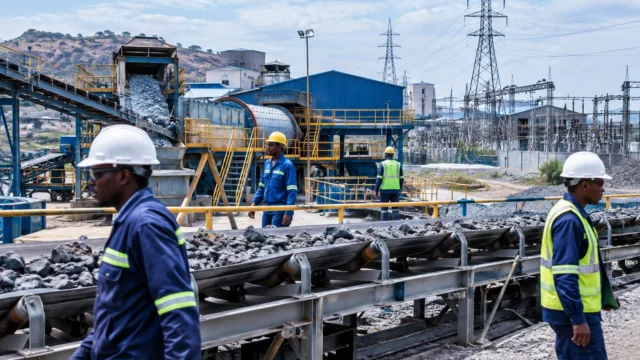
In southern Zimbabwe, mining projects are judged not only by the opening of a mine. They are also assessed over the long term, as platinum sites attract capital only when rules are stable, rights are clear and there is enough visibility to recoup infrastructure costs. That is precisely what the Karo project is seeking, as Harare looks to turn its underground resources into jobs, exports and tax revenue.
The project is located on the Great Dyke, the geological belt that contains a major share of Zimbabwe’s platinum-group metals. This mineral-rich strip is strategically important for the country and for southern Africa, and has for years underpinned the local beneficiation policy championed by Zimbabwean authorities and the Southern African Development Community, of which Zimbabwe is a member. In national planning documents, the government presents mineral resources as a driver of industrial transformation, not merely as a raw material for export.
What the agreement signed in Harare provides for
On 24 August 2026, at State House in Harare, the Zimbabwean government signed a 25-year special mining lease with Karo Platinum covering 23,903 hectares. President Emmerson Mnangagwa attended the ceremony, while the ministers responsible for mining and finance signed the agreement. The document secures tenure for the project and sets out a fiscal and operational framework for its development.
According to the company’s announcement, Karo Platinum is 85% owned by Karo Mining Holdings, with the remaining 15% held by the Zimbabwean state through Generation Minerals, on a carried-interest basis. The lease was granted under the Mines and Minerals Act and covers an area already known for its platinum-group metal reserves. Karo says it has already invested more than $240 million in the project.
The project is based on an initial phase that, according to Tharisa, will employ more than 1,000 people and produce 226,000 ounces of platinum-group metals a year once it reaches full capacity. The plan presented also envisages nearly $1 billion in additional investment in the plant, mining equipment, and water and electricity infrastructure. Available estimates also refer to an open-pit reserve of 2.1 million ounces and a mineral resource of 11.2 million ounces, with a potential mine life of more than 50 years.
The fiscal framework is also part of the signal being sent to investors. The project benefits from a special arrangement announced by the authorities, including a 7% mining royalty. The government is relying on this kind of arrangement to accelerate large, costly projects that are sensitive to metals cycles.
Why the project matters to Zimbabwe’s economy
Zimbabwe is heavily dependent on mining. Public data cited by official sources and the US Commercial Service indicate that the mining sector accounts for about 14.5% of GDP and nearly 75% of national exports. Minerals also generated $5.9 billion in exports in 2024, compared with $5.4 billion in 2023, according to figures from the Reserve Bank of Zimbabwe cited in the same documentation.
In this context, Karo is more than just another construction project. For Harare, the stakes are threefold. First, to secure capital in a sector where legal certainty remains crucial. Second, to increase platinum-group metal production, a flagship product of Zimbabwe’s economy. Finally, to create a broader chain of activity, with expected effects on roads, energy, water, services and indirect employment around the site.
But this promise will not benefit everyone in the same way. For the state, the project promises revenue, foreign currency and a vote of confidence from markets. For residents of nearby areas, the issues are more immediate: access to jobs, pressure on land, the distribution of local benefits, truck traffic, water availability and compliance with environmental commitments. Zimbabwe has already included beneficiation in its national strategy — processing minerals locally — in order to capture more value at home.
The project also comes as the authorities seek to tighten discipline in the sector. The mines ministry recently reaffirmed that only companies holding valid titles and approved facilities may export certain minerals, with an emphasis on transparency and local processing. This policy reflects a familiar tension in African mining economies: attracting capital without surrendering the state’s share or allowing value added to flow out of the country.
Significance beyond Zimbabwe
The Great Dyke remains one of southern Africa’s major assets in platinum-group metals. At the regional level, the Karo project shows how states are now seeking to negotiate longer-term deals with clearer frameworks and greater industrial integration. It also illustrates competition among mining countries to capture strategic metals value chains, as the global energy transition increases interest in these resources.
For SADC, the significance goes beyond the announcement of a lease. This type of agreement could become a model for other projects in the region, provided promises of jobs, infrastructure and revenue are fulfilled on the ground. The next milestones to watch will therefore be the actual pace of Phase 1 works, the commissioning of equipment and the conversion of commitments into jobs and revenue for Zimbabwe, whose economy remains highly exposed to commodity cycles.