Algeria
 Egypt
 Libya
 Morocco
 Sudan
 Tunisia
 Benin
 Burkina Faso
 Cabo Verde
 Côte d'Ivoire
 Ghana
 Guinea
 Guinea-Bissau
 Liberia
 Mali
 Mauritania
 Niger
 Nigeria
 Senegal
 Sierra Leone
 The Gambia
 Togo
 Cameroon
 Central African Republic
 Chad
 DR Congo
 Equatorial Guinea
 Gabon
 Republic of the Congo
 São Tomé and Príncipe
 Burundi
 Comoros
 Djibouti
 Eritrea
 Kenya
 Madagascar
 Malawi
 Mauritius
 Mozambique
 Rwanda
 Seychelles
 Somalia
 South Sudan
 Tanzania
 Uganda
 Angola
 Botswana
 Eswatini
 Lesotho
 Namibia
 South Africa
 Zambia
 Zimbabwe
When the road becomes a line of fire
In South Sudan, security is not measured only in administrative capitals or around official palaces. It is also measured on Jonglei’s muddy tracks, where a patrol can become a target in seconds. Monday’s attack is a reminder of a persistent reality: in several parts of the country, peacekeeping still depends on fragile routes, armed communities and public trust that remains incomplete.
Jonglei, in the country’s east-central region, remains one of its most sensitive flashpoints. Violence there intersects with local conflicts, armed rivalries and the spillover effects of the political standoff in Juba, the South Sudanese capital. In a country that is a member of IGAD, the East African cooperation organisation, and the EAC, the East African Community, each incident of this kind quickly reaches beyond the local security context. It also affects the credibility of the regional mechanisms tasked with supporting the transition.
Two Ethiopians killed, seven wounded in ambush
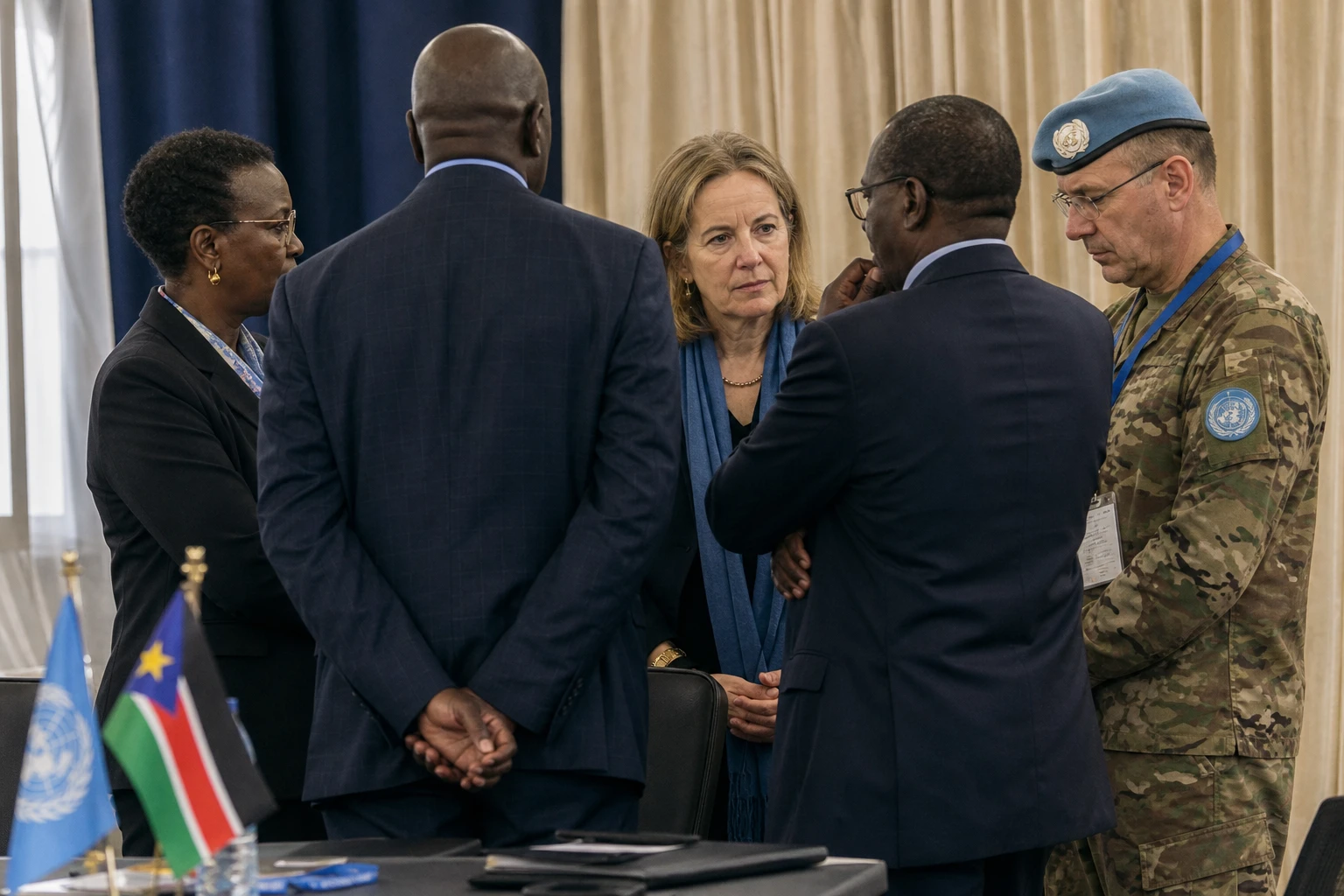
According to the United Nations Mission in South Sudan, a patrol travelling towards Pajut in Jonglei state was targeted by unidentified armed individuals. Two peacekeepers were killed and seven people wounded, including three peacekeepers, two South Sudanese police officers and two UN civilian staff members. The two soldiers killed were Ethiopian, the UN Secretary-General’s spokesperson later said.
The UN mission condemned the attack and deployed a rapid response force to secure the area. The UN recalled that an attack on peacekeepers may constitute a crime under international criminal law if it targets protected personnel in the context of an armed conflict. This is no theoretical reminder. In South Sudan, the mission has been engaged since 2011 to protect civilians, facilitate humanitarian aid, support the peace process and monitor human rights violations.
The shock is also symbolic. Ethiopia is one of the leading troop contributors in South Sudan. It has been sending soldiers to peace operations in the region for years. This presence reflects an often-invisible African reality: South Sudan’s security depends largely on neighbouring or nearby countries, mobilised within a regional architecture in which the UN, AU and IGAD work together, but with uneven results.
A country under strain, between an unfinished transition and scattered violence
The timing is particularly sensitive. South Sudan has seen fighting intensify in recent months in several counties across the country, notably in Jonglei. The Secretary-General’s latest report on the situation in South Sudan highlights a deterioration in humanitarian conditions in 2026, with nearly 10 million people expected to need assistance and large-scale displacement linked to the fighting. At the same time, the UN mission has documented a sharp rise in violence against civilians in the first quarter of 2026.
The core problem remains political. The revitalised peace agreement signed in 2018 prevented a complete collapse, but its implementation remains unfinished. IGAD and the African Union continue to stress the need for a clear roadmap for the transition and elections, with a deadline of December 2026 under consideration. In other words, the country is entering a period in which every security incident could further weaken an already pressured timetable.
This fragility has very tangible effects. For the state, it reduces the ability to control territory and protect transport routes. For rural populations, it limits access to markets, healthcare and schools. For humanitarian actors, it complicates aid delivery. For local authorities, finally, it sustains a grey zone in which the state’s presence remains intermittent. The violence of an ambush is therefore measured not only in lives lost; it also means lost working days, isolated villages and eroded public trust.
Why this attack goes beyond Jonglei
South Sudan belongs to the EAC, whose member states have made regional integration a political and economic goal. But integration requires a minimum level of security on roads, in counties and around transit areas. When a UN patrol is attacked in Jonglei, the entire chain of regional support is also put to the test, from diplomatic mediation to humanitarian logistics.
The continental significance is clear. The deaths of African peacekeepers are a reminder that the continent’s peace operations still rely heavily on the commitment of African states themselves. They also show that peace cannot be stabilised by signing agreements alone. It requires credible institutions, genuine security discipline and a durable, accepted sharing of power. In South Sudan, that equation remains unresolved. And Jonglei, once again, is paying the price.