Algeria
 Egypt
 Libya
 Morocco
 Sudan
 Tunisia
 Benin
 Burkina Faso
 Cabo Verde
 Côte d'Ivoire
 Ghana
 Guinea
 Guinea-Bissau
 Liberia
 Mali
 Mauritania
 Niger
 Senegal
 Sierra Leone
 The Gambia
 Togo
 Cameroon
 Central African Republic
 Chad
 DR Congo
 Equatorial Guinea
 Gabon
 Republic of the Congo
 São Tomé and Príncipe
 Burundi
 Comoros
 Djibouti
 Eritrea
 Ethiopia
 Kenya
 Madagascar
 Malawi
 Mauritius
 Mozambique
 Rwanda
 Seychelles
 Somalia
 South Sudan
 Tanzania
 Uganda
 Angola
 Botswana
 Eswatini
 Lesotho
 Namibia
 South Africa
 Zambia
 Zimbabwe
One tuber, two markets
In Abuja, the cassava sector is no longer talking only about attiéké, gari or flour. It is also looking at tablets, capsules and industrial supply chains. This is where a quieter but decisive part of Nigeria’s economic sovereignty is at stake: turning a staple crop into a strategic input for health and industry.
Nigeria remains the world’s leading cassava producer, an agricultural advantage long confirmed by the FAO. But that ranking is not enough. The country continues to import a large share of the derived products and excipients its industries need, even though cassava grows across several parts of the country, from the humid south to the Middle Belt.
Abuja seeks to move up the value chain in pharmaceutical starch
On 20 August 2026, the Nigerian Cassava Industrial Stakeholders Association urged processors to target pharmaceutical-grade starch. The idea is simple: no longer confine cassava to food, but capture greater value in a segment where margins, standards and traceability matter as much as volume. Pharmaceutical starch is an excipient, meaning a substance that helps make a medicine but is not its active ingredient.
This positioning has not emerged from nowhere. In December 2024, the Nigerian Natural Medicines Development Agency, the public agency responsible for natural medicines, launched a drive to produce pharmaceutical starch locally from cassava. Its director-general, Martins Emeje, said at the time that the aim was to build a complete supply chain, from dedicated cultivation to industrial production. In January 2026, he told the Nigerian press that research on the input was 85% complete and that a pilot phase was expected to follow within one to two years.
This path also forms part of a broader budgetary and industrial approach. For several years, the federal government has promoted the local processing of raw materials, with support from the Raw Materials Research and Development Council, pharmaceutical regulator NAFDAC and applied research organisations. The RMRDC also says that the country already has research on pharmaceutical starch, with an explicit aim of reducing imports.
An import bill that remains a burden
The main argument put forward by proponents of the sector is economic. In 2024, the NNMDA estimated Nigeria’s pharmaceutical starch import bill at about $23 million a year. Another estimate reported in the Nigerian press put national demand at about 600,000 tonnes of starch a year, against much lower domestic production. This imbalance explains industrial interest in gradual import substitution, but also pharmacists’ caution.
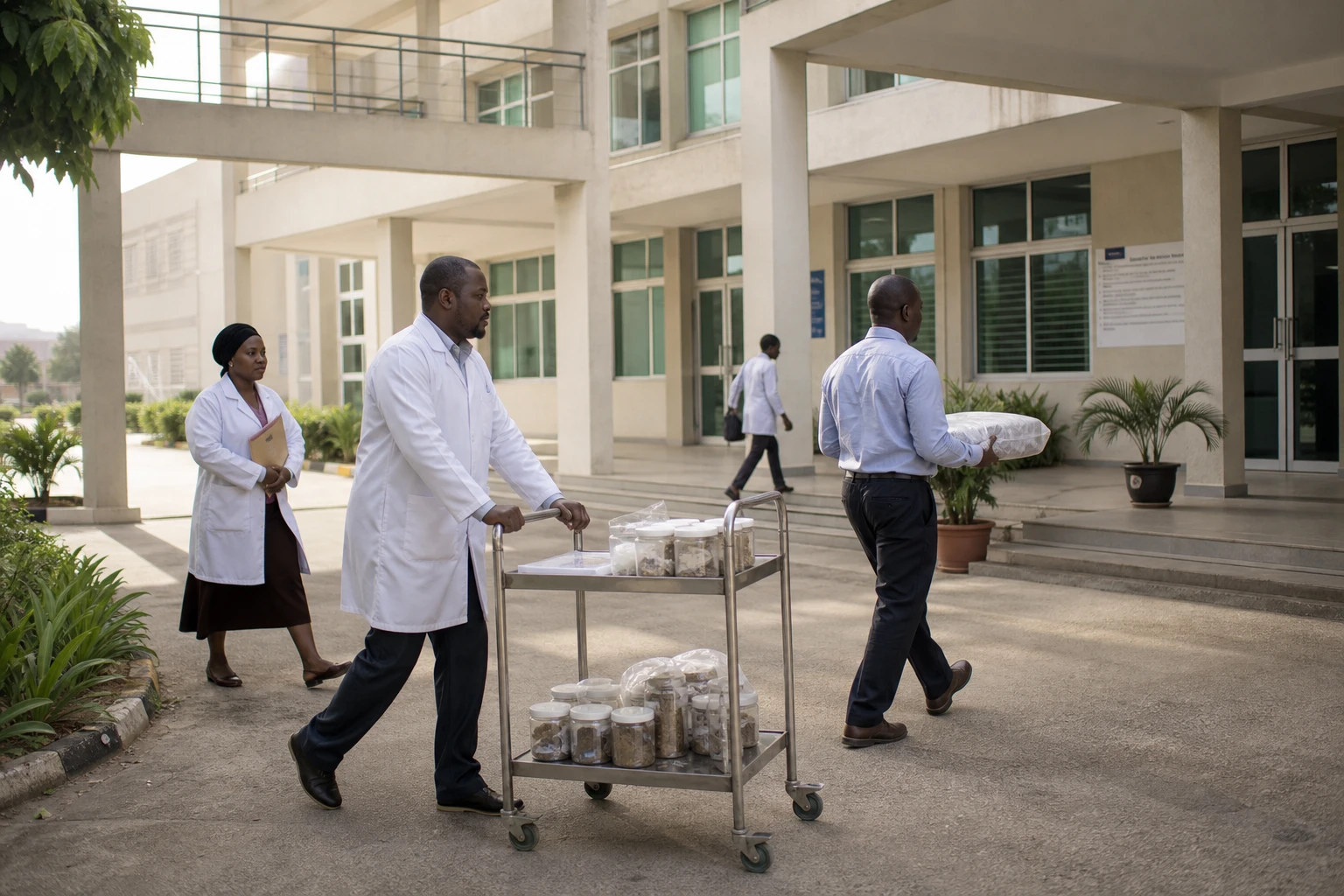
Producing starch is not enough. Drug manufacturers require a raw material that meets precise thresholds for purity, microbiological quality, functionality and traceability. Without these, the input cannot be used in tablets or capsules. ICSAN therefore stresses a central point: close cooperation between processors, laboratories, pharmaceutical manufacturers and regulators is essential if cassava is to meet pharmaceutical standards.
This requirement changes the debate. It shifts the sector from simple agricultural processing towards certification, equipment and quality control. For small-scale processors, that means more investment. For drug manufacturers, it could reduce dependence on imports. For consumers, the impact is more indirect: it concerns the stability of supply and, eventually, the cost of finished products.
Agricultural reform is also reflected in its markets
The pharmaceutical starch initiative is being added to another project already under way in Abuja: cassava-based bioethanol. In January 2026, Nigeria’s Ministry of Budget and Economic Planning announced plans to bring 14 million smallholders into the bioethanol value chain as part of an energy diversification drive. The government is thus talking less about an isolated food crop and more about a range of industrial uses, from food to energy.
This direction is consistent with the longstanding strategy of processing cassava locally. The Central Bank of Nigeria had already noted that the country imported about $600 million worth of cassava derivatives despite being the world’s leading producer. The message is clear: the wealth created should no longer leave the country at the packaging, purification or refining stage.
The issue therefore goes beyond agriculture alone. It concerns the pharmaceutical industry, quality standards, public research and the state’s ability to create a reliable domestic market. In Abuja, this economic policy has taken on symbolic importance: it seeks to show that a country often described in terms of its raw-material exports can also manufacture sophisticated inputs.
A signal for West Africa
The regional significance is real. Across the ECOWAS area, several states are seeking to capture more value from their agricultural output before it is exported. Nigeria’s case matters all the more because the country has one of the sub-region’s largest domestic markets and an industrial ecosystem capable of absorbing a move up the value chain if standards are met.
For other cassava-producing countries in West Africa, the point is not to copy Nigeria but to learn a lesson: value is not found only in yields per hectare. It also lies in industrial uses, laboratories and long-term purchasing contracts. If Abuja manages to stabilise a domestic supply of pharmaceutical starch, the model could inspire other agricultural value chains across the continent.
The next steps will hinge on two concrete milestones: increasing the capacity of the pilot units promised by the NNMDA, and the authorities’ ability to turn announcements into an industrial specification. That, more than declarations, will show whether Nigerian cassava becomes a raw material for sovereignty or remains a promise of diversification.