Algeria
 Egypt
 Libya
 Morocco
 Sudan
 Tunisia
 Benin
 Burkina Faso
 Cabo Verde
 Côte d'Ivoire
 Ghana
 Guinea
 Guinea-Bissau
 Liberia
 Mali
 Mauritania
 Niger
 Nigeria
 Senegal
 Sierra Leone
 The Gambia
 Togo
 Cameroon
 Central African Republic
 Chad
 DR Congo
 Equatorial Guinea
 Gabon
 Republic of the Congo
 São Tomé and Príncipe
 Burundi
 Comoros
 Djibouti
 Eritrea
 Ethiopia
 Kenya
 Madagascar
 Malawi
 Mauritius
 Mozambique
 Rwanda
 Seychelles
 Somalia
 South Sudan
 Tanzania
 Uganda
 Angola
 Botswana
 Eswatini
 Lesotho
 Namibia
 South Africa
 Zimbabwe
An election watched beyond Lusaka
In Zambia, an election is not decided only at polling stations. It also depends on institutions’ ability to secure acceptance of the result, without pressure on election officials, uncontrolled rumours or delays that fuel mistrust. In a country where peaceful transfers of power have long served as a democratic benchmark in southern Africa, every incident weighs heavily on public confidence.
The 2026 presidential election is taking place in Zambia, a country of more than 22 million people, rich in copper and a member of SADC, the Southern African Development Community. The regional mission had already been deployed ahead of the vote, as had the European Union mission, a sign that the election was being closely watched in Lusaka and across the region.
Count halted, then resumed amid tension
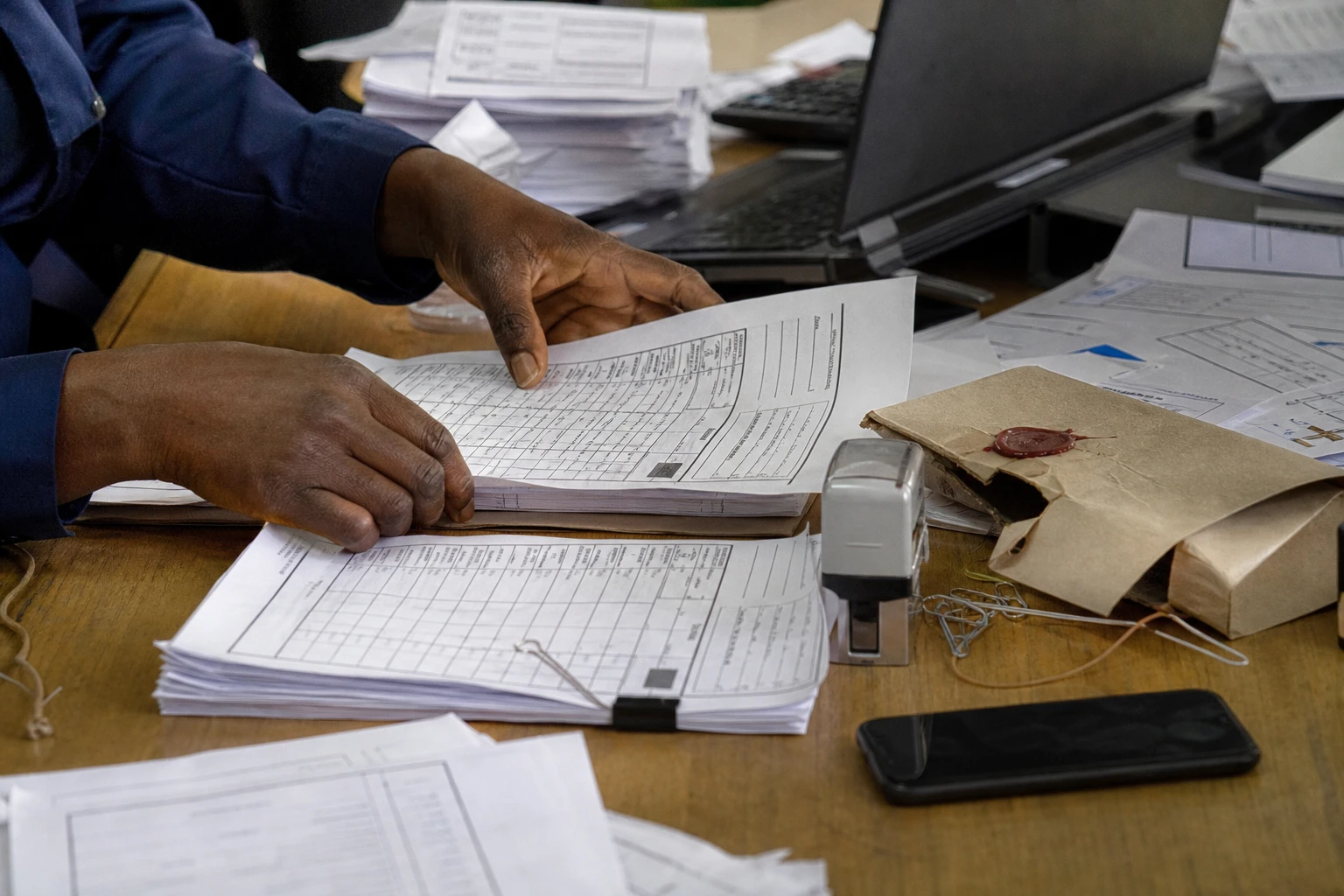
The vote on Thursday 13 August 2026 led to an unusual turn of events. The Electoral Commission of Zambia suspended the count for several hours on Friday after reports of attacks on election officials and suspected theft of ballot papers. The commission later said the security threat had been «contained» and resumed operations.
According to the ECZ, the incident affected only a limited number of polling stations, but it was enough to raise nationwide doubts about the pace of the count. The official timetable calls for the results to be announced on 17 August 2026, explaining the sensitivity around every hour lost in the collation process.
Police, for their part, said they had arrested nine suspects after a 57-year-old election official was killed in an urban area on the outskirts of Lusaka on election day. Police also said the election had been generally peaceful. As is often the case in such situations, accounts and responsibility should remain attributed until they have been fully corroborated.
Regional and international observers urged the parties to moderate their language. The SADC mission said it had recorded, without being able to verify everything, reports of intimidation, assaults, abductions and property damage in several provinces. The European mission, meanwhile, highlighted what it described as a restricted democratic space and the need to publish detailed results polling station by polling station.
A campaign shaped by an uneven balance of power
The political contest pits incumbent President Hakainde Hichilema against Brian Mundubile, an opposition figure and former minister under the previous Patriotic Front system. Hichilema is seeking a second term. For his supporters, Mundubile represents an alternative capable of capitalising on social fatigue caused by the cost of living.
The election is also a test of Hichilema’s first five-year term. Zambia’s economy has returned to growth, but that recovery has not benefited households evenly. The World Bank estimates that 70.7% of the population lived below the $3-a-day poverty line in 2022, and that poverty remains particularly concentrated in rural areas.
In other words, the election is not only about the presidency. It is also about the state’s credibility as an impartial arbiter of political competition, without confusion between public resources and the party machinery. European observers specifically pointed to this blurring of the lines between the state and the ruling party, as well as public media coverage considered highly favourable to the government camp.
This criticism is significant in a country that has presented itself for decades as one of the sub-region’s relatively stable institutional environments. In Zambia, then, the question is not only who wins. It is also on what terms the loser accepts the verdict, and whether citizens still believe that voting can genuinely change the balance of power.
What Zambia tells southern Africa
The significance of these events extends far beyond the capital. SADC has made election observation a major political instrument, precisely because the region has experienced several transitions in which disputes over results spilled beyond the institutional arena. The Zambian case is therefore a signal to other southern African capitals, where the balance between competition, security and transparency remains fragile.
For the European Union and African missions alike, the issue is straightforward: results published clearly and at the right level of detail leave less room for suspicion. The ECZ has already highlighted an official results portal and centralised communication. But an election’s credibility also depends on the speed of publication, the consistency of the figures and candidates’ ability to avoid premature announcements.
Domestically, the episode is a reminder that electoral tensions do not arise only on voting day. They build beforehand, through campaigns, the spread of rumours, restrictions on gatherings and perceptions of unequal treatment between political actors. In June, the ECZ had already intervened in Mazabuka Central to suspend campaign activities over concerns about violence.
Across the continent, Zambia offers a reminder worth considering without alarmism or complacency: a democracy is judged not only by the result at the ballot box, but by the quality of its verification procedures. The next point to watch is clear: publication of the final results, followed by the way any appeals are handled by the competent institutions. That is where the strength of the process is measured in practice.