Algeria
 Egypt
 Libya
 Morocco
 Sudan
 Tunisia
 Benin
 Burkina Faso
 Cabo Verde
 Côte d'Ivoire
 Ghana
 Guinea
 Guinea-Bissau
 Liberia
 Mali
 Mauritania
 Niger
 Nigeria
 Senegal
 Sierra Leone
 The Gambia
 Togo
 Cameroon
 Central African Republic
 Chad
 DR Congo
 Equatorial Guinea
 Gabon
 Republic of the Congo
 São Tomé and Príncipe
 Burundi
 Comoros
 Djibouti
 Eritrea
 Ethiopia
 Madagascar
 Malawi
 Mauritius
 Mozambique
 Rwanda
 Seychelles
 Somalia
 South Sudan
 Tanzania
 Uganda
 Angola
 Botswana
 Eswatini
 Lesotho
 Namibia
 South Africa
 Zambia
 Zimbabwe
When mobility becomes a tangible right
In Kijabe, in central Kenya, a simple idea is taking on very practical significance: a wheelchair must first and foremost be suited to the child, their body and their everyday life. In a country where access to transport, schools and even pavements remains unequal for people with reduced mobility, a well-designed assistive device can change far more than how someone gets around. It can open the door to a classroom, a playground, a trip to hospital, and sometimes a first circle of friends.
Kenya has adopted a legal and institutional framework on disability, but the gap between policy and everyday practice remains clear. Figures most often cited by Kenyan and UN institutions put the number of Kenyans living with a disability at about 900,000, or 2.2% of the population, according to the 2019 census, with a majority living in rural areas. At the same time, ordinary services such as public transport are rarely designed with them in mind.
From locally grown bamboo to the Kijabe workshop
It is in this context that BethanyKids, a paediatric healthcare organisation active in Kenya and other African countries, is expanding its assistive technology programme. The organisation says it uses low-cost imported wheelchairs, 3D-printed prototypes and models made in Africa, in order to better tailor each piece of equipment to the child who needs it. On its website, it says it wants to avoid ill-fitting wheelchairs, often passed down from adults and sometimes dangerous for a young user.
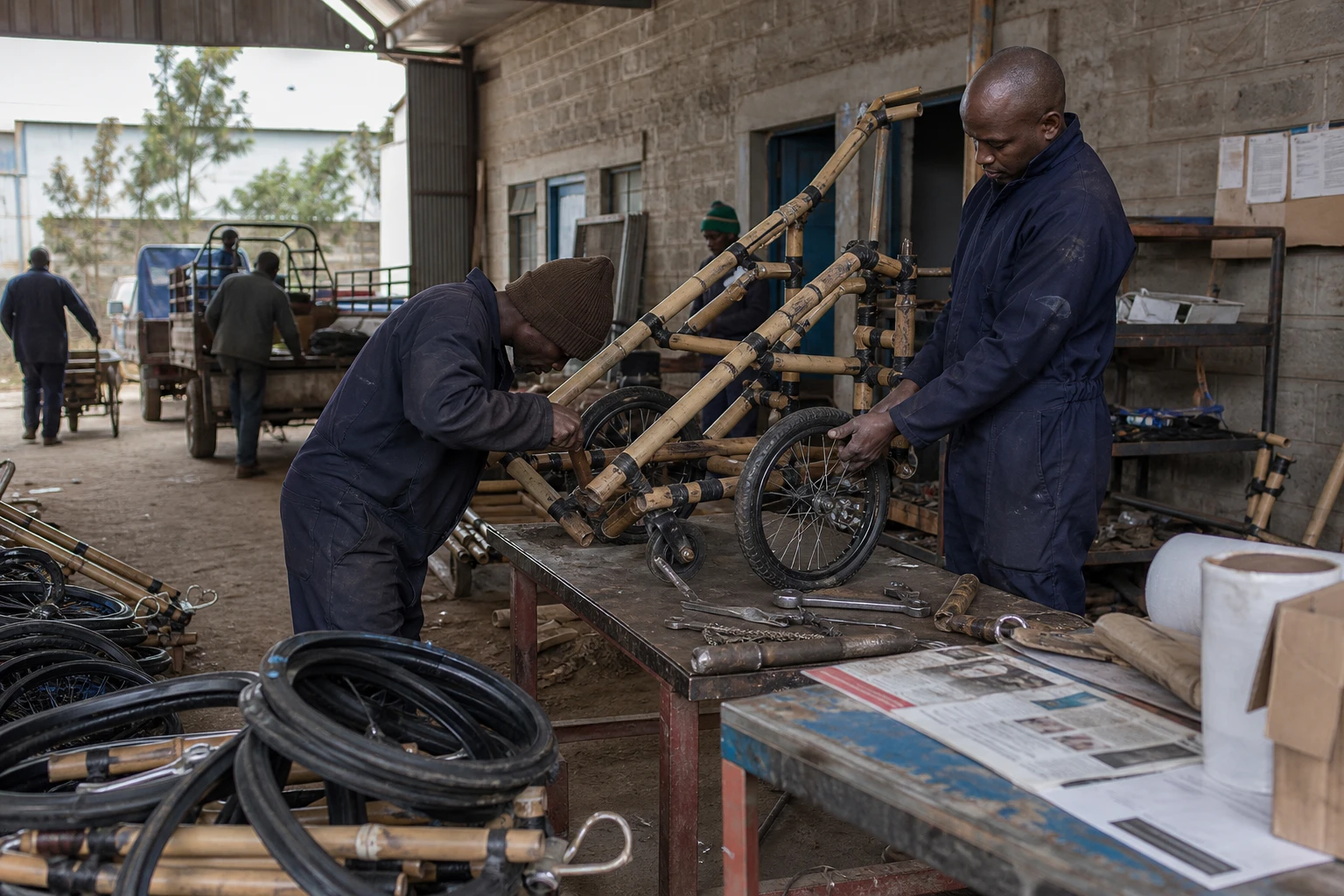
The Kijabe project is also part of a local industrial strategy. BethanyKids says its planned Kenyan centre is to include a wheelchair assembly workshop, with the aim of moving from dependence on imports to production designed in Kenya, and potentially then expanding into Ethiopia and Uganda. This approach reflects a broader trend in East Africa: making products closer to where they are needed, using locally available materials and enabling simpler repairs.
In the latest version of the project reported in July 2026, technicians are using locally grown bamboo to make the frames. The material is described as lightweight, durable and easier to repair than some conventional metal frames. Other components, such as wheels and bearings, also come from local suppliers. The stated goal is clear: cut costs, save time and create a wheelchair truly tailored to a child’s body.
The real barriers: price, weight and poor fit
In Kenya, the problem is not limited to a shortage of wheelchairs. Their price is also an obstacle. BethanyKids estimates that its bamboo prototypes could cost less than 10,000 Kenyan shillings. Imported wheelchairs, by contrast, are often priced at between 45,000 and 80,000 shillings, far beyond the means of many families. Disability thus becomes a matter of household budgets, not just health.
The need is all the more pressing because getting around remains difficult, especially in cities. In Nairobi, minibuses and other forms of public transport do not easily accommodate wheelchairs, owing to the lack of ramps and adaptations. Passengers often have to be carried on board, while their wheelchair is stowed with the luggage. This seemingly routine act sums up a system that remains largely inaccessible.
For children, the stakes are even clearer. A poorly sized wheelchair is not just an obstacle to getting around. It can hinder learning, place a strain on the family, and even worsen some orthopaedic complications if the support is inadequate. BethanyKids’ project is therefore based on a practical observation: paediatric mobility cannot be treated as an adult wheelchair in a smaller size. It requires genuine specialisation.
The Kenya National Commission on Human Rights also notes that people living with disabilities are more numerous in rural areas than in cities, at 2.6% in rural areas compared with 1.4% in urban areas, according to the 2019 census. This means that access to a suitable wheelchair does not depend only on the medical services available in Nairobi. It also depends on roads, repair networks, household incomes and county governments’ ability to connect families with services.
What this innovation says about Kenya and East Africa
The significance of this initiative extends beyond Kenya. In East Africa, where local employment, light industry and inclusive healthcare often feature in public debate, the bamboo wheelchair shows that a useful innovation does not need to be sophisticated to be relevant. Above all, it must be grounded in local needs, repairable and affordable. That is what distinguishes equipment available on paper from a child’s real independence.
This issue also points to a broader continental challenge. UNFPA data for Kenya show that people with disabilities are mostly rural, and that suitable equipment remains in short supply at health facilities. Across Africa, the same question arises: how can healthcare and mobility systems be built that do not leave families alone to cope with the cost of equipment, the shortage of technicians and the lack of urban accessibility?
For now, the bamboo wheelchair in Kijabe remains at the prototype stage. But it already points to a political and social direction: produce locally, tailor carefully, repair quickly and take account of real-world use. In Kenya, this approach could matter as much as the technology itself. For a child, the difference between an imported wheelchair that is too expensive and one made close to home is often the difference between waiting and living normally.