Algeria
 Egypt
 Libya
 Morocco
 Sudan
 Tunisia
 Benin
 Burkina Faso
 Cabo Verde
 Côte d'Ivoire
 Ghana
 Guinea
 Guinea-Bissau
 Liberia
 Mali
 Mauritania
 Niger
 Nigeria
 Senegal
 Sierra Leone
 The Gambia
 Togo
 Cameroon
 Central African Republic
 Chad
 DR Congo
 Equatorial Guinea
 Gabon
 Republic of the Congo
 São Tomé and Príncipe
 Burundi
 Comoros
 Djibouti
 Eritrea
 Ethiopia
 Kenya
 Madagascar
 Malawi
 Mauritius
 Mozambique
 Rwanda
 Seychelles
 Somalia
 South Sudan
 Tanzania
 Uganda
 Angola
 Botswana
 Eswatini
 Lesotho
 Namibia
 South Africa
 Zambia
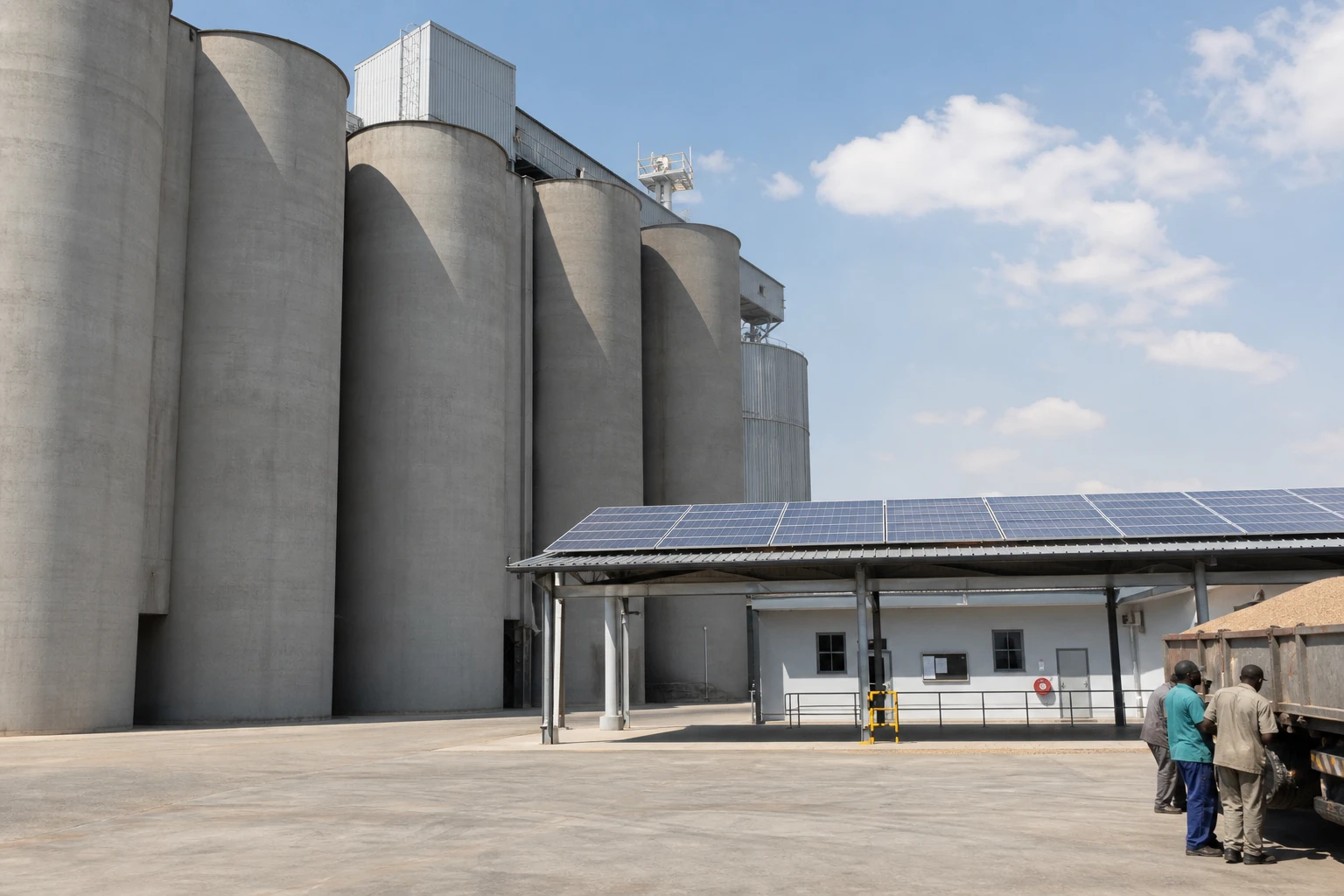
Silos to withstand increasingly volatile seasons
In Harare, the question is not only how to produce more maize. It is also where to store it, how to keep it for longer and how to get it to areas facing shortages at critical moments. In a country where maize remains the staple food, storage has become a food security policy as well as a tool for social stability.
For several years, Zimbabwe has pursued a broader climate resilience strategy. Vision 2030, the national development framework, and the agricultural strategy revised after the El Niño-related drought have emphasised irrigation, strategic reserves and the modernisation of public depots. The country is also a member of SADC, the Southern African Development Community, where climate shocks repeatedly affect the same regional grain supply chains.
Harare’s stated target
The Zimbabwean government is aiming for national grain storage capacity of 1.5 million metric tonnes by 2030. This target has already been included in agricultural planning documents and reiterated in official food security communications. It marks a step change from the capacity of about 750,000 tonnes cited in the Agriculture Ministry’s strategic planning work.
The strategy’s core is the national strategic reserve. The Agriculture Ministry has said it is working to build stocks of 450,000 tonnes by the end of 2026, with 300,000 tonnes to be acquired quickly and 150,000 tonnes expected from the wheat harvest. The authorities also want to deploy solar-powered silos, designed to preserve grain for up to five years and to be located close to areas of consumption, not only in producing regions.
This approach is part of a wider effort to modernise the Grain Marketing Board’s depots. The state agency is responsible for grain storage and marketing. The authorities are now linking storage, transport, energy and supply security. Politically, this amounts to treating grain as critical infrastructure, on a par with a road network or a dam.
A response born of drought
The project’s significance is clear in light of the 2024 drought. The FAO recalled that Zimbabwe declared the 2023-2024 agricultural season a national disaster after the El Niño episode. The United Nations and the World Food Programme, for their part, highlighted the scale of food insecurity and assistance needs in the country.
Zimbabwean authorities say they distributed 328,000 tonnes of grain to 6.5 million people and 33,000 tonnes to 4.5 million pupils through school feeding during this period. These figures, cited by the government, illustrate a central point: when the harvest falls, demand on public reserves surges quickly, and logistics become a major political factor.
The memory of this crisis also explains the desire to move stocks to non-producing areas. The reasoning is simple: if transport disruption, pockets of deficit and rising prices are concentrated in certain provinces, more needs to be stored closer to vulnerable markets. In a country where the movement of food shapes daily life in both urban and rural areas, storage is not a technical detail. It is a buffer.
Better harvests, but food security remains uneven
The government’s message also draws on a recent improvement in volumes. According to official data published in late July 2026, the area planted with maize stood at 1.96 million hectares, compared with 1.81 million a year earlier. Production is said to have risen from 2.20 million to 2.68 million metric tonnes, an increase of 17.1%. Other public assessments put total cereal production at close to 2.7 million tonnes for the 2025/2026 season.
But this progress has not eliminated regional disparities. FEWS NET says maize prices fell after the harvest in several areas, while remaining high in deficit districts and remote areas. The organisation still expects food stress in these areas through September 2026. In other words, a good national season does not automatically resolve imbalances between provinces or the vulnerability of households dependent on markets.
Zimbabwean agricultural production therefore remains caught between two realities. On the one hand, better-watered farming areas and major production zones are recording stronger results. On the other, the most exposed households, particularly in the south and west of the country, continue to bear the cost of grain, erratic rainfall and incomes too low to absorb shocks. Public storage is intended specifically to narrow this gap.
A signal for Southern Africa
Beyond Zimbabwe, the issue resonates across Southern Africa. The 2024 drought affected several SADC countries, and national responses highlighted the same lesson: producing more is not enough if grain cannot be stored, moved and released at the right time. In a region regularly exposed to El Niño, silos, strategic reserves and market-monitoring systems are becoming instruments of food sovereignty.
For Harare, the immediate challenge is now twofold. It must achieve the planned increase in capacity by 2030, while also turning stocks into an operational tool in the coming agricultural cycles. The next season, wheat purchases, the condition of Grain Marketing Board depots and any imports will therefore remain indicators to watch closely. The test will not only be the volume stored, but the state’s actual ability to cushion another climate shock without allowing prices to become destabilised.