Algeria
 Egypt
 Libya
 Morocco
 Tunisia
 Benin
 Burkina Faso
 Cabo Verde
 Côte d'Ivoire
 Ghana
 Guinea
 Guinea-Bissau
 Liberia
 Mali
 Mauritania
 Niger
 Nigeria
 Senegal
 Sierra Leone
 The Gambia
 Togo
 Cameroon
 Central African Republic
 Chad
 DR Congo
 Equatorial Guinea
 Gabon
 Republic of the Congo
 São Tomé and Príncipe
 Burundi
 Comoros
 Djibouti
 Eritrea
 Ethiopia
 Kenya
 Madagascar
 Malawi
 Mauritius
 Mozambique
 Rwanda
 Seychelles
 Somalia
 South Sudan
 Tanzania
 Uganda
 Angola
 Botswana
 Eswatini
 Lesotho
 Namibia
 South Africa
 Zambia
 Zimbabwe
When a defection weighs more than a simple headcount
In Sudan, leaving an armed militia is never just an individual act. In a war that has shattered alliances since April 2023, every departure says something about fighter fatigue, internal rivalries and the balance of power on the ground. And when men leave with their heavy weapons, it is no mere logistical detail: it is a sign that the chain of command is cracking.
This shift comes as the war continues to pit the Sudanese Armed Forces, based in Port Sudan since losing Khartoum, against the Rapid Support Forces, which retain a strong presence in Darfur and several areas of Kordofan. The front line now divides the country into shifting blocs, while the African Union and IGAD, the regional organisation for the Horn of Africa, continue to call for a political settlement involving Sudanese civilians.
What is known about the defection
The specific incident reported in Khartoum is the departure of 45 Rapid Support Forces fighters with their heavy weapons. The information circulated amid a growing number of defections by former RSF officials, including figures who have already joined the army or distanced themselves from the paramilitary hierarchy. Several recent cases show that these breaks are not merely symbolic: they can involve armed groups, vehicles and military expertise useful to the Sudanese army.
This development did not come out of nowhere. In April and then May 2026, several RSF officials defected, some saying they opposed the way the war was being conducted, others explaining that they had been sidelined by their own camp. One, described as a senior field commander, joined the Sudanese army with a substantial number of men and equipment. Another publicly announced his break with the group, then went on to say he intended to fight alongside the army. These departures show a simple reality: the RSF remains powerful, but no longer operates as a cohesive bloc.
At this stage, no independent evidence allows the tactical details of each defection to be verified beyond doubt. The broader trend, however, is confirmed by several sources: the withdrawal of officials, fighters moving from one side to the other, and the army’s efforts to take advantage of these divisions. That is why a defection by 45 men carries political significance beyond the size of the group alone.
Internal divisions are changing the war
For the Sudanese army, these defections offer a double benefit. First, they bolster a narrative of reconquest and national legitimacy. Second, they strengthen, sometimes in very concrete terms, its fighting capacity along certain routes in Kordofan, Khartoum or the outskirts of Darfur. In a conflict where drones, convoys and supply lines matter as much as capturing a city, gaining trained and equipped men can alter the local military balance.
For the RSF, the cost is different but just as heavy. The group was built on wartime discipline, tribal loyalties and cross-border supply networks. Yet several analysts now point to clan tensions, command rivalries and an eroding combatant base. Successive departures suggest that military pressure, territorial losses and disagreements over the distribution of power in conquered areas are weakening the movement’s hard core.
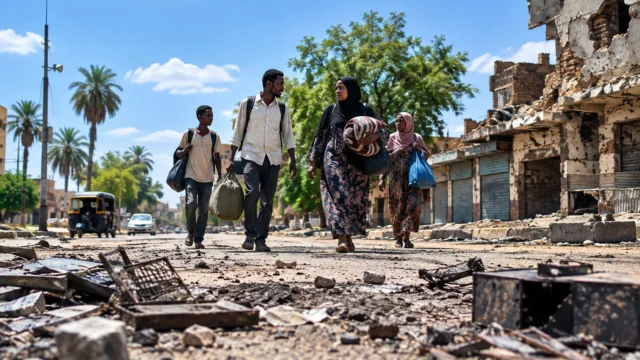
For Sudan’s population, these shifts do not mean peace. They often mean a more unpredictable war. Civilians remain caught between the lines, facing mass displacement, service disruptions and chronic insecurity. The African Union says the crisis has already caused a major humanitarian catastrophe, with millions displaced within the country and beyond its borders. The IOM, the UN migration agency, estimated in early 2026 that about 8.9 million people were displaced inside Sudan, while the crisis had already driven millions more to neighbouring countries.
In cities such as Khartoum, the military dynamic becomes clear very quickly. A defection strengthens the side that receives the men and fuels the sense that a shift is under way. In peripheral regions, especially Darfur and Kordofan, the impact is measured differently: control of roads, market security, access to healthcare, and the movement of fuel and wheat. In other words, this kind of defection signals less a final victory than a war being reshaped in fragments.
Sudanese, regional and African implications
Sudan is not simply embroiled in an internal war. Its conflict is destabilising north-east Africa and the Horn of Africa as a whole, affecting Chad, South Sudan, the Central African Republic, Egypt and the Red Sea. IGAD and the African Union have repeatedly called for a political way out, but the immediate priority remains preventing the complete collapse of civilian structures and curbing the regionalisation of the conflict.
African institutions now describe a crisis that threatens regional stability and humanitarian law. The African Commission on Human and Peoples’ Rights and the joint UN-AU fact-finding mission recalled in April 2026 that both sides had committed serious violations, in a conflict marked by systematic brutality and persistent impunity. This perspective is essential: in Sudan, the debate is not between a “good” side and a “bad” side, but between two war machines whose internal shifts are prolonging civilians’ ordeal.
What happens next will depend on two fronts. First, the army’s actual ability to absorb these defections without creating new parallel militias. Second, the RSF’s response: it could seek to make up for the losses through tougher mobilisation in Darfur and Kordofan. Across the continent, Sudan remains a major test for African diplomacy: if military divisions continue to outweigh negotiations, the war risks becoming a protracted conflict at the heart of north-east Africa.