Algeria
 Egypt
 Libya
 Morocco
 Tunisia
 Benin
 Burkina Faso
 Cabo Verde
 Côte d'Ivoire
 Ghana
 Guinea
 Guinea-Bissau
 Liberia
 Mali
 Mauritania
 Niger
 Nigeria
 Senegal
 Sierra Leone
 The Gambia
 Togo
 Cameroon
 Central African Republic
 Chad
 DR Congo
 Equatorial Guinea
 Gabon
 Republic of the Congo
 São Tomé and Príncipe
 Burundi
 Comoros
 Djibouti
 Eritrea
 Ethiopia
 Kenya
 Madagascar
 Malawi
 Mauritius
 Mozambique
 Rwanda
 Seychelles
 Somalia
 South Sudan
 Tanzania
 Uganda
 Angola
 Botswana
 Eswatini
 Lesotho
 Namibia
 South Africa
 Zambia
 Zimbabwe
A war sustained far from the front line
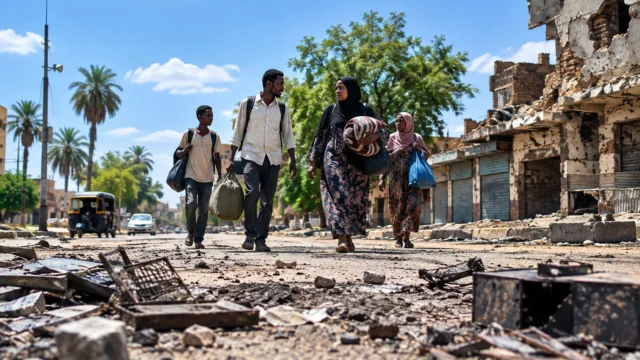
In eastern and western Sudan, the war is no longer confined to visible front lines. It also runs through secondary airstrips, shell companies and logistics networks flexible enough to evade checks. In Sudan, this military back office has a direct bearing on the duration of the conflict, the flow of aid and the state’s ability to regain control from its capital, Khartoum.
The latest dossier shows just how far the conflict in Sudan extends beyond national borders. It links civilian aircraft, foreign personnel and transnational business networks to the war effort of the Rapid Support Forces, or RSF, the paramilitary group fighting the Sudanese army since April 2023. The RSF still controls several areas and continues to fuel a fragmented balance of power spanning Darfur, Kordofan and the Khartoum region.
What the new UN cross-checking reveals
The Security Council and the panel of experts on Sudan describe a system for circumventing the arms embargo. The text made public by the United Nations recalls that sanctions on Sudan still include measures on arms, assets and travel, and that states must prevent direct or indirect transfers to armed groups. In this context, the UN investigation reports the use of three Boeing 727s linked to companies associated with Steven Shaulis, a former US serviceman who became head of a logistics and security services group.
According to this evidence, two aircraft may have been acquired through a Shaulis company in South Africa, followed by a third in Brazil. The three planes were reportedly first registered in N’Djamena, Chad, before departing for Sudan in September 2024. The experts say they found no official record of the aircraft moving thereafter, which they interpret as a concealment strategy to avoid detection during flights. This is a significant allegation, attributed at this stage to the UN report and not a judicial conviction.
The dossier also raises a second sensitive issue: the presence of 1,500 to 2,000 Colombian mercenaries alongside the RSF. This estimate is consistent with other United Nations documents, which since 2025 have described the arrival of Colombian fighters in Darfur and their role in training, drone operations and tactical support. Here again, the issue is not only the number, but the method: the conflict in Sudan is opening up to mercenary networks moving between several theatres in Africa and the Middle East.
Why this case goes beyond the RSF alone
Sudan is already at the heart of a regional crisis. Since April 2023, fighting has displaced millions of people, destroyed civilian infrastructure and triggered humanitarian tensions spilling over into Chad, South Sudan, Libya and the Red Sea. The UN has repeatedly warned of the growing use of armed drones and the geographical spread of hostilities, including around Khartoum. This makes clandestine air routes all the more crucial, as they fuel the war even when the front appears frozen.
In this context, Chad’s role is a particular concern. N’Djamena lies at the crossroads of several regional flows, and the initial registration of aircraft in the Chadian capital illustrates the porous nature of controls in an expanded war zone. This does not mean that the Chadian state is automatically involved in the reported operations, but it shows that air surveillance and customs systems across the Sahel and the Sahel-Sudan belt remain vulnerable to cross-border arrangements.
The dossier also touches on the accountability of private intermediaries. A former special forces soldier, a company registered in Singapore, subsidiaries operating in several jurisdictions and public contracts secured in the United States form an ecosystem now familiar in contemporary wars. The investigation’s importance lies not only in naming a network; it also shows how commercial actors can prolong a war despite a legal framework intended to constrain it.
What this means for Khartoum, Darfur and the region
For the Sudanese, the consequences are tangible. The more supply routes the RSF can find, the longer the war lasts. The longer it lasts, the more civilians remain caught between bombardments, sieges and forced displacement. Cities remain exposed, but rural areas often pay an even higher price, as they receive displaced people without the same services or institutional protection. In Khartoum, a political recovery seems ever more distant as long as military flows remain active beyond public view.
Across the continent, the case is a reminder of a simple reality: African embargoes are effective only if states, transit platforms, airlines, registries and banks genuinely co-operate. Sudan is not sealed off from the world. Its wartime networks cross southern Africa, east Africa, Chad and more distant commercial hubs. This is also why the African Union, Sudan’s neighbours and the United Nations are closely monitoring routes supplying the belligerents: every consolidated link in the logistics chain makes de-escalation more difficult.
The next point to watch is the full publication of the UN report, announced for September 2026, as well as any judicial, diplomatic or sanctions-related follow-up. For Sudan, the issue is not abstract. It bears on the very possibility of breaking the supply chains that prolong the war and reopening a political horizon from Khartoum to the country’s battered peripheries.