Algeria
 Egypt
 Libya
 Morocco
 Sudan
 Tunisia
 Benin
 Burkina Faso
 Cabo Verde
 Côte d'Ivoire
 Ghana
 Guinea
 Guinea-Bissau
 Liberia
 Mali
 Mauritania
 Niger
 Nigeria
 Senegal
 Sierra Leone
 The Gambia
 Togo
 Cameroon
 Central African Republic
 Chad
 DR Congo
 Equatorial Guinea
 Gabon
 Republic of the Congo
 São Tomé and Príncipe
 Burundi
 Comoros
 Djibouti
 Eritrea
 Ethiopia
 Kenya
 Madagascar
 Malawi
 Mauritius
 Mozambique
 Rwanda
 Seychelles
 Somalia
 South Sudan
 Tanzania
 Uganda
 Angola
 Botswana
 Eswatini
 Lesotho
 Namibia
 Zambia
 Zimbabwe
When the border becomes a political test
In South Africa, migration is no longer just an administrative issue. It has become a test of the state’s capacity, a source of social tension and a marker of the economy’s condition. In Pretoria, the government wants to show it can regain control of borders, deportations and fraud networks, while avoiding a debate that turns into a witch-hunt against foreigners. The current phase is unfolding in a sensitive context, in which protests against irregular migrants have prompted the executive to set out a five-part plan, presented by President Cyril Ramaphosa on 7 June 2026.
The issue extends well beyond government offices in Pretoria. It also affects the Southern African Development Community, SADC, because the flows concerned originate chiefly in neighbouring countries such as Malawi, Zimbabwe, Mozambique and Lesotho. Finally, it concerns the African Union, where violence against African nationals in South Africa has already taken on a diplomatic dimension. In other words, a domestic policing decision can quickly become a regional issue.
Figures released by the South African government
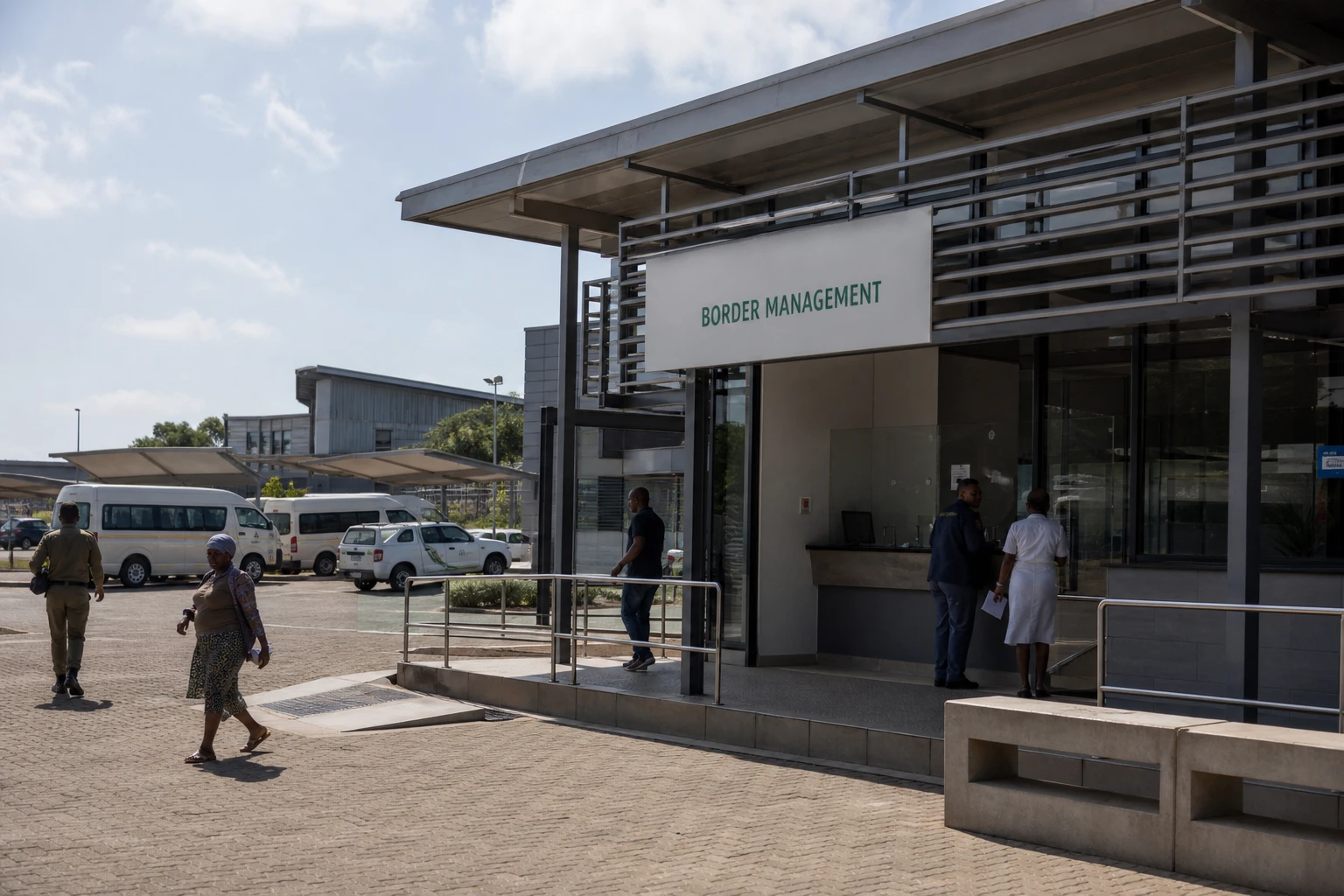
On 26 July 2026, South Africa’s Department of Justice and Correctional Services, through the inter-ministerial committee on migration, announced that the Border Management Authority had carried out 72,906 repatriations between 7 June and 14 July 2026. The same statement said the returns involved various nationalities, with a significant share of nationals from Malawi, Zimbabwe and Mozambique. The government also said that more than 68,000 people had passed through the Temporary Repatriation Processing Centre in Musina between 14 June and 24 July.
The same update highlighted 93 joint operations carried out since April against cross-border trafficking networks. Pretoria presents these actions as an expansion of its enforcement toolkit, with increased investment in infrastructure, surveillance and border identification. The executive says it wants to build a “modern and integrated” system capable of protecting national sovereignty without obstructing the legitimate movement of people and goods. That wording matters. It shows that South Africa’s government is seeking to reconcile security, trade and domestic political pressure.
The five-point plan announced in early June covers faster deportations of irregular migrants, stronger borders, tackling corruption in the migration system, modernising identification systems and reviewing the legal framework on immigration and employment. The government says the first results are visible, but also acknowledges that capacity remains under strain. This is central: South Africa does not just lack laws. It still has to make administrations, ports of entry, courts and inspection services work effectively, and their capacity varies across provinces.
Social pressure, a fragile economy and a political tightrope
The current crackdown cannot be understood without the social climate. For several weeks, the March and March movement has organised demonstrations in several major cities calling for stricter enforcement of immigration laws. Its activists accuse irregular migrants of fuelling crime, putting pressure on public services and worsening the economic crisis. The government, meanwhile, emphasises the rule of law and the fact that constitutional rights also apply to children and people with complex immigration status. The official line is clear: tighter controls, but no break with constitutional principles.
The debate is taking place against a backdrop of sluggish economic growth. The World Bank expects South Africa’s growth to strengthen in 2026, but remain too weak to significantly improve employment and poverty levels. Stats SA, for its part, reported an official unemployment rate of 32.7% in the first quarter of 2026, up from 31.4% in the previous quarter. In a country where access to formal work remains difficult, migrants can easily become a politicised issue, particularly in sectors dominated by informal work, subcontracting and competition for modest incomes.
This is where the migration question becomes most delicate. In poorer neighbourhoods, it is intertwined with transport costs, the cost of living, youth unemployment and a sense that some public services have been abandoned. In border areas, it also affects customs, police posts, transport companies and small businesses that rely on cross-border traffic. For the South African state, the challenge is therefore twofold: to demonstrate effectiveness without giving the impression that deportation alone can resolve the social crisis.
A South African issue, but also an African one
The continental implications are immediate. Malawi, Zimbabwe and Mozambique are directly affected, as they are among the main nationalities cited in the announced returns. Reactions from several African capitals also show that the issue has moved beyond policing. Ghana and Nigeria have pressed for it to be included on the agenda of a debate at the African Union, citing Afrophobia and repeated violence against African nationals in South Africa. Pretoria, for its part, says it is ready to discuss the issue in regional and continental forums, including through SADC, the AU and bilateral relations.
This episode is a reminder of a reality that is often underestimated: African migration is primarily within Africa. It crosses neighbouring borders, trade corridors and regional labour markets. When South Africa tightens its controls, the balance across southern Africa also shifts. In the short term, attention will focus on the implementation of the government plan, the actual deportation figures, the ability of courts and border services to keep pace, and the evolution of diplomatic tensions with countries of origin. In the longer term, the question will remain the same: how to manage mobility without further weakening a regional space where workers, traders and families already move between economic interdependence and political borders.