
 Algeria
 Egypt
 Libya
 Morocco
 Sudan
 Tunisia
 Benin
 Burkina Faso
 Cabo Verde
 Côte d'Ivoire
 Ghana
 Guinea
 Guinea-Bissau
 Liberia
 Mali
 Mauritania
 Niger
 Senegal
 Sierra Leone
 The Gambia
 Togo
 Cameroon
 Central African Republic
 Chad
 DR Congo
 Equatorial Guinea
 Gabon
 Republic of the Congo
 São Tomé and Príncipe
 Burundi
 Comoros
 Djibouti
 Eritrea
 Ethiopia
 Kenya
 Madagascar
 Malawi
 Mauritius
 Mozambique
 Rwanda
 Seychelles
 Somalia
 South Sudan
 Tanzania
 Uganda
 Angola
 Botswana
 Eswatini
 Lesotho
 Namibia
 South Africa
 Zambia
 Zimbabwe
When Southwest forests become capture zones
In southwestern Nigeria, the boundary between a trade route, a wooded area and a criminal hideout has become more fragile than it might seem. What is unfolding in Ogun State and, a month later, in Oyo State is not just a matter for drug enforcement: it is also about Nigeria’s ability to prevent transnational networks from turning its territory into an industrial site for clandestine production.
The case is revealing of a regional shift. West Africa is no longer merely a transit corridor for drugs from elsewhere. It is now attracting groups capable of manufacturing, storing and redistributing synthetic drugs there. Dense forests, the mobility of local networks, porous borders and the easy movement of chemical precursors create a favourable environment for these operations.
What Nigerian authorities uncovered
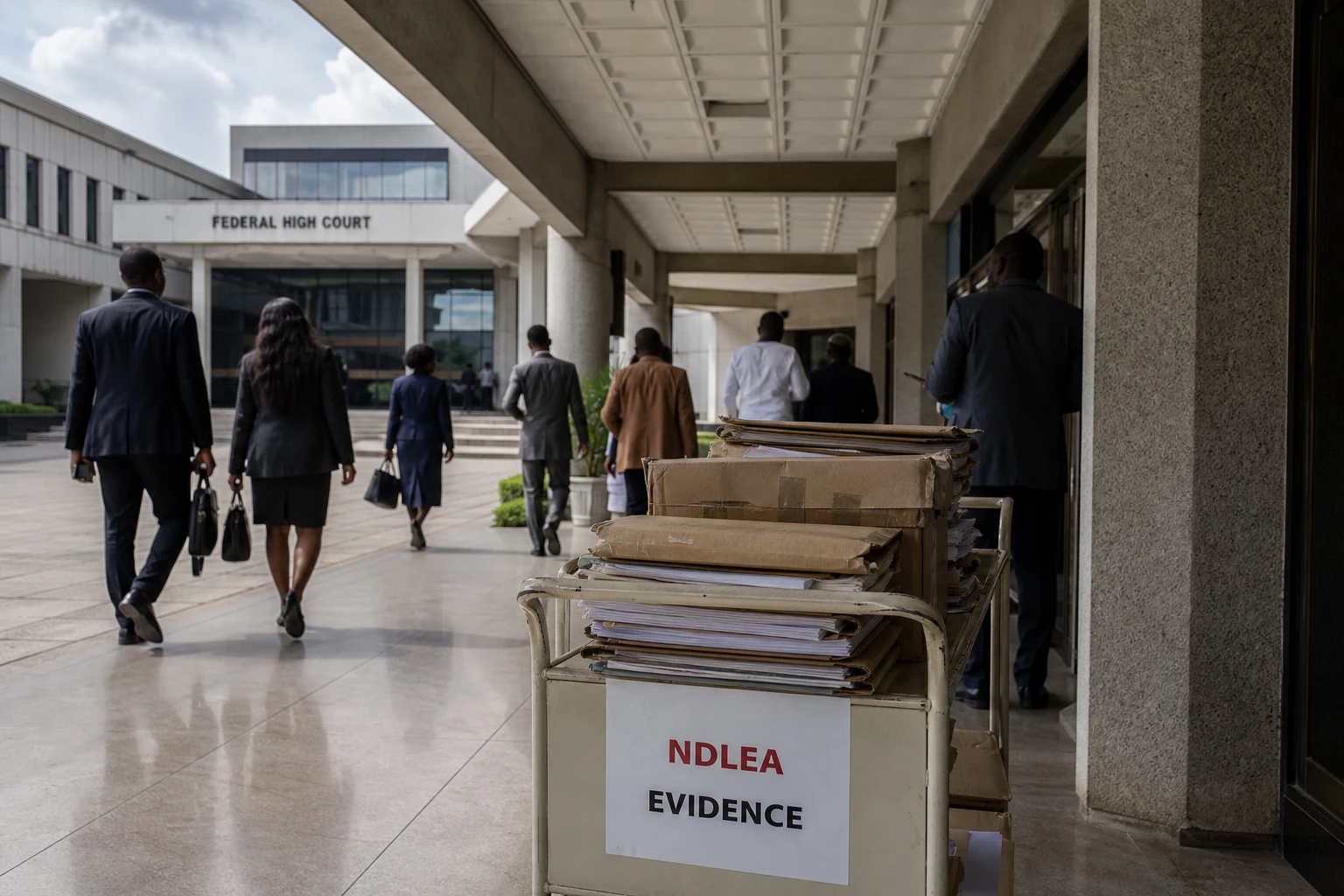
In Nigeria, the case took on an unprecedented scale in May 2026, when the National Drug Law Enforcement Agency, the NDLEA, dismantled a clandestine laboratory described as the largest ever discovered in the country. According to the agency, 2,419.48 kilograms of methamphetamine were seized, worth more than 480 billion naira on the international market. Three Mexican nationals and six Nigerians were subsequently brought before the federal court in Lagos, presided over by Judge Musa Kakaki.
The proceedings themselves say much about the shock caused by the case. The hearing was held close to the site, in the heart of Ogun State, so the court could see the scale of the operation uncovered. A few weeks later, on 17 June 2026, the NDLEA announced another industrial laboratory in a forest in Oyo State, which it described as being operated by a Nigerian-Mexican cartel. This succession of raids suggests an attempt to establish a lasting presence, rather than a single isolated episode.
Nigerian authorities also say they have observed a recurring pattern of establishment: remote areas, local protection, chemists from Mexico and well-established logistics networks. The NDLEA has long argued that traffickers are now targeting not only transit, but also local production.
Why methamphetamine changes the equation
Methamphetamine, sometimes called “ice” on the ground, is not like cocaine or heroin, which depend on specific crops and identifiable agricultural supply chains. It is a synthetic drug. It can be produced wherever chemicals, expertise and a degree of isolation are available. This flexibility explains its appeal to criminal networks, as well as its health risks.
In Abuja, anti-drug officials stress a simple point: the closer production is to markets, the higher the margins and the harder it is to monitor. The NDLEA also says traffickers are seeking to cut costs by producing closer to transatlantic shipping routes and Asian or European markets. West Africa offers precisely this combination of markets, discretion and connectivity.
For Nigeria, the risk is twofold. On the one hand, there is an already substantial domestic market. The first major national survey on drug use, published in 2019 using data from 2017, estimated the annual prevalence of drug use in the country at 14.4%, or 14.3 million people aged 15 to 64. On the other, Nigeria’s geographical position makes it a natural crossroads between the Gulf of Guinea, the Sahel and the Atlantic.
This public health reality is not marginal. The same report notes that men use drugs more, but that problematic use cuts across society. In several southern areas, observed rates were higher than in the North. In other words, domestic demand cannot be treated as a mere side effect of trafficking. It is part of the problem.
A regional challenge, not just Nigeria’s
The Nigerian case forms part of a broader trend documented by the United Nations: West and Central Africa have become more visible sites for the production and movement of illicit drugs, particularly because of porous borders and uneven enforcement capacity. The UNODC also notes that the region has already served as a base for other criminal markets, from cocaine trafficking to counterfeiting networks.
ECOWAS, the Economic Community of West African States, therefore faces a challenge that is both familiar and new. Familiar, because drug trafficking remains linked to governance weaknesses, maritime flows and land borders. New, because industrial methamphetamine production requires chemical expertise, imports of precursors and more specialised criminal partnerships.
At the continental level, the case also reveals a shift in Mexican cartels’ operations. US authorities and UN agencies have for several years described the growing internationalisation of clandestine laboratories, with operations in Southern Africa, East Africa and, increasingly, West Africa. The balance of power is changing: Mexican groups bring the formula, while local networks bring knowledge of the terrain.
For Nigeria, the immediate challenge is judicial and security-related. But it is also institutional. The NDLEA stepped up operations, seizures and stock destructions in 2025 and 2026, indicating increased pressure on trafficking networks. A broader question remains: can this intensification slow a market that is constantly reshaping itself, or will it merely push it into other states in the subregion? A decisive part of West Africa’s drug-fighting battle is now being played out there.



