Algeria
 Egypt
 Libya
 Morocco
 Sudan
 Tunisia
 Benin
 Burkina Faso
 Cabo Verde
 Côte d'Ivoire
 Ghana
 Guinea
 Guinea-Bissau
 Liberia
 Mali
 Mauritania
 Niger
 Nigeria
 Senegal
 Sierra Leone
 The Gambia
 Togo
 Cameroon
 Central African Republic
 DR Congo
 Equatorial Guinea
 Gabon
 Republic of the Congo
 São Tomé and Príncipe
 Burundi
 Comoros
 Djibouti
 Eritrea
 Ethiopia
 Kenya
 Madagascar
 Malawi
 Mauritius
 Mozambique
 Rwanda
 Seychelles
 Somalia
 South Sudan
 Tanzania
 Uganda
 Angola
 Botswana
 Eswatini
 Lesotho
 Namibia
 South Africa
 Zambia
 Zimbabwe
A Sunday race, but above all a test of cohesion
In N’Djamena, it was about more than the clock. For a few hours, the main thoroughfares of Chad’s capital became a racecourse for a half-marathon presented as a gesture towards peace, in a country where stability remains a daily topic of conversation. About 754 runners took part in the first edition of the International Peace Half-Marathon, including athletes from several African countries; the French-language version of the event also refers to 17 nationalities represented.
The choice of sport is no coincidence. It speaks to a large, urban and mobile youth population, and to a city seeking to maintain spaces for people to meet at a time when security concerns, political tensions and regional pressures continue to weigh on everyday life. In N’Djamena, the symbolic dimension matters as much as the organisation. The race started outside Idriss-Mahamat-Ouya Stadium, under the patronage of the Ministry of Youth and Sports, in the presence of public officials and diplomatic representatives.
Chad between political reconstruction and a tense regional environment
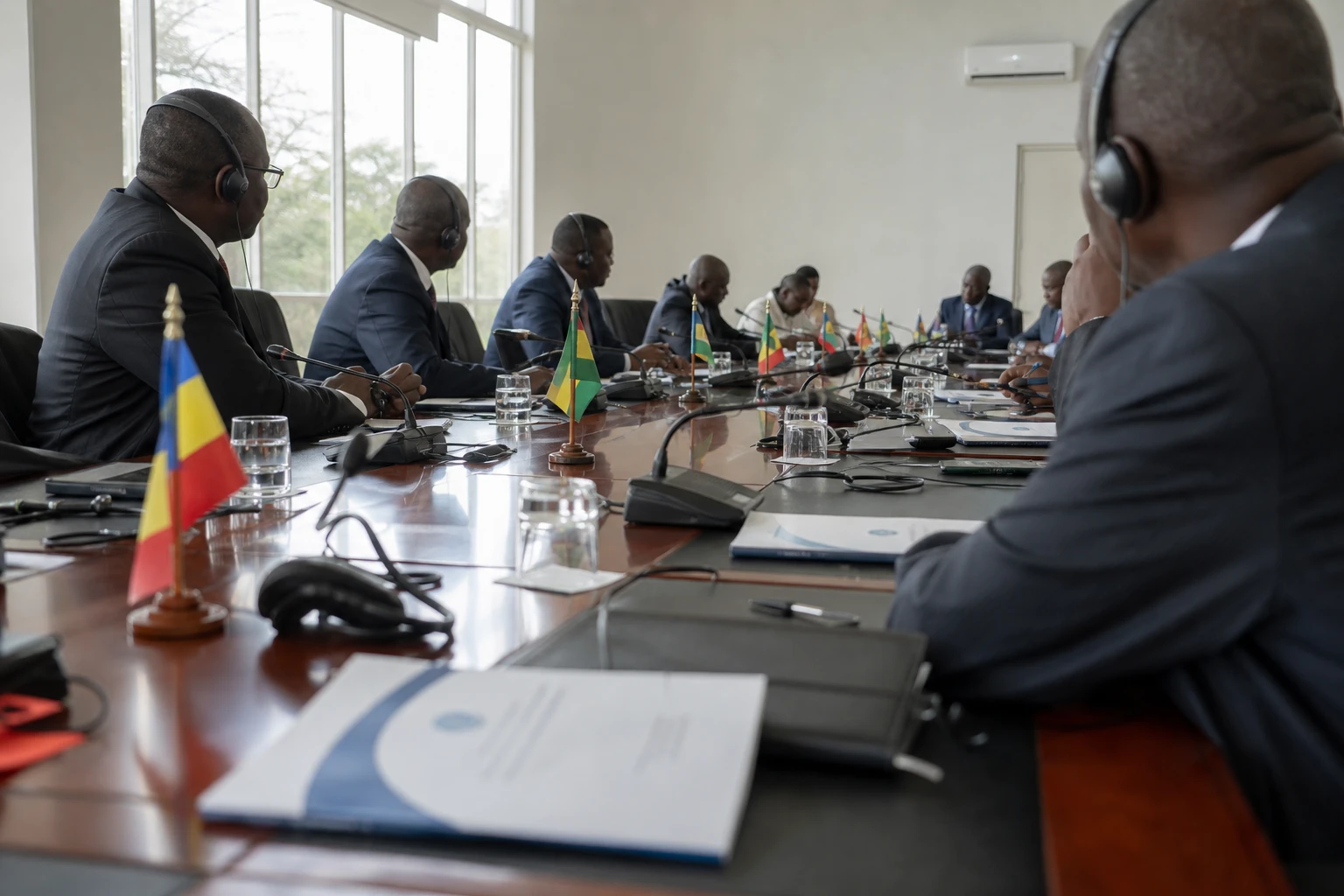
The context helps explain why a half-marathon can become a political message without being a rally. Chad is a member of CEMAC, the Economic and Monetary Community of Central Africa, an integration bloc comprising six states in the sub-region: Cameroon, the Central African Republic, the Republic of the Congo, Gabon, Equatorial Guinea and Chad. Within this bloc, the movement of people and regional openness remain practical concerns, particularly for a crossroads country such as Chad.
But N’Djamena also faces the constraints of a fragile neighbourhood. The United Nations has noted that the conflict in Sudan continues to have a direct impact on Chad, with pressure on its eastern border and humanitarian operations sometimes disrupted by insecurity. The World Bank, for its part, says Chad was already hosting hundreds of thousands of refugees and remains one of the region’s main host countries, adding to local pressures, from social services to informal employment.
In this context, peace initiatives serve a dual purpose. They offer reassurance at home. They also project an image abroad of a country seeking to remain a hub of stability in Central Africa, at a time when the region’s capitals are watching every sign of institutional consolidation or political fragility.
What this half-marathon really says
On purely sporting grounds, runners from the Horn of Africa took the honours. The Arabic-language version of the local news agency reports that Djiboutian Adin Waberi Drar won the men’s 21.1km race in 1:02:51, ahead of Kenyan Kiro Free Kipchirchir and Chadian Kimani Alfred Moga. In the women’s race, Kenyan Chepkorir Faith won in 1:17:39, ahead of Chadian Fraida Hassanatte and Ethiopian Belay Aberash-Mingsewo. The French-language version publishes very similar times and confirms the Chadian and Kenyan presence on the podium.
This dominance is no surprise. Above all, it highlights the gap that still separates Chad from the continent’s leading road-running nations. But it also shows something else: N’Djamena’s ability to attract a range of sporting talent and provide a competitive setting that extends beyond the national arena. This matters for Chadian athletics, which is often less visible than football, and for a capital seeking recognition on the map of African sporting events.
The institutional message was clear: make running a tool for cohesion. This is not an isolated approach. In recent months, other initiatives in N’Djamena have brought together sport, citizenship and peace, including the Intercommunal Solidarity Cup launched in late 2025, as well as community and cultural projects promoting coexistence. The half-marathon is therefore part of a broader series of efforts in which public authorities and social actors use public spaces to rebuild ties.
An impact that goes beyond the finish line
The event deserves attention beyond the sporting arena. In a country facing security challenges, refugee-hosting pressures, political tensions and urban development needs, bringing together several hundred people of different nationalities for a shared race is not mere window-dressing. It is a way of showing that the capital can also foster connection, organisation and international visibility.
For N’Djamena’s residents, the impact is immediate but temporary: streets briefly taken over, traffic patterns changed, local businesses seeing more customers, and young people exposed to an event that celebrates sport. For the authorities, the stakes are broader. The aim is to show that a well-run event can become a showcase for urban governance and a tool of sports diplomacy. In a capital often associated with security issues, this change of focus matters.
Its continental significance is clear. Chad wants to wield influence in ways other than through its crises or military balances alone. In Central Africa, where integration remains uneven, an event such as this is a reminder that the movement of people, encounters between athletes and the celebration of coexistence can also shape politics. It remains to be seen whether this first edition becomes an annual fixture, establishing itself on the CEMAC sporting calendar and, more broadly, the African calendar.