Algeria
 Egypt
 Libya
 Morocco
 Sudan
 Tunisia
 Benin
 Burkina Faso
 Cabo Verde
 Côte d'Ivoire
 Ghana
 Guinea
 Guinea-Bissau
 Liberia
 Mali
 Mauritania
 Niger
 Nigeria
 Senegal
 Sierra Leone
 The Gambia
 Togo
 Cameroon
 Central African Republic
 Chad
 DR Congo
 Equatorial Guinea
 Gabon
 Republic of the Congo
 São Tomé and Príncipe
 Burundi
 Comoros
 Djibouti
 Eritrea
 Ethiopia
 Madagascar
 Malawi
 Mauritius
 Mozambique
 Rwanda
 Seychelles
 Somalia
 South Sudan
 Tanzania
 Uganda
 Angola
 Botswana
 Eswatini
 Lesotho
 Namibia
 South Africa
 Zambia
 Zimbabwe

A budget seeking breathing space in a country still under pressure
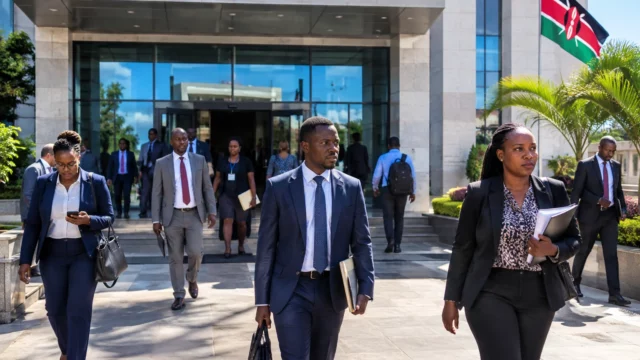
In Nairobi, the budget debate is no longer just about the figures. It also speaks to how far a state can fund its priorities without being stifled by the cost of its debt. In Kenya, this question remains central, as every percentage-point reduction in the deficit must also preserve schools, roads, healthcare and jobs.
The Kenyan government has therefore chosen to begin preparations for the 2027/28 budget earlier than usual, on 22 July 2026 in Nairobi, to allow time for sectoral consultations, public debate and parliamentary scrutiny ahead of the 2027 general election. This process is part of the Budget and Medium-Term Expenditure Framework, the multi-year spending planning exercise that shapes the state’s choices.
The announced trajectory: a smaller deficit, but how much room for manoeuvre?
Kenya’s Treasury is projecting a public deficit of 3.6% of gross domestic product for the financial year running from July 2027 to June 2028. This is an important milestone in the consolidation path set out by the authorities, who are aiming for about 3% by 2029/30. The deficit is already expected to reach 5.5% in 2026/27, down from 6.7% in 2025/26, according to figures presented in Nairobi.
This reduction is not coming out of nowhere. In the official budget document, the overall deficit is expected to fall progressively from 5.3% of GDP in 2026/27 to 3.6% in 2027/28, then 3.3% in 2028/29 and 3.2% in 2029/30. The government says it intends to achieve this through more disciplined revenue growth, cuts to non-essential spending, greater tax digitisation and more efficient public spending.
The authorities also emphasise a change in approach. The Treasury wants to broaden the tax base, reduce exemptions, improve compliance through digital tools and avoid introducing new taxes for now. This choice matters politically. In Kenya, tensions over taxes have already shown that fiscal adjustment can quickly become a social issue, not just an accounting one.
Fiscal consolidation under scrutiny
The problem remains the debt. The World Bank says Kenya’s public debt remains at high risk of debt distress and that interest payments absorb about a third of tax revenues. The same assessment is made in the joint World Bank-IMF review, which considers the risk of debt distress to be high, even though the debt is deemed sustainable provided adjustments continue.
In other words, reducing the deficit is not enough. The government must also create room for public investment without putting households or businesses under strain. This is where the political timetable matters. With the 2027 election a year away, an overly tight budget could curb development spending. But a budget that is too expansive could revive market mistrust and increase the cost of debt servicing.
The government is pointing to several recent reforms to show that the effort is already under way. The official budget document cites, in particular, spending rationalisation, e-procurement, the digitisation of pension management and improved revenue collection. Meanwhile, the 2024 Tax Laws (Amendment) Act and tax authority guidance have already changed several rules for calculating income tax and certain social contributions.
What this means for Kenyans and East Africa
For households, the issue is not abstract. A smaller deficit can reassure creditors and stabilise the economy. But this will only make a tangible difference if a lower cost of debt frees up money for public services and useful investment. Otherwise, the adjustment will remain invisible to households and painful for essential services.
For businesses, the stakes are twofold. On the one hand, fiscal credibility can support confidence, interest rates and private investment. On the other, consolidation can slow public procurement, particularly for infrastructure and social projects. The Treasury nevertheless says growth could reach 5.1% in 2027 and 5.2% in 2028, driven by reforms, macroeconomic stability and private investment.
Kenya plays a regional role that extends beyond its borders. A member of the East African Community (EAC), alongside seven other states, the country remains one of the region’s main commercial and financial gateways. When Nairobi tightens its budget, it matters for cross-border trade, supply chains, banks, bond markets and the expectations of regional partners.
The next stage will therefore be decisive. Between preparations for the 2027/28 budget, the announced deficit path and the forthcoming decisions on revenues and spending, Kenya is testing its ability to reconcile fiscal discipline, social stability and growth. In an East African environment still shaped by the need for integration, this equation in Kenya has implications far beyond the walls of the national Treasury.