Algeria
 Egypt
 Libya
 Morocco
 Sudan
 Tunisia
 Benin
 Burkina Faso
 Cabo Verde
 Côte d'Ivoire
 Ghana
 Guinea
 Guinea-Bissau
 Liberia
 Mali
 Mauritania
 Niger
 Senegal
 Sierra Leone
 The Gambia
 Togo
 Cameroon
 Central African Republic
 Chad
 DR Congo
 Equatorial Guinea
 Gabon
 Republic of the Congo
 São Tomé and Príncipe
 Burundi
 Comoros
 Djibouti
 Eritrea
 Ethiopia
 Kenya
 Madagascar
 Malawi
 Mauritius
 Mozambique
 Rwanda
 Seychelles
 Somalia
 South Sudan
 Tanzania
 Uganda
 Angola
 Botswana
 Eswatini
 Lesotho
 Namibia
 South Africa
 Zambia
 Zimbabwe
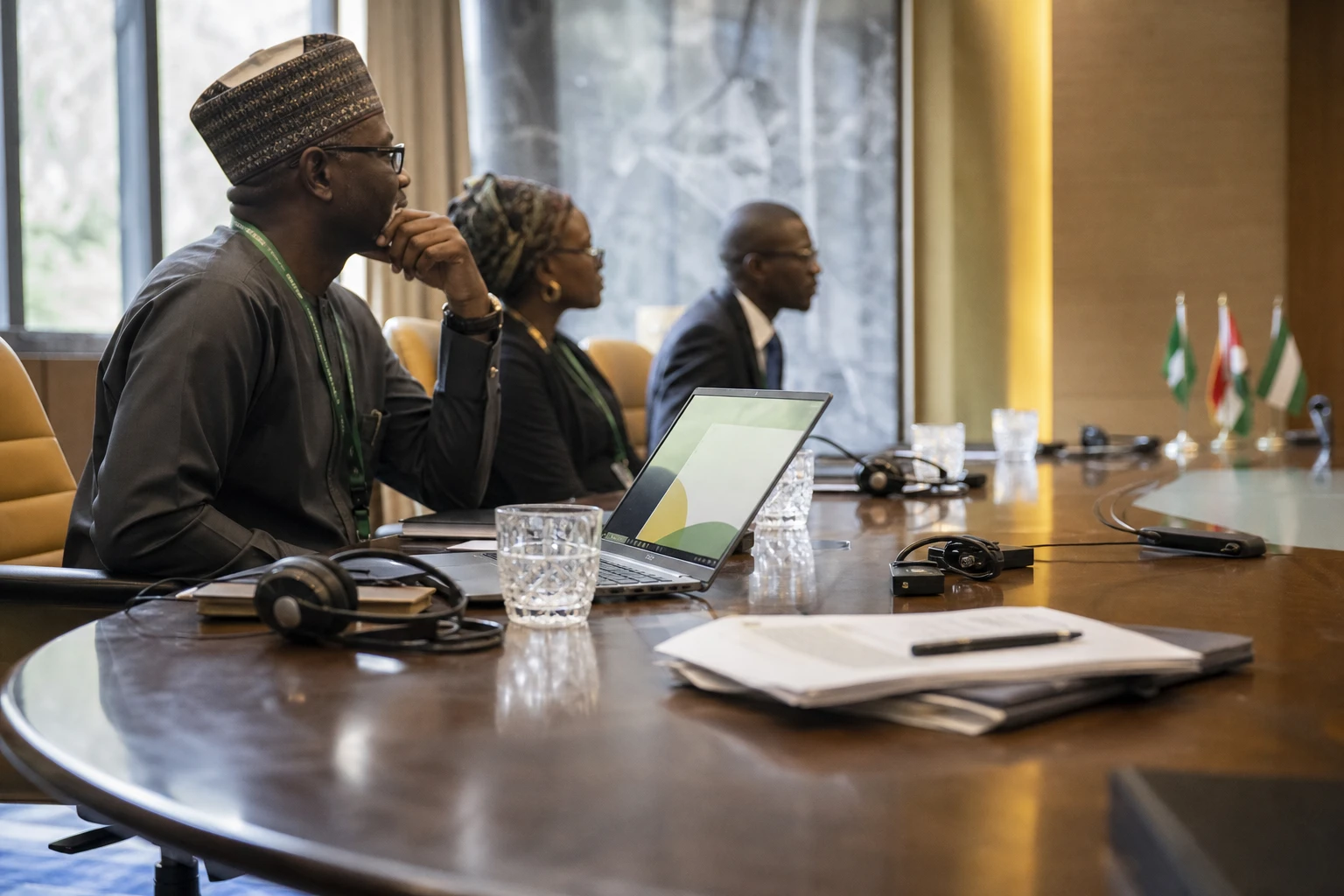
Training teachers in digital skills is also about ensuring continuity in education
In Nigeria, the question is not simply whether schools are becoming more modern. It is above all how they keep functioning, day after day, in a system where teachers are in short supply, enrolment is rising and access to digital tools remains uneven across states. In Abuja, this tension is now reflected in a very concrete strategy: making digital technology a direct support for teachers’ work, rather than a mere reform slogan.
Nigeria is not starting from scratch. The Federal Ministry of Education has already established online learning platforms such as eLearn and Nigeria Learning Passport, both designed to work offline on mobile devices. At the same time, the federal education reform, driven by the Nigeria Education Sector Renewal Initiative, has made teaching quality, continuing professional development and the integration of technology public priorities. The issue, then, is less about introducing digital technology into schools than scaling it up in a sector already under pressure.
In Abuja, a three-day course for 2,000 teachers
On Tuesday 21 July 2026, Abuja hosted the opening of a three-day workshop devoted to integrating mobile technologies into teaching. The initiative is to train 2,000 teachers and school leaders in digital skills, according to the Federal Ministry of Education. The programme is being run with support from the Japanese government and partners including UNESCO’s International Institute for Capacity Building in Africa, Pan-African University and consultancy Castalia Co. Ltd. It is part of PAVEU, the Pan-African Virtual and E-University Initiative.
The training content reflects this focus on providing practical tools. Participants are introduced to digital literacy, the use of artificial intelligence in education and gender-responsive pedagogy. They also learn about the GOKU Mobile Learning platform, designed to work on mobile phones. The programme is accompanied by announced material support of around $1 million, as well as tablets and computer equipment. In a country where mobile phones often remain the most accessible tool, the choice of mobile learning is no trivial matter.
The real challenge: spreading skills, not just bringing people to Abuja
The official plan relies on a cascade effect. The trained teachers are then expected to become conduits able to pass on what they have learned in their schools and, by extension, through their teaching networks. This model is common in large-scale public training policies. It can work. But it requires a solid framework: monitoring, support, equipment, connectivity and time genuinely set aside for skills development. Without these, the workshop risks remaining a useful but limited interlude.
The context shows the scale of the challenge. The Federal Ministry of Education’s statistics portal lists 1,193,908 teachers for 40,130,946 learners across the system covered in 2024/2025, a national ratio of 33.6 pupils per teacher. At primary level, data from the Universal Basic Education Commission show 915,593 teachers for 31,771,916 pupils, illustrating persistent structural pressure. Against this backdrop, training 2,000 people is a worthwhile measure, but still falls far short of the scale of need.
The system is also being weakened by the international mobility of its staff. Recent professional initiatives, such as Naija Teacher AI, were launched specifically to strengthen Nigerian teachers’ ability to use digital tools and remain in the profession. The very existence of these programmes shows that the issue is no longer just recruitment, but also retention and recognition of the teaching profession. When foreign countries recruit teachers trained in Nigeria, education policy can no longer focus solely on producing graduates. It must also offer credible career prospects.
An education reform that extends beyond the ministry
This initiative is part of a broader sequence. Nigeria has launched NESRI, its strategy to renew the education sector, combining teaching quality, virtual classrooms, curriculum reform and school safety. The country also published its National Teachers Policy in 2025, a sign that the teaching profession is now being treated as a governance issue, rather than simply a budget variable. In short, Abuja is seeking to rebuild the system’s foundations around teachers, their training and their working environment.
The partnership with Japan and UNESCO reinforces this trajectory. It is part of a trend already visible elsewhere in Africa: mobile learning projects supported by the Japanese government, IICBA and Pan-African University in several countries across the continent, with particular attention to crisis-hit areas and underserved schools. Nigeria gains a useful lever from this, but also assumes a responsibility: to show that digital solutions can be adapted to a large system that is both urban and rural, and marked by sharp regional inequalities.
For teachers, the immediate challenge is access to useful, understandable content that is compatible with often fragile infrastructure. For school leaders, it is about turning training into practical work organisation. For pupils, the impact will depend on the regularity of lessons, the quality of resources and schools’ ability to absorb digital tools without further widening the gap between urban and rural areas. That is the heart of the matter: the success of education reform is not measured by the number of tablets distributed, but by the continuity of learning it genuinely enables.
What Nigeria is watching, and what Africa is monitoring
Nigeria occupies a distinctive place in African education debates. Given its population, regional weight in West Africa and role in ECOWAS, it often serves as a large-scale test case. If training digital skills champions produces measurable results, it could inform other national policies across the continent, particularly where teacher shortages, geographical isolation and weak infrastructure demand hybrid solutions. If it fails, it will be a reminder that no technology can replace a lasting policy of recruitment, remuneration and professional support.
The next steps to watch are now clear: the first assessments of implementation, the ministry’s ability to extend training beyond the core group of 2,000 participants, and coordination with the other strands of NESRI. This is where the initiative’s credibility will be determined. Digital technology can accelerate reform. On its own, it cannot repair an education system whose scale, inequalities and teacher shortages demand broader and more stable responses.