
 Algeria
 Egypt
 Libya
 Morocco
 Sudan
 Tunisia
 Benin
 Burkina Faso
 Cabo Verde
 Côte d'Ivoire
 Ghana
 Guinea
 Guinea-Bissau
 Liberia
 Mali
 Mauritania
 Niger
 Nigeria
 Senegal
 Sierra Leone
 The Gambia
 Togo
 Central African Republic
 Chad
 DR Congo
 Equatorial Guinea
 Gabon
 Republic of the Congo
 São Tomé and Príncipe
 Burundi
 Comoros
 Djibouti
 Eritrea
 Ethiopia
 Kenya
 Madagascar
 Malawi
 Mauritius
 Mozambique
 Rwanda
 Seychelles
 Somalia
 South Sudan
 Tanzania
 Uganda
 Angola
 Botswana
 Eswatini
 Lesotho
 Namibia
 South Africa
 Zambia
 Zimbabwe
A government that speaks, but is not seen by the country
In Cameroon, the question is not simply one of absence. It touches on a more sensitive issue: how does a highly centralised state function when its leader remains outside the country for several weeks? In a country where the presidency concentrates most political arbitration, every silence fuels questions, particularly as decisive institutional milestones approach.
The controversy intensified after Jacques Fame Ndongo, Minister of State and communications secretary of the ruling CPDM, spoke out. He rejected the idea of a power vacuum and said that no Cameroonian law sets a maximum period for the president’s absence from the country. This defensive line forms part of a broader period in which debate over the continuity of the state has gathered pace just as the authorities seek to show that they remain in control of the institutional timetable.
A constitutional framework open to interpretation
Cameroonian law provides for a presidential vacancy in specific circumstances: death, resignation or permanent incapacity established by the Constitutional Council. The Constitution then provides for a new election to be held between 20 and 120 days after the vacancy. But the texts consulted make no mention of an automatic threshold linked to a prolonged absence from the national territory. This gap is precisely what is fuelling the current political battle.
This legal interpretation intersects with a recent institutional change. In April 2026, Parliament adopted reforms to the functioning of the Constitutional Council, amid discussion of a provision to introduce a vice-president. The authorities’ supporters see this as modernising the institutions. Their critics, by contrast, see an opening for debate about succession and how to anticipate a possible failure at the top of the state.
The facts: a prolonged absence and an immediate political response
According to Reuters, as reported by several African media outlets, Paul Biya, 93, had spent 45 days outside the country when the CPDM convened a rare meeting of its senior officials on 22 July 2026. He left on 7 June 2026 for what had been described as a private stay in Europe. Meanwhile, the president’s entourage maintained that the head of state remained at work and was following matters electronically.
The opposition’s response was swift. The MRC, through Mamadou Mota, argued that 45 days away from the national territory could not be reduced to a mere interlude. The opposition party ridiculed a country “governed by remote working”, while raising a fundamental question: when does the head of state’s physical absence cease to be a matter of protocol and become an issue of governance?
Other parties adopted a more institutional tone. The UDC, an opposition party represented in the National Assembly, called for the continuity of the state to be secured without declaring that a vacancy had been legally established. This distinction matters. It shows that in Cameroon, even opponents of the authorities often distinguish between a political warning and a strict constitutional determination.
What this episode reveals about Yaoundé and the country beyond
The debate goes beyond Paul Biya himself. It exposes the Cameroonian system’s dependence on a presidential figure who has become the main focal point for loyalties, appointments and arbitration. In such a model, the head of state’s physical distance quickly weighs on perceptions of stability, even when the administrative machinery continues to turn. The capital, Yaoundé, retains control of announcements, but regions, local elected officials and economic actors read the uncertainty differently: in terms of visibility, decision-making and delay.
This episode is also unfolding in a charged political context. In 2025, Paul Biya began a new term after a presidential election contested by the opposition. In 2026, the National Assembly and Senate continued institutional reforms and extended certain terms of office, reinforcing the impression of a political timetable compressed around central power. In this context, the president’s absence acts as a revealer: it brings to light tensions between professed stability, the concentration of decision-making and the need for clarity about the chain of command.
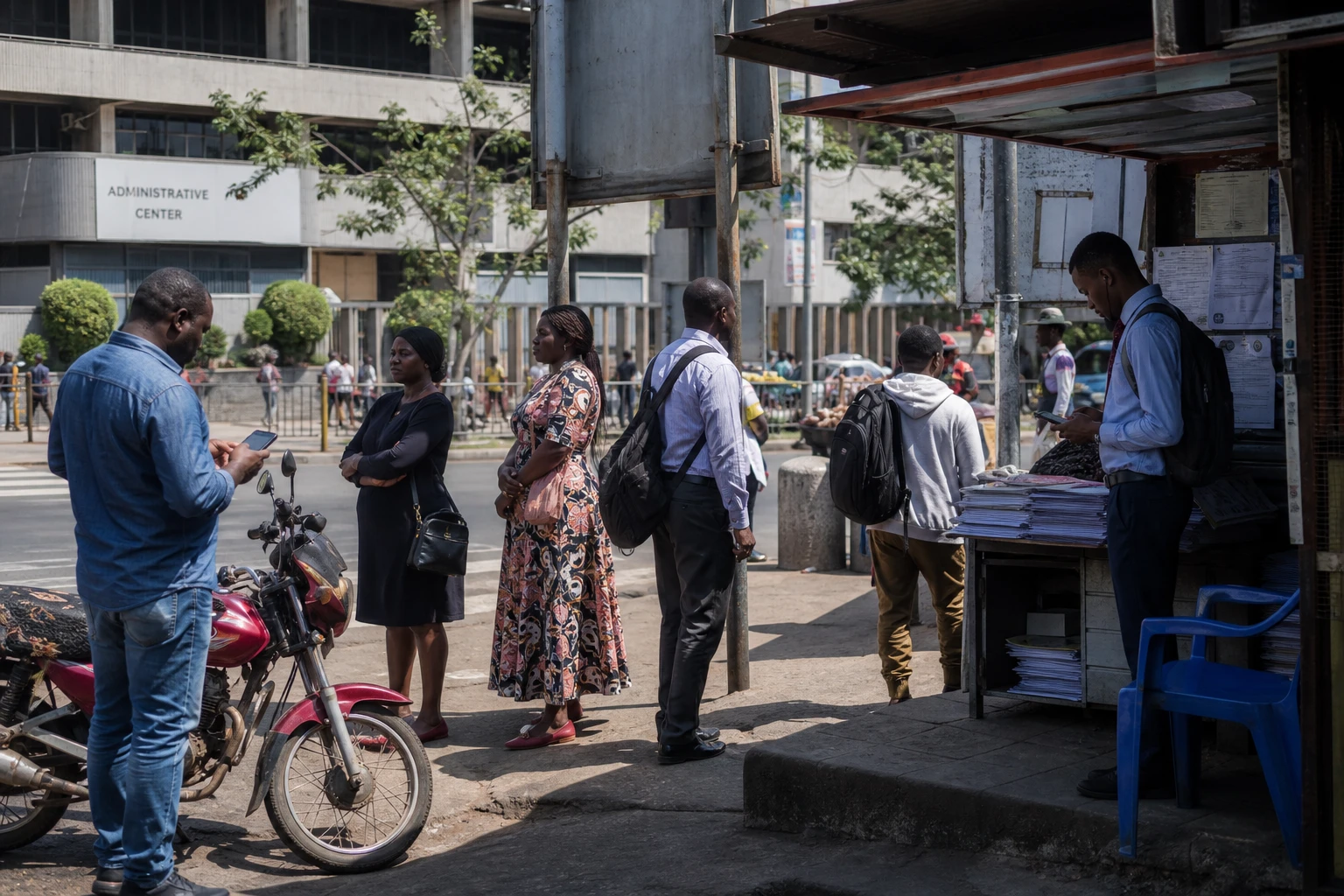
For the population, the stakes are concrete. The formal economy is waiting for clear signals on public spending, appointments and budget decisions. The informal economy, for its part, first feels the political atmosphere: rumours, increased caution and waiting in government offices. In a country where decisions from the top have a direct impact on the provinces, the perceived slowness of the centre can quickly become an economic and social factor.
Regional implications beyond Cameroon
Cameroon is not an isolated case in Central Africa, but it remains a key pillar of CEMAC, the subregional organisation that shapes some of the basin’s trade and monetary balances. Any questions about the continuity of the state in Yaoundé are therefore closely followed across the region, because they concern the stability of a pivotal country bordering Nigeria, the Central African Republic, Chad, Gabon and Equatorial Guinea.
The continental implications are similar. In several African capitals, questions of succession, institutional transparency and the age of leaders are increasingly coming to the fore. Cameroon serves as a case study: it shows that a prolonged absence does not necessarily trigger a legal crisis, but can create lasting political uncertainty if continuity mechanisms remain unclear or poorly explained. The next steps will therefore be closely watched: any new statement by the CPDM, any formal move by the presidency, and above all any clarification about the head of state’s return or the activation of the relevant institutions.



