Algeria
 Egypt
 Libya
 Morocco
 Sudan
 Tunisia
 Benin
 Burkina Faso
 Cabo Verde
 Côte d'Ivoire
 Ghana
 Guinea
 Guinea-Bissau
 Liberia
 Mali
 Mauritania
 Niger
 Nigeria
 Senegal
 Sierra Leone
 The Gambia
 Togo
 Cameroon
 Central African Republic
 Chad
 DR Congo
 Equatorial Guinea
 Gabon
 Republic of the Congo
 São Tomé and Príncipe
 Burundi
 Comoros
 Djibouti
 Eritrea
 Ethiopia
 Kenya
 Madagascar
 Malawi
 Mauritius
 Mozambique
 Rwanda
 Seychelles
 Somalia
 South Sudan
 Tanzania
 Uganda
 Angola
 Botswana
 Eswatini
 Lesotho
 Namibia
 South Africa
 Zambia
 Zimbabwe
Ten teams at the World Cup, but one story is not enough
The presence of ten African teams at a World Cup is more than a record. It is also a test: of the depth of football across the continent, its ability to compete over time and the way its national teams cope with—or are affected by—a tournament that has become longer, broader and more exposed to political issues. In 2026, Africa arrived with an unprecedented contingent, but the teams followed very different paths depending on their countries, groups and the conditions in which they reached the tournament.
The context matters. The 2026 World Cup is being held in the United States, Canada and Mexico, with the final scheduled for 19 July 2026 at New York New Jersey Stadium. The 48-team format has opened the door to more African national teams, but it has not erased the gaps in experience, resources or administrative arrangements for players and supporters.
The key achievement: Africa has reached a new level
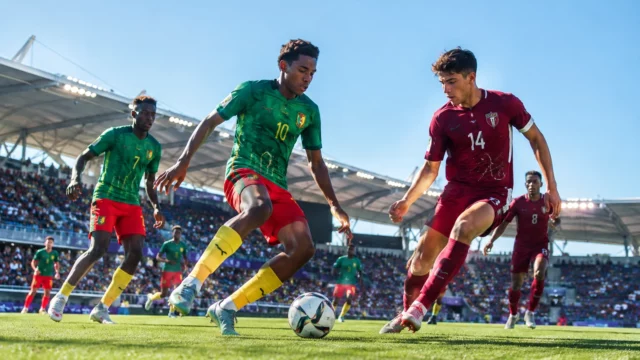
At the outset, the CAF announced a record ten African representatives at the 2026 World Cup, with DR Congo qualifying through the intercontinental play-off. By the end of the first round, nine African teams had progressed to the next round, an unprecedented achievement for the continent in the tournament’s history. The teams that qualified were Algeria, Cape Verde, Côte d’Ivoire, DR Congo, Egypt, Ghana, Morocco, Senegal and South Africa.
This result is not simply a mechanical effect of the expanded World Cup. It is also built on qualification campaigns that took shape over time. Morocco confirmed its status as a continental benchmark. Senegal retained a strong competitive base. Egypt and Algeria returned to the forefront. Cape Verde, Côte d’Ivoire and South Africa achieved historic milestones. Meanwhile, DR Congo showed that a well-organised national team could overcome the obstacles of a long campaign without the institutional clout of Africa’s leading favourites.
The CAF praised this progress as a major milestone for the continent, stressing that its 54 member associations now see more countries capable of progressing beyond the group stage.
Between sporting maturity and unequal starting points
The sporting record must be read with caution. On the one hand, African teams showed that they no longer come to the World Cup merely to take part. On the other, the gaps remain visible once the competition reaches the knockout matches. Progression to the next round highlighted teams able to defend deep, manage difficult spells and capitalise on opponents’ mistakes. But it also underlined that tactical depth, squad strength and efficiency in decisive areas remain major differentiators.
Cape Verde is a case in point. For a national team seeking a foothold at the highest level, reaching the knockout stage at its first appearance gave its campaign considerable symbolic weight. South Africa and Côte d’Ivoire also broke through a ceiling they had never crossed in this format. By contrast, other teams with a more established pedigree had to settle for a more limited run, a reminder that historical status offers no protection from realities on the pitch at a World Cup.
For football associations, the stakes go beyond the result. They include preparation, training staff, travel arrangements, the quality of friendly opposition and the stability of coaching teams. For several months, the CAF had noted that a number of African national teams were using warm-up matches against opponents from other continents to prepare for the World Cup format. This matters. It points to growing professionalisation, but also to the need to invest in competition cycles, not just in the windows around major tournaments.
Off-field issues weighed on the tournament
The 2026 World Cup also brought a sensitive issue into focus: African supporters’ access to stadiums in North America. Visa rules, interview waiting times and some travel restrictions have fuelled genuine concern in several countries across the continent. US authorities did announce adjustments to consular services in Africa from 1 August 2026, reorganising them around regional hubs. In practice, however, this mainly confirms that access to the tournament is not uniform across African nationalities.
Another issue drew criticism: visa deposits and exemptions granted to certain ticket holders. Multiple sources showed that supporters from several African countries continued to face logistical obstacles, including for matches played in Canada or Mexico. In other words, the World Cup did not just put national teams in competition. It also tested the ability of African fans to move around a highly regulated North American region.
This dimension affects different groups in different ways. For associations and coaching teams, performance is the main concern. For supporters, the questions are first and foremost cost, visas and mobility. For African host cities following the competition from afar, the issue is symbolic: seeing more teams from the continent establish themselves among the nations that matter.
What this World Cup changes for Africa
At continental level, this tournament confirms a shift. Africa is no longer relying on one or two flag-bearers. It is fielding a larger, more diverse and more competitive group. This changes how the qualifying rounds are viewed, the strategies of football associations and perceptions of young players trained on the continent or in the diaspora. The success of a team such as Cape Verde, Morocco’s consolidation and the resilience of nations such as Senegal and Egypt send a clear signal: African quality is no longer confined to a few showcases.
But this new level remains fragile. The continent still needs to turn breakthroughs into continuity. That will require more structured domestic leagues, training centres better connected to national teams, and associations able to stabilise their governance. The 2026 World Cup shows that the talent is there. It also shows that without solid organisation, success remains a one-off.
The next question will be simple to ask, but harder to answer: in 2030 and beyond, can Africa make this record the new standard rather than a brief interlude? The answers will depend on future continental competitions, development cycles and the budgetary choices of governments and football associations. For African football, then, the 2026 World Cup has not closed a chapter. Above all, it has set a new benchmark.