
 Aljeria
 Libya
 Misri
 Moroko
 Sudan
 Tunisia
 Benin
 Burkina Faso
 Gambia
 Ghana
 Gine
 Ginebisau
 Kepuvede
 Kodivaa
 Liberia
 Mali
 Moritania
 Niger
 Nigeria
 Senegal
 Sierra Leone
 Togo
 Chadi
 Gaboni
 Guinea ya Ikweta
 Jamhuri ya Afrika ya Kati
 Kamerun
 Kongo
 Sao Tome na Principe
 Burundi
 Eritrea
 Ethiopia
 Jibuti
 Kenya
 Komoro
 Madagaska
 Malawi
 Morisi
 Msumbiji
 Rwanda
 Shelisheli
 Somalia
 Sudan Kusini
 Tanzania
 Uganda
 Afrika Kusini
 Angola
 Botswana
 Eswatini
 Lesoto
 Namibia
 Zambia
 Zimbabwe
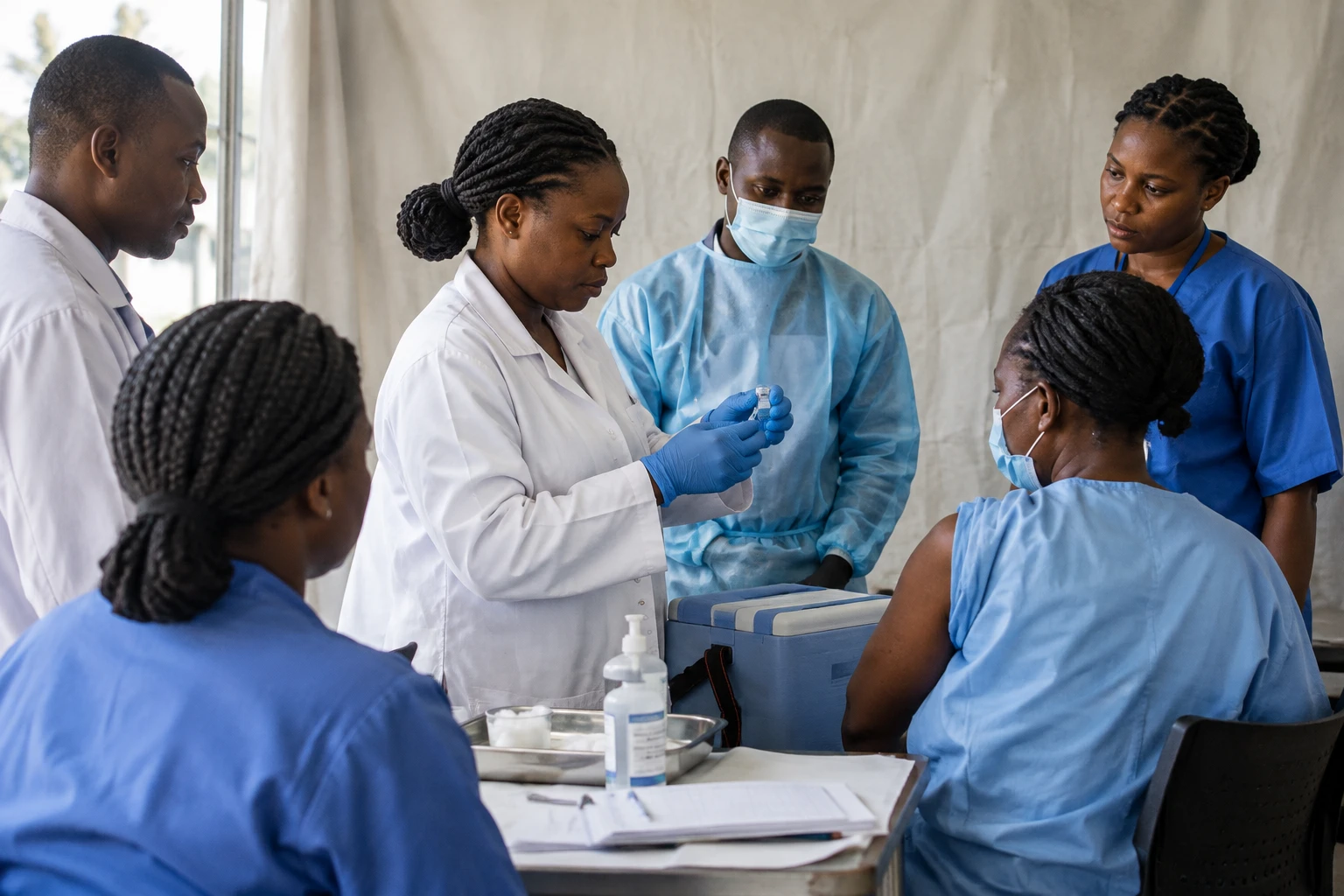
Vaccinating health workers against Ebola when the vaccine’s protection remains uncertain: in the Democratic Republic of the Congo, this choice addresses an urgent practical need. In affected areas, every exposed health professional can also become an essential part of the response.
The vaccine being used, Ervebo, has proved effective against the Zaire strain of the Ebola virus. But the current outbreak is caused by Bundibugyo, a different strain. Health authorities are considering the possibility of cross-protection, but cannot yet confirm it in humans.
Possible protection, not a guarantee
In Beni, in the east of the country, health workers and other frontline responders have received Ervebo under compassionate use. This arrangement allows a product to be used in a serious situation, even if its approval does not specifically cover the disease in question.
The distinction matters. Ervebo is approved for the disease caused by the Zaire virus. For Bundibugyo, the available data do not support claims that it prevents infection or severe illness. The World Health Organization (WHO) says that laboratory results and animal studies suggest possible protection, but that its effectiveness in humans remains unknown. The WHO and the Africa Centres for Disease Control and Prevention announced in August the allocation of 70,000 doses to the DRC.
The announced distribution provides for about 50,000 doses for health professionals and other people working in the field. The remaining 20,000 are to be used in a clinical trial to assess protection against Bundibugyo. This protocol should produce stronger evidence than extrapolating from another strain.
Vaccination therefore does not replace protective equipment, testing or the isolation of cases. It is added to these measures in a context where teams must limit risks while maintaining routine care.
Care beyond the vaccine
In the absence of a vaccine or treatment specifically approved for Bundibugyo, supportive care remains crucial. This includes correcting dehydration, treating certain associated infections, providing oxygen or giving a patient a blood transfusion when their condition warrants it.
WHO Regional Director for Africa Mohamed Janabi stressed that these interventions can improve the chances of survival. He also reported 2,400 survivors during this outbreak. This figure needs to be viewed in context: tallies change rapidly and do not necessarily describe the most recent situation.
In data released before this update, the Congolese Ministry of Health recorded 9,066 confirmed cases and 4,381 deaths. A tally published on 13 October by the Associated Press, citing the authorities, said the number of confirmed cases had exceeded 9,000 and deaths 4,300. These figures show the scale of the outbreak, but should not be mistaken for a final tally.
Declared on 15 May 2026, the DRC’s 17th Ebola outbreak is caused by the Bundibugyo virus. It was initially concentrated in Ituri, in the northeast, before spreading to other provinces. The WHO has also reported cases in Uganda and declared the event a public health emergency of international concern. Its epidemiological monitoring highlights the need for coordination between the two countries.
Response hampered by displacement and insecurity
The health response is taking place in difficult conditions. Insecurity makes it harder to reach some communities. Population movements complicate contact tracing. A health workers’ strike and substantial movement of people can also disrupt care and surveillance.
These obstacles do not affect everyone in the same way. Medical teams face direct exposure to the virus and sometimes have to work with limited resources. For people in rural or remote areas, reaching a health facility quickly can be more difficult than for those in large urban centres. Conversely, movement between cities and provinces increases the need for coordination and follow-up.
The authorities have also emphasised early care. Prompt treatment can address complications and support the body, even though it is not a specific cure for Bundibugyo. The ability of centres to admit patients, protect staff and maintain the trust of communities therefore remains central.
An issue that extends beyond the DRC’s borders
Ituri’s proximity to Uganda gives the response a regional dimension. The two countries need to share alerts, organise border surveillance and coordinate the monitoring of exposed people. African health authorities and the WHO are taking part in this effort, while data from the Ervebo trial could inform future responses to this strain.
The DRC is also a member of the Southern African Development Community, or SADC, and the East African Community, or EAC. For this emergency, health cooperation with Uganda and continental mechanisms, particularly Africa CDC, is especially direct. The outbreak is a reminder that viruses do not follow administrative borders, and that regional preparedness must rely on laboratories, teams and alert systems able to work together.
The next challenge will be to document the results of vaccination without attributing to it an effectiveness against Bundibugyo that has not yet been demonstrated. At the same time, access to care, the protection of responders and the monitoring of transmission hotspots will determine the ability to curb the outbreak. For Congolese people, the immediate promise therefore does not rest on a vaccine alone, but on a response combining prevention, reliable data and accessible care.



