
 Aljeria
 Libya
 Misri
 Moroko
 Sudan
 Tunisia
 Benin
 Burkina Faso
 Gambia
 Ghana
 Gine
 Ginebisau
 Kepuvede
 Kodivaa
 Liberia
 Mali
 Moritania
 Niger
 Nigeria
 Senegal
 Sierra Leone
 Togo
 Chadi
 Gaboni
 Guinea ya Ikweta
 Jamhuri ya Afrika ya Kati
 Kamerun
 Kongo
 Sao Tome na Principe
 Burundi
 Eritrea
 Ethiopia
 Jibuti
 Kenya
 Komoro
 Madagaska
 Malawi
 Morisi
 Msumbiji
 Rwanda
 Shelisheli
 Somalia
 Sudan Kusini
 Tanzania
 Uganda
 Afrika Kusini
 Angola
 Botswana
 Eswatini
 Lesoto
 Namibia
 Zambia
 Zimbabwe
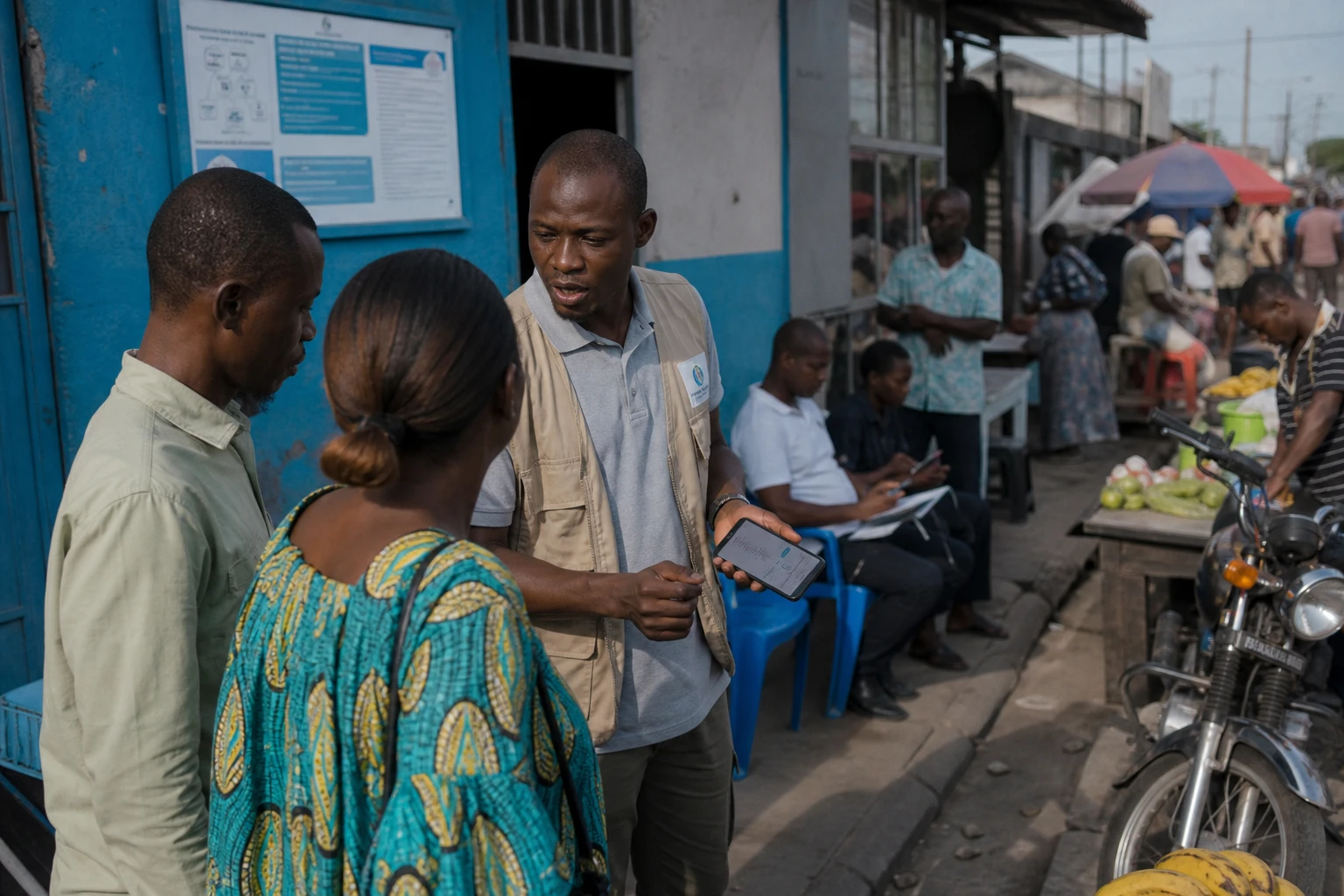
In Bunia, the Ebola response depends as much on health centres as on the flow of information
In the Democratic Republic of the Congo, an epidemic never puts only the health system to the test. It also reveals the state’s ability to coordinate its resources, provide funding quickly and speak with one voice. In Ituri, where Ebola returned in May 2026, the issue is therefore not only medical. It is also political, budgetary and regional.
The virus was confirmed in Ituri province, in the country’s north-east, and the authorities activated emergency mechanisms with support from the WHO and Africa CDC. The disease was declared on 15 May 2026, involving the Bundibugyo strain, at the heart of an area already marked by population displacement and access difficulties.
Congo’s response is now seeking a clearer centre of gravity
The Congolese government and the WHO confirmed their joint mission to Bunia, led by Health Minister Samuel Roger Kamba, as part of an effort presented as national and coordinated with partners. Africa CDC, for its part, convened an emergency regional meeting with the DRC, Uganda and South Sudan, as well as several agencies and donors. The message is clear: Ebola cannot be tackled province by province, but through the chain of transmission, across porous health borders.
This sequence explains why the debate has shifted to Kinshasa. The authorities want tighter control over coordination and the resources mobilised, while field teams stress the need for rapid action, case surveillance and community engagement. The WHO has also noted that the epidemic affects several health zones in Ituri, including Bunia, Mongbwalu and Rwampara, making the response more complex than a simple local containment operation.
The Congolese context matters. The DRC already has long experience of Ebola outbreaks, but that knowledge is not enough if alerts are delayed, funds arrive poorly or trust between health workers and residents falters. The WHO has also indicated that this outbreak constituted a public health emergency of international concern, reinforcing the need for cross-border cooperation and rigorous monitoring.
From public finances to public health, credibility is central
In this matter, President Félix Tshisekedi and health partners have put coordination back at the centre of attention. That is where the African perspective on the issue lies: effectiveness depends not only on announcements, but on speed of implementation, transparency of financial flows and the ability to relay information from affected areas to decision-makers. This is a governance requirement, not an administrative detail.
Health authorities have stressed the mobilisation of additional resources and the rapid delivery of life-saving interventions. In a province such as Ituri, where insecurity and population movements complicate the response, every delay has a tangible cost: interrupted surveillance, more difficult contact tracing, delayed care and amplified rumours. The stakes therefore go beyond the fight against a virus alone. They concern trust in the state, medical teams and public messages.
This demand for clarity is also reflected in another issue closely monitored in Kinshasa: the reform of standardised invoices and VAT. The Directorate General of Taxes set 1 December 2025 as the date from which VAT-registered entities would be required to issue and request this invoice. The Ministry of Finance then ended the moratorium and announced that penalties would apply from 15 May 2026. The logic is simple: track transactions, reduce discrepancies and broaden public revenue.
This reform does not concern only large companies. It also affects tax officials, small and medium-sized formal businesses and, ultimately, the public services the state claims it wants to fund more effectively. Compliant businesses must adapt to a more digital system. Those that resist face inspections and penalties. The administration, for its part, promises greater traceability.
Beyond Kinshasa, the stakes are continental
Ituri is a reminder that health crises in Central Africa quickly spill across national borders. Coordination between the DRC, Uganda and South Sudan shows that the response now requires regional action, with Africa CDC, the WHO and other partners sharing responsibility. The continent has also begun organising a joint response, with a joint Africa CDC-WHO plan launched in early June 2026 for six months.
For the DRC, the test is twofold. On the health front, it must contain Ebola without losing its connection with communities in the east of the country. Institutionally, it must show that coordination in Kinshasa produces visible results in Bunia. On the tax front, finally, the state wants to prove that it can collect more effectively in order to act more effectively. In all three cases, the same question arises: can the machinery of government move faster than the crisis?
The answer will be watched far beyond the DRC. An effective response in Ituri will affect Central Africa’s health credibility. A smoothly implemented tax reform will also send a signal to other administrations across the continent seeking to modernise revenue collection without disrupting economic activity. In other words, Bunia and Kinshasa reflect the same picture: a state trying to gain the upper hand over an emergency, in a context where speed, coordination and trust have become essential public goods.



