Algeria
 Egypt
 Libya
 Morocco
 Sudan
 Tunisia
 Benin
 Burkina Faso
 Cabo Verde
 Côte d'Ivoire
 Ghana
 Guinea
 Guinea-Bissau
 Liberia
 Mali
 Mauritania
 Niger
 Senegal
 Sierra Leone
 The Gambia
 Togo
 Cameroon
 Central African Republic
 Chad
 DR Congo
 Equatorial Guinea
 Gabon
 Republic of the Congo
 São Tomé and Príncipe
 Burundi
 Comoros
 Djibouti
 Eritrea
 Ethiopia
 Kenya
 Madagascar
 Malawi
 Mauritius
 Mozambique
 Rwanda
 Seychelles
 Somalia
 South Sudan
 Tanzania
 Uganda
 Angola
 Botswana
 Eswatini
 Lesotho
 Namibia
 South Africa
 Zambia
 Zimbabwe
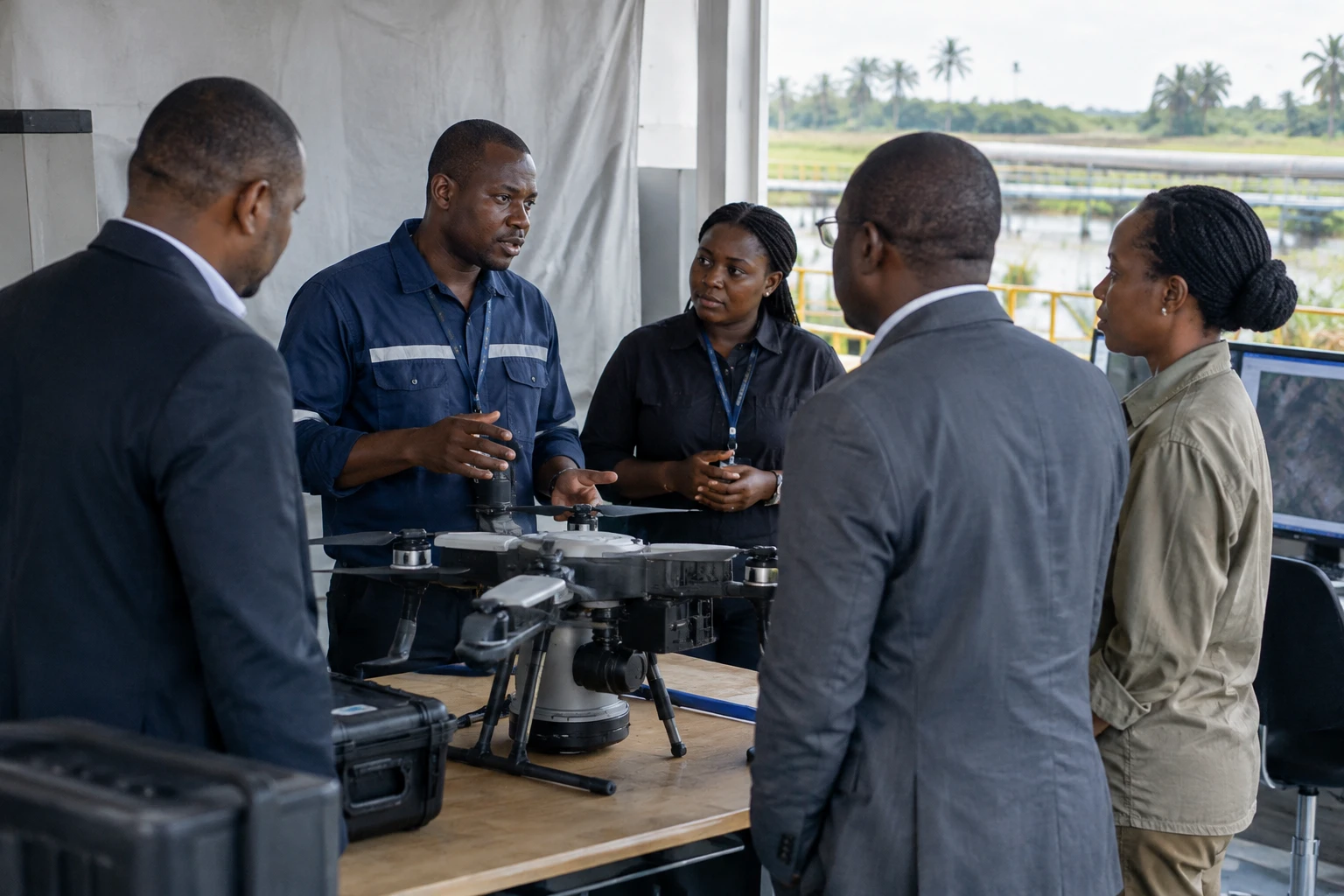
In the Niger Delta, monitoring oil infrastructure means tracking pipelines that cross swamps, waterways and populated areas. Nigeria is now also turning to drones and digital analysis tools. But their effectiveness will depend as much on coordination with public forces and communities as on their technical capabilities.
Private surveillance as part of a national issue
Oil remains a major source of revenue for Nigeria, Africa’s largest crude producer. Theft, illegal connections and acts of sabotage have long disrupted the flow of oil to export terminals. The Niger Delta, in the south of the country, is home to a large share of the infrastructure and the tensions surrounding its protection.
Since 2022, the federal authorities have entrusted some pipeline surveillance to private companies, including Tantita Security Services. This choice complements the work of security forces and public institutions; it does not transfer overall responsibility for national security to a private company. A report by the United Nations Office on Drugs and Crime describes Tantita teams deployed on the delta’s waterways, working with the Nigerian Security and Civil Defence Corps and residents of the communities concerned.
The model also raises questions about oversight and accountability. In 2026, a challenge to the renewal of surveillance contracts was heard by a federal court in Abuja. Infrastructure protection is therefore an economic issue, but also an institutional and political one.
Drones, data and maritime surveillance
On 29 October, Warredi Enisuoh, Tantita’s executive director for operations and technical matters, presented new equipment at the Africa International Defence Exhibition, held in Lagos from 26 to 29 October. The event, dedicated to defence and security technologies, was hosted by the Defence Industries Corporation of Nigeria.
Enisuoh said the company had partnered with a US supplier to obtain drones and other equipment. He said teams were undergoing training. Among the aircraft presented was the MK4.7, which he said could fly for up to 14 hours, with night vision and real-time image transmission. He also mentioned drones capable of staying airborne for 24 hours, with a brief interruption for maintenance.
These performance figures and other technical details reported at the presentation remain company claims. A separate announcement by US company Textron Systems, published in December 2025, confirms the sale of three Aerosonde MK4.7 aircraft to Tantita, with a training option. It documents a specific contract, but does not in itself verify all the acquisitions announced in October 2026.
Tantita also says it uses an artificial intelligence system to identify behaviour deemed suspicious and track the movements of vessels involved in oil loading. Enisuoh mentioned the use of satellite data and radars capable of detecting vessels even when some navigation signals are switched off. According to him, the company has two command centres that can be accessed remotely. These capabilities can help direct patrols; without published and verifiable results, however, they do not prove that detected activity is in fact theft.
Results to be measured beyond the announcements
Securing pipelines can limit losses and facilitate the transport of crude. On its own, it is not enough to guarantee a sustained increase in production. Production also depends on infrastructure maintenance, producers’ decisions and investment conditions. In October 2025, Nigeria’s NAN news agency, citing data from national oil company NNPC, reported average crude oil and condensate production of 1.61 million barrels a day in September, compared with 1.65 million in August. This indicator, which includes condensates, should not be confused with crude-only figures.
Residents of the delta are directly affected. Local surveillance jobs can generate income and strengthen ties with communities. But new sensors will not resolve disputes over the distribution of oil revenues or the environmental damage associated with leaks and illegal activities. A credible policy must therefore combine detection with transparent investigations, public protection and a response to local concerns.
The division of responsibilities also requires constant attention. Private companies can contribute local knowledge and surveillance capabilities; the authorities must retain the ability to investigate, make arrests and account for their actions. Tensions have already emerged between contractors and public institutions over the interception of vessels, underscoring the need to verify alerts through shared procedures.
An issue that extends beyond Nigeria’s borders
Illicit oil trading and vessel movements do not stop at national waters. They affect the Gulf of Guinea, where maritime cooperation between West African states remains important for tracking routes and sharing information. For Nigeria, a member of ECOWAS — the West African organisation for economic and political integration — digital surveillance could therefore have regional reach, provided data and operations are coordinated between institutions.
The next measure of success will not simply be the number of drones deployed. Verifiable results will also need to be assessed: incidents prevented, volumes actually transported, public oversight procedures and benefits for communities in the delta. Without these indicators, the technology will remain a promise; with them, it can be evaluated as one of several tools for protecting Nigeria’s infrastructure and revenues.