Algeria
 Egypt
 Libya
 Morocco
 Sudan
 Tunisia
 Benin
 Burkina Faso
 Cabo Verde
 Côte d'Ivoire
 Ghana
 Guinea
 Guinea-Bissau
 Liberia
 Mali
 Mauritania
 Niger
 Nigeria
 Senegal
 Sierra Leone
 The Gambia
 Togo
 Cameroon
 Central African Republic
 Chad
 DR Congo
 Equatorial Guinea
 Gabon
 Republic of the Congo
 São Tomé and Príncipe
 Burundi
 Comoros
 Eritrea
 Ethiopia
 Kenya
 Madagascar
 Malawi
 Mauritius
 Mozambique
 Rwanda
 Seychelles
 Somalia
 South Sudan
 Tanzania
 Uganda
 Angola
 Botswana
 Eswatini
 Lesotho
 Namibia
 South Africa
 Zambia
 Zimbabwe
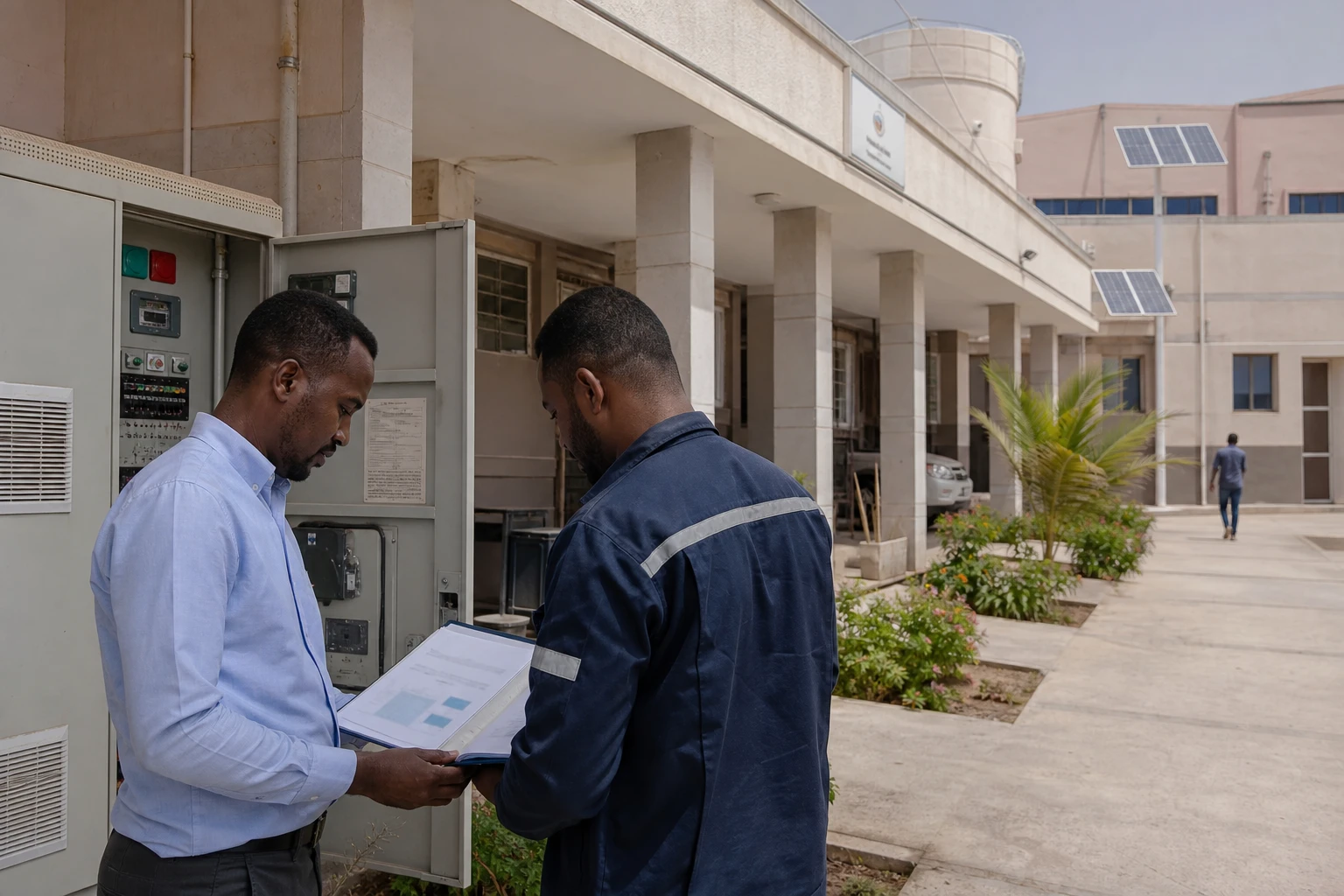
In Djibouti, energy is no longer just a question of producing more electricity. It is now linked to industrialisation, regional development and the country’s ability to reduce its dependence on imports. Against this backdrop, Djama Mohamed Hassan and France’s ambassador to Djibouti, Jérôme Bresson, discussed several avenues for cooperation, from green hydrogen to training in civil nuclear energy.
An energy strategy extending beyond the capital
The meeting took place in Djibouti on 5 October 2026. The Minister of Energy, in charge of Natural Resources, presented the government’s priorities to his French counterpart. These include energy sovereignty and universal access to electricity.
Djibouti faces a twofold challenge: meeting rising demand in the capital and economic zones while extending electricity services to remote communities. This trajectory directly affects households, businesses and public services located outside Djibouti City.
The country is therefore seeking to diversify its energy mix. The projects discussed include a new thermal power plant at Damerjog, solar development at Grand Bara, geothermal energy and green hydrogen in the Obock region. The Djiboutian Ministry of Energy had already identified hydrogen and its derivatives as development priorities in Moulhoule, in the Obock region.
Green hydrogen is produced using renewable electricity. It can then be used in industry and transport, or to produce derivatives such as ammonia. In Djibouti’s case, however, its development will depend on several conditions: the availability of competitively priced electricity, access to water, port infrastructure and the ability to secure commercial outlets.
Obock at the heart of industrial ambitions
The Obock region has a particular place in this strategy. Located in the north-east of the country, it has access to the sea and significant solar potential. The green hydrogen project planned for Moulhoule, also associated with the Kor Angar area, could help broaden Djibouti’s economic map beyond the capital.
This type of infrastructure does not automatically create local jobs. The benefits will depend on training young Djiboutians, involving national businesses and integrating maintenance, transport and service activities. Infrastructure choices will also need to take account of water use and environmental balances in an arid region.
The Djiboutian government has already incorporated green hydrogen into its long-term vision. An interministerial body dedicated to the “HAYYU Green Hydrogen Hub” project was announced to oversee its development in the Obock region. This shows that the issue has moved beyond a simple diplomatic announcement.
It nevertheless remains subject to technical studies, the mobilisation of funding and the conclusion of industrial partnerships. The next steps will make it possible to assess the project’s true maturity, particularly in terms of its timeline, production capacity and business model.
Civil nuclear energy: first and foremost, a need for expertise
During the meeting, Djama Mohamed Hassan also argued for a stable and continuous baseload energy supply. He cited a possible complementarity between geothermal and civil nuclear energy to support economic activity, small industrial units and job creation.
At this stage, the request to France is focused mainly on training Djiboutian officials in civil nuclear professions and technologies. The minister referred to small modular reactors, or SMRs, installations designed to produce less electricity than a large power plant and to be deployed in modules.
This direction does not mean that a reactor will be built in Djibouti in the near future. Before any project could proceed, the country would need a robust regulatory framework, an independent nuclear safety authority, specialised staff and appropriate arrangements for managing fuel and waste. Training is therefore a preliminary step, not evidence of an investment decision.
Djibouti has nevertheless stepped up its exchanges on this issue. In August 2026, the minister took part in the US-Africa Nuclear Energy Summit in Accra, Ghana. He presented the country’s interest in civil nuclear energy to produce reliable electricity and, in time, support seawater desalination. The Djiboutian Ministry of Energy’s account of the summit also mentions needs in technology transfer, training and regulation.
French cooperation set to take shape
Jérôme Bresson said France could support Djibouti through technical assistance, project financing and skills transfer. He also recalled existing projects, including the Energy Efficiency Programme for Administrative Buildings.
The proposed cooperation therefore covers several levels. Energy efficiency can reduce consumption in public buildings. Renewables can strengthen local production. Training can improve the skills available. French companies could also work in production, distribution or storage, provided projects move from intention to clearly defined contracts.
An economic mission from the Francophonie is also due to bring together four French small and medium-sized enterprises specialising in energy. Its value will lie in connecting Djibouti’s needs with practical solutions, particularly for the grid, storage and maintenance.
The regional challenge of access to electricity
The discussions also covered rural electrification. Djibouti wants to connect villages around the capital and regional administrative centres to the national grid. For the most isolated communities, decentralised solar solutions are to continue being developed with the support of partners such as the French Development Agency.
This approach aligns with the priorities of the Intergovernmental Authority on Development, IGAD, a regional organisation in the Horn of Africa. Across this area, distances, climatic constraints and low population densities often make extending conventional grids costly. Solar mini-grids and hybrid systems can meet the needs of remote areas more quickly.
For residents, the success of the energy strategy will be measured less by the number of projects announced than by the continuity of service, the price of electricity and the arrival of productive activities. For the authorities, it will also depend on their ability to coordinate funding, train technicians and preserve natural resources.
The Franco-Djiboutian meeting has thus opened several lines of work, but has not concluded them. Developments to watch include the announced economic mission, progress on the hydrogen project in Obock, decisions on rural electrification and the establishment of the skills needed for civil nuclear energy. Djibouti’s challenge now is to turn a portfolio of energy ambitions into useful, well-managed and accessible infrastructure.