Algeria
 Egypt
 Libya
 Morocco
 Sudan
 Tunisia
 Benin
 Burkina Faso
 Cabo Verde
 Côte d'Ivoire
 Ghana
 Guinea
 Guinea-Bissau
 Liberia
 Mali
 Mauritania
 Niger
 Nigeria
 Senegal
 Sierra Leone
 The Gambia
 Togo
 Cameroon
 Central African Republic
 Chad
 DR Congo
 Equatorial Guinea
 Gabon
 Republic of the Congo
 São Tomé and Príncipe
 Burundi
 Comoros
 Eritrea
 Ethiopia
 Kenya
 Madagascar
 Malawi
 Mauritius
 Mozambique
 Rwanda
 Seychelles
 Somalia
 South Sudan
 Tanzania
 Uganda
 Angola
 Botswana
 Eswatini
 Lesotho
 Namibia
 South Africa
 Zambia
 Zimbabwe
A short sea crossing, lives to rebuild
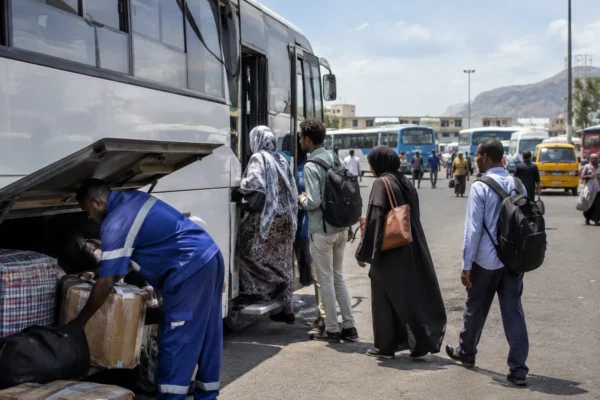
Just a few dozen kilometres from Yemen’s coast, Djibouti is once again a landing point for families fleeing war, hunger and fear. On the map, the crossing is short. In reality, it is often immense. In just a few days, the Bab el-Mandeb Strait has once again linked the crisis in Yemen to Djibouti’s shore, placing immediate pressure on reception centres in Obock, in the north of the country.
This movement is not an isolated episode. It is part of the long eastern route linking the Horn of Africa to Yemen and then the Gulf. The route passes through Djibouti, a small country but a strategic crossroads in the IGAD region, the Intergovernmental Authority on Development in East Africa. The country already hosts around 32,000 displaced people, including refugees and asylum seekers, mainly from Somalia, Ethiopia and Yemen.
Yemen under strain, Djibouti on the front line
According to the International Organization for Migration, nearly 94,000 people have been displaced in Yemen since fighting between the Houthis and government forces intensified this month. The worst-affected areas are Taiz and Lahj, where more than 48,000 people have fled their homes. The UN agency adds that more than 2,000 people have crossed the sea to Djibouti.
Another signal confirms the scale of the shift. On 13 September 2026, UNICEF said that around 1,400 people, including many women and children, had arrived on Djibouti’s shores within 24 hours. The agency says families land on beaches in the north of the country before being transferred to centres in Obock, where the Djiboutian state and its partners organise assistance.
This humanitarian escalation comes as Yemen remains torn by a fragmented war, with front lines shifting intermittently around coastal areas and the country’s south-west. Fighting around Taiz and Lahj is directly affecting civilians, as well as supply routes, schools turned into shelters and already fragile basic services. The IOM is calling for emergency support for shelter, water and sanitation.
What Djibouti is absorbing, and what it reveals
For Djibouti, the challenge goes beyond receiving people in the short term. The country is managing two pressures: people arriving from Yemen by sea, and a territory exposed to transit migration towards Saudi Arabia. Obock, a coastal town often cited in connection with these movements, is becoming a humanitarian gateway where rescue, registration, medical referrals and temporary accommodation converge. Local solidarity is real, but the capacity to absorb arrivals is not unlimited.
The impact is felt in daily life. In a small port town, every additional arrival puts pressure on water, tents, medical care, logistics and relations with host communities. The IOM says pressure could quickly exceed available resources if departures from Yemen resume at the same pace. UNICEF, for its part, highlights the risks of dehydration, extreme heat and insecurity faced by children during the crossing.
The regional context explains this vulnerability. The Djibouti-Yemen route remains one of the continent’s most dangerous for mixed migration, combining conflict, smugglers, rough seas and a lack of protection guarantees. In its regional work, the IOM notes that movements through Djibouti and the Bab el-Mandeb Strait continue to be driven by overlapping crises: war, economic hardship and climate shocks in the Horn of Africa.
A Yemeni crisis spilling beyond the peninsula
The significance of this new wave extends across the continent. It shows that the Red Sea is not merely a trade corridor. It is also a humanitarian space where conflicts in the Middle East reshape African migration patterns, and where Djibouti serves as a first point of contact, a transit hub and sometimes a place of refuge. For African and regional institutions, the issue is not simply border control. It also concerns protection, rescue at sea, registration and dignified reception.
The country thus stands at the intersection of two realities. On the one hand, it remains a transit point for those seeking to reach the Gulf. On the other, it is becoming a place of protection for those driven west by war. This position explains why UN agencies coordinate most of the response there, in cooperation with Djiboutian authorities and the Djiboutian Red Crescent.
What happens next will depend on how long the escalation in Yemen lasts and whether regional actors can sustain viable reception mechanisms. If fighting continues in south-west Yemen, Djibouti will remain on the front line. If military pressure eases, the flow could slow. But the geography will not change: Bab el-Mandeb will remain a short, exposed crossing of decisive importance to the entire region.