Algeria
 Egypt
 Libya
 Morocco
 Sudan
 Tunisia
 Benin
 Burkina Faso
 Cabo Verde
 Côte d'Ivoire
 Ghana
 Guinea
 Guinea-Bissau
 Liberia
 Mali
 Mauritania
 Niger
 Senegal
 Sierra Leone
 The Gambia
 Togo
 Cameroon
 Central African Republic
 Chad
 DR Congo
 Equatorial Guinea
 Gabon
 Republic of the Congo
 São Tomé and Príncipe
 Burundi
 Comoros
 Djibouti
 Eritrea
 Ethiopia
 Kenya
 Madagascar
 Malawi
 Mauritius
 Mozambique
 Rwanda
 Seychelles
 Somalia
 South Sudan
 Tanzania
 Uganda
 Angola
 Botswana
 Eswatini
 Lesotho
 Namibia
 South Africa
 Zambia
 Zimbabwe
When the forest becomes a chemical workshop
In south-western Nigeria, a clandestine laboratory is not always hidden behind walls. It can also blend into a forest, amid secondary roads, fields and villages where people might initially think they hear a construction site or a new building going up. That is what recent discoveries in Ogun State and then Oyo State, a few weeks apart, have revealed. Nigerian authorities uncovered industrial methamphetamine facilities there, described as the largest ever dismantled in the country.
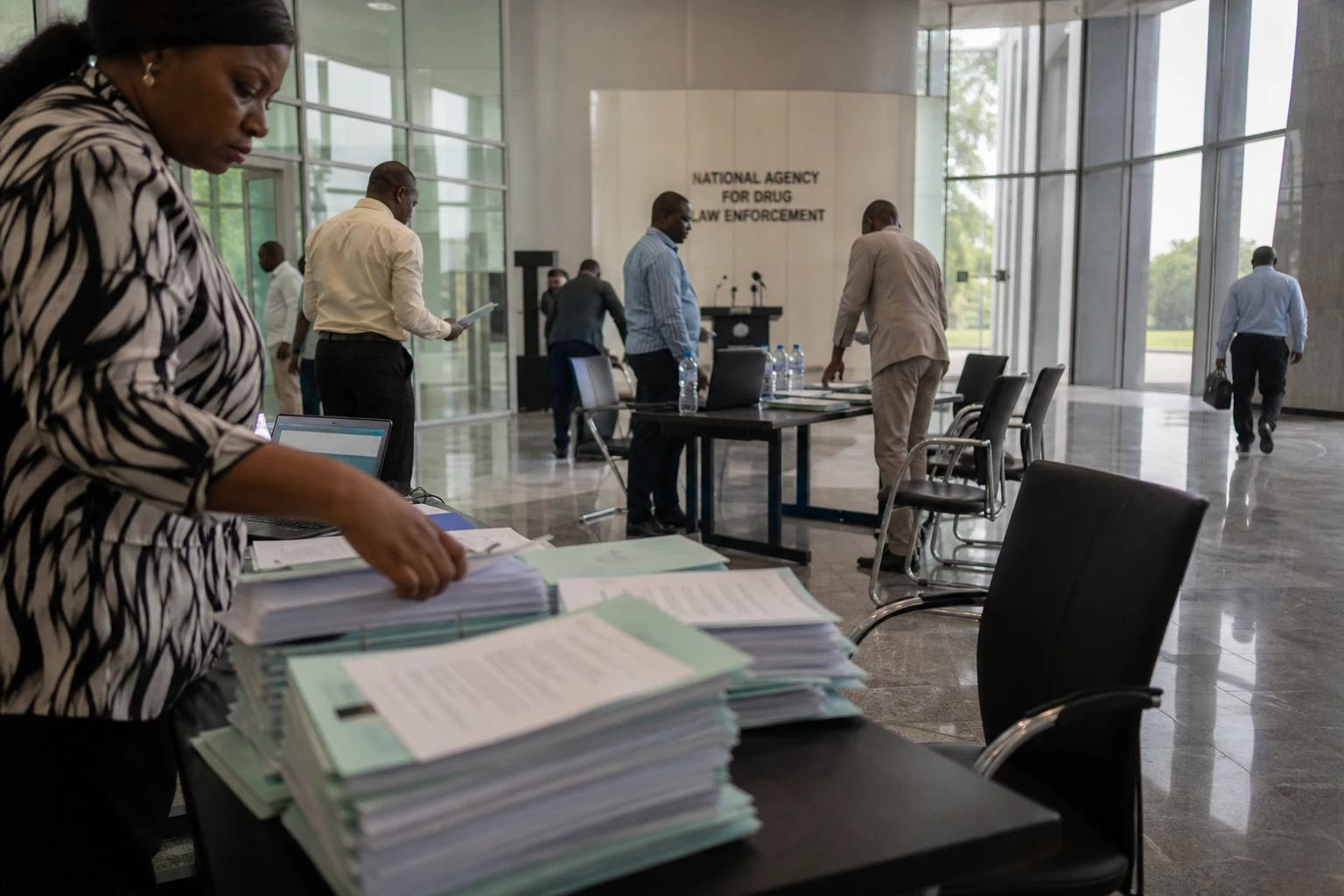
Nigeria is not only exposed to regional trafficking. It has become a sought-after location for the local manufacture of synthetic drugs, while remaining a major corridor for other narcotics passing through on their way to Europe and the rest of the continent. West African regional organisations are watching this development closely. ECOWAS, which brings together the states of West Africa, further strengthened its drug-monitoring system in Abuja in early July 2026, around WENDU, its epidemiological tool for monitoring drug use.
The facts: a Nigerian case with transnational links
The Ogun case dates back to May 2026. According to the NDLEA, Nigeria’s anti-narcotics agency, its officers carried out co-ordinated operations in Ogun and Lagos states between 16 and 18 May. They arrested ten people, including three Mexican nationals and several Nigerians, following a raid in a forest in the Ijebu East area and at residences in Lagos. The seizure was valued at 480 billion naira, or about $363 million, according to the agency and corroborating news reports.
The NDLEA later gave details of the scale of the Ogun facility. Its statement described an “industrial” site, with reactors, distillation units, mixers, chemicals and filtration equipment. The agency also said that a federal court in Lagos had ordered its destruction on environmental grounds, owing to the potential pollution of groundwater and air.
A second operation followed in June in Oyo State. On 24 June, the NDLEA announced that it had dismantled another clandestine laboratory, this time in the village of Tapa, in the Ibarapa North area. The agency said the operation on 17 June had led to the arrest of five members of the network, including a Mexican methamphetamine specialist and four Nigerian associates. The statement refers to a Nigerian-Mexican cartel and describes its operations as explicitly transnational.
This point matters. Nigeria is no longer just a transit location; it is also becoming a production site. The United Nations Office on Drugs and Crime has been making this point for several years: West Africa was first identified as a cocaine corridor, then as a region where methamphetamine production took hold. The UNODC’s regional report notes that laboratories were detected in Nigeria as early as 2011-12.
What this means for Ogun, Oyo and Lagos
In Ogun State, the production site was not in a legal vacuum. It was located near villages and farmland, and close to a route linking the hinterland to Lagos, the country’s major economic metropolis. This is where part of these networks’ profitability lies. Proximity to markets, ports, roads and local expertise makes logistics easier, while wooded areas provide discreet cover. The forest is not just a backdrop; it becomes a tool for concealment.
For residents, the impact is immediate and tangible. Chemicals can poison the soil, pollute groundwater and make the air unbreathable. In the Ogun case, the NDLEA specifically cited these risks to justify dismantling the laboratory. In Tapa, in Oyo State, the agency showed stocks of caustic soda, sulphuric acid and other precursors used to synthesise methamphetamine. This indicates the health and environmental danger to neighbouring villages, extending well beyond drug trafficking alone.
The phenomenon is not confined to Nigeria. In its WENDU report, ECOWAS noted that amphetamine-type substances, including methamphetamine, are among the main drugs seized in West Africa. The same report highlights the consequences for public health, security, governance and development. In other words, this is not an issue for security forces alone. It also affects healthcare systems, rural communities and port cities, which are already under pressure.
The Nigerian reading of the case is clear: cartels are testing the edges of the country, moving into forests and seeking local contacts. But the institutional response is also taking shape. The operations in May and June 2026, followed by legal proceedings in Lagos, point to a more structured enforcement chain than before. ECOWAS’s presence in Abuja at the same time is a reminder that the response also depends on shared intelligence, harmonised data and regional co-operation.
A West African warning, not just a Nigerian one
This case says something broader about West Africa. The region remains a hub for drugs from South America, but it is also entering a phase of local production, with more sophisticated criminal value chains. The UNODC observes that methamphetamine produced in or transiting through Africa now features in broader international trafficking patterns, while ECOWAS is seeking to consolidate reliable data to better target public responses.
Nigeria, with its capital in Abuja, is at the centre of this realignment. Its demographic and economic weight in the sub-region makes it a testing ground for both criminal networks and public responses. What happens next will play out in the courts in Lagos, in further investigations and in the ability of West African states to prevent these hidden forest laboratories from becoming the norm.